

Is US debt sustainable at current levels and how secure is the dollar’s status as the world’s reserve currency? Together, these questions sit at the heart of the third of four economic, technological and geopolitical themes that Capital Group investment director Alvaro Peró Gala tells the audience of Wealthwise’s Sumer Wealth Forum will be “critical for strategic asset allocation and drive the majority of long-term returns”.
Also comprising the changing nature of global trade and capital flows and AI’s impact on productivity, which were covered in Part 1 of this feature, and the introduction of more shareholder value-oriented regulation around the world (outlined below), this quartet constitute the ‘Great Global Restructuring’ – an idea that first appeared in a paper of the same name that Peró Gala and three colleagues wrote towards the end of last year.
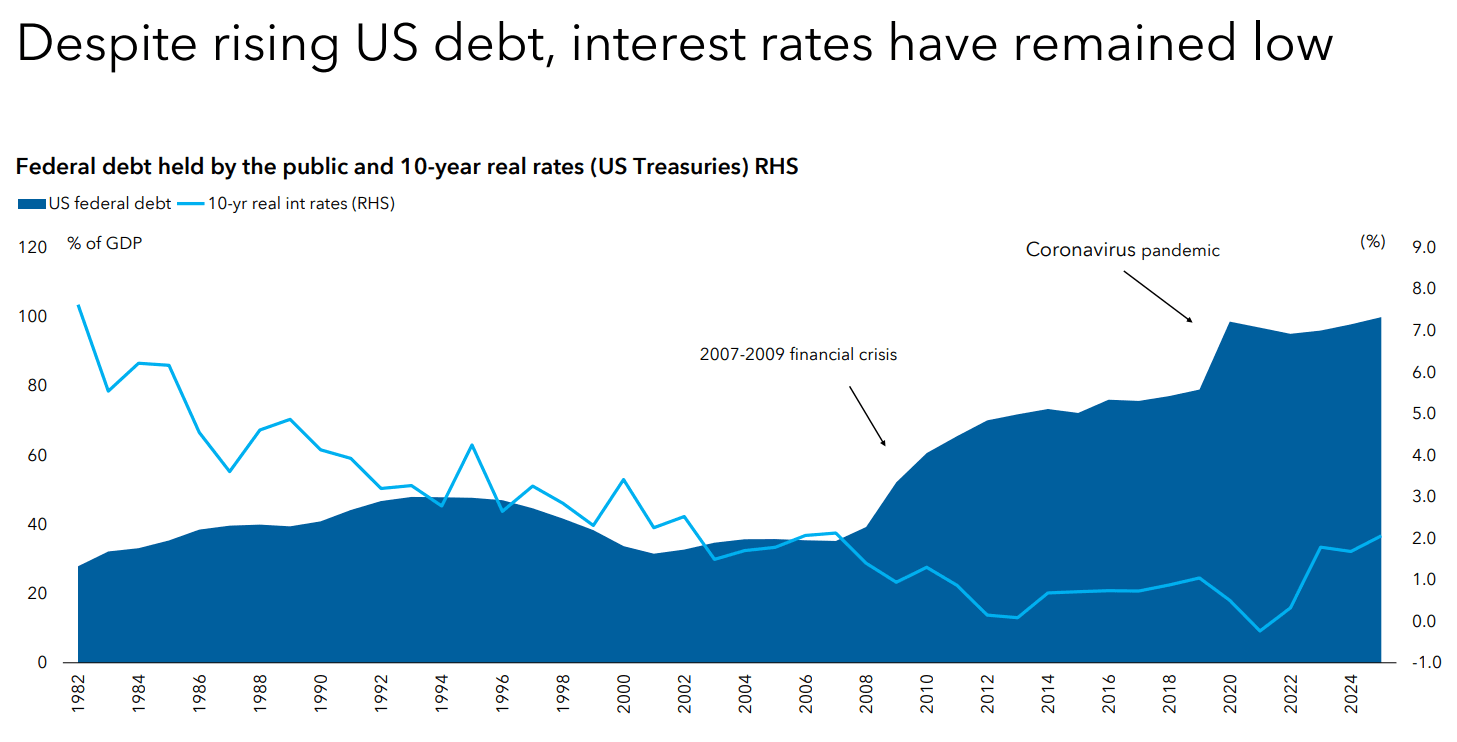
“The sustainability of US debt is a hot topic at every meeting I have attended lately,” says Peró Gala. “The fact US debt has crossed the 100% debt-to-GDP ratio has attracted a lot of attention – and particularly since the current administration announced the ‘One Big Beautiful Bill’, which will lock in deficits of roughly 7% over multiple years. The question then is, if we do see a deceleration at some point, what will happen?”
Pointing to the following chart, he continues: “It would not be unusual then to see deficits close to or even above 10% but it is important to add two key points of context. First, since the 2000s, the overall increase in US debt has come from two idiosyncratic – I would say extraordinary – events: the fiscal packages that followed the Global Financial Crisis and Covid. If you remove these, US debt-to-GDP over the past 20 years is actually flat.
“IMF data shows 15 countries with debt-to-GDP above 100% so this is not a US issue – it is a global one – but the US has an advantage versus all these other countries.
Source: Capital Group
“Second, IMF data shows 15 countries with debt-to-GDP above 100% so this is not a US issue – it is a global one – but the US has an advantage versus all these other countries. That is the role the dollar plays as the world’s reserve currency, which essentially allows what you can also see in the slide – that the US has been able to accumulate ever-rising debt levels while maintaining a stable currency and progressively lower interest rates.
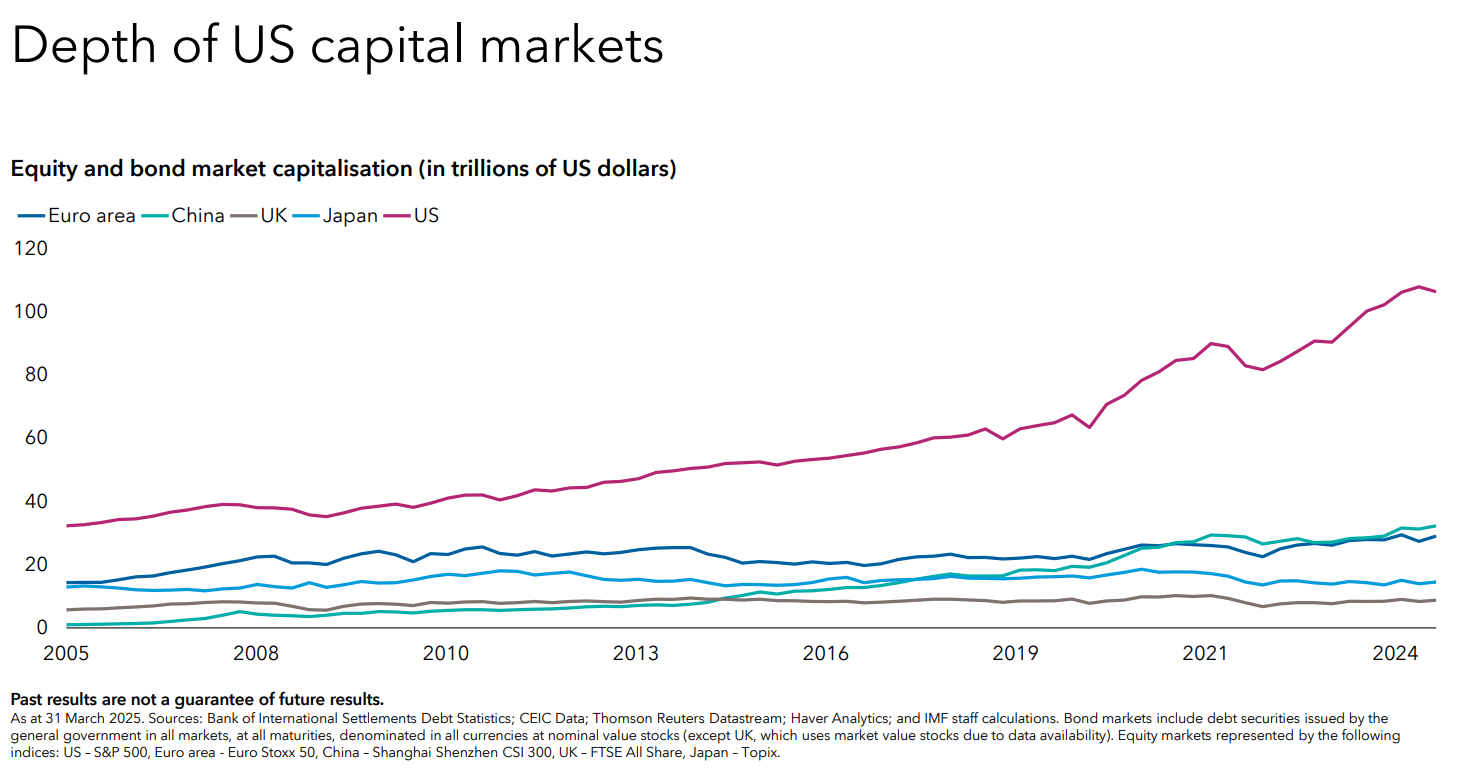
“And it is this structural demand for its assets that is putting the US in such strong position because, as you can see from this next chart, US capital markets have grown significantly compared with their major global counterparts. This is important because the US treasuries market represents roughly one-third of overall outstanding global government debt – one-third.
Source: Capital Group
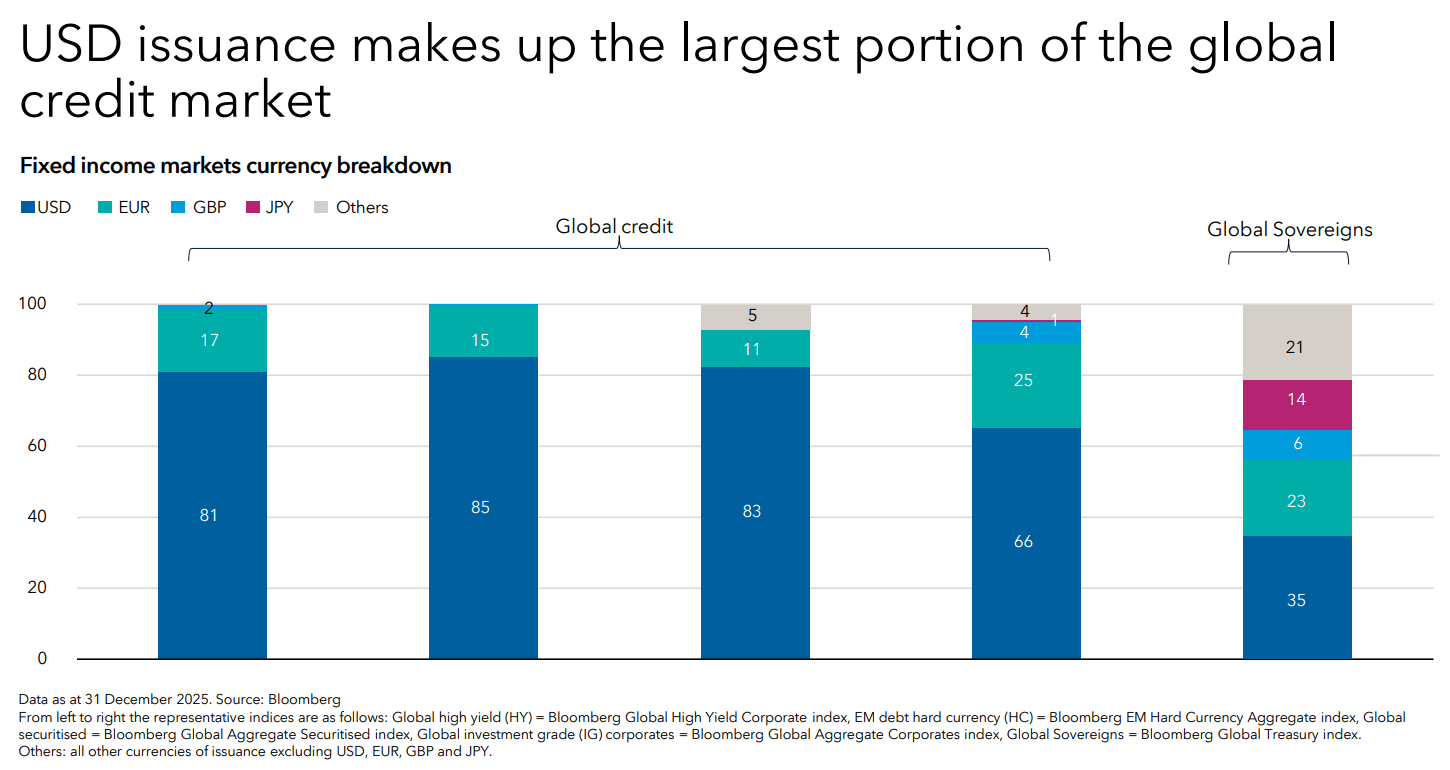
“So you can diversify exposure but, once you take in credit markets – securitised credit, investment grade, high-yield, EM hard currency – then between 70% and 85% is dollar-denominated. That means, if you are an institutional portfolio manager or if you are a central bank and you want to build reserves, the reality is you have to invest in the US. This is why the US is in such a dominant position – and one that will be difficult to change.”
As ever, risks to the status quo do exist and Peró Gala highlights four in particular. “The first is geopolitical fragmentation,” he continues. “This stems from the use of the US dollar as a weapon – as we saw first with Russia and then Iran. That has accelerated alternative payment systems, such as China’s ‘Cross-Border Interbank Payment System’, which basically facilitates international payments in yuan.
“Next is technological disruption as bitcoin and other cryptocurrencies could take a higher share of international transactions – albeit the reality is more than half of these transactions are currently done via dollars. The third and, I would argue, most dangerous risk is the loss of institutional credibility. If domestic and foreign investors start to perceive US institutions as not being independent from the White House, it could have enormous implications for US markets.
Sentiment changes – and quickly
“The final risk is fiscal irresponsibility. Obviously, the US could continue for some years with similarly aggressive policies on its debt and deficits but at some point – and history shows this can happen very quickly – sentiment changes. Nevertheless, the overriding point here is that, when you begin to look for alternatives to the dollar, the reality is there are not many – and, arguably, just three.”
The first of these – the Chinese yuan – Peró Gala dismisses quickly, noting: “The currency is facing very strict capital controls and, if you are a central bank, you really do not want that. Another possibility is the euro but that is super-fragmented and lacks a unified fiscal umbrella, which is also problematic. And a third option, in theory, would be either gold or cryptocurrencies – although the main issue here is these tend to have higher volatility.
Read ‘Part 1’ here: Alvaro Peró Gala – the ‘Great Global Restructuring’
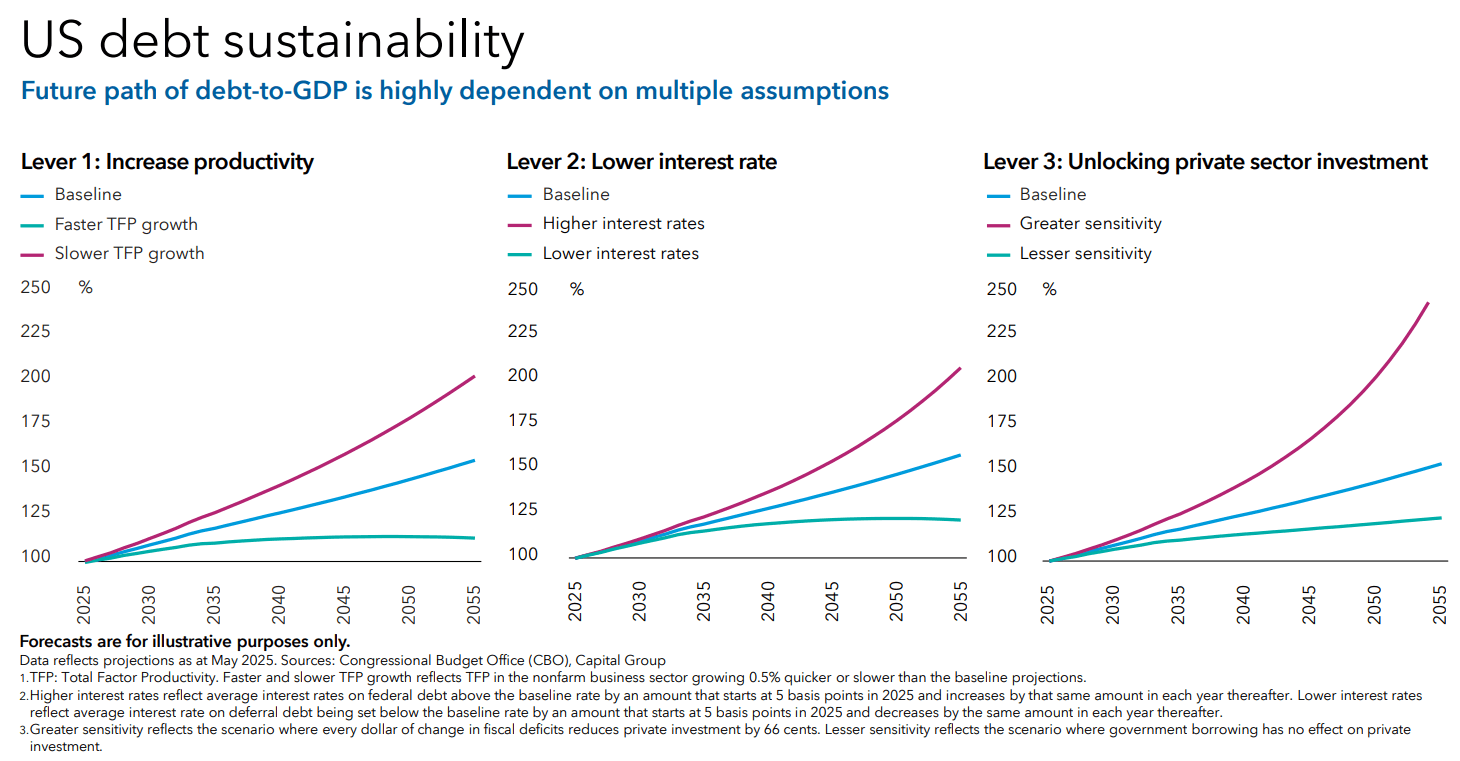
“If you want to own a meaningful exposure for your reserves, then these are not the best assets – and so the biggest strength for the US dollar is arguably the lack of viable alternatives. The good news here for US debt then is there are multiple levers policymakers can pull to fix the problem. One of these we have discussed already – that AI has hugely positive implications for productivity – but here are some numbers around that.”
Pointing to the following chart, Peró Gala continues: “An increase of 50 basis points to productivity on the overall 1% we noted earlier could increase the debt-to-GDP ratio by just 15% in the next 30 years. Compare that to the baseline – if nothing happens, the ratio moves above 50%. So just imagine, if we saw that estimated 1.5% rise in productivity due to AI – if it is that much higher, it could have massive positive implications.
Source: Capital Group
“In addition, if central banks actually cut rates and engage in QE or financial repression, there would be benefits from lower interest costs. Lastly, governments can also encourage strategic investments in certain sectors of the overall economy to try and generate higher revenue. So, while this is something we are monitoring, the US is in such a privileged position right now it does seem unlikely the dollar will lose its reserve currency status.”
Unlocking shareholder value
The fourth and final trend Peró Gala highlights as part of the ‘Great Global Restructuring’ is the increasing attention some key markets are directing towards shareholder value – particularly through regulatory initiatives. “If you analyse why the US has been able to attract such significant capital flows for so long, the reality is it has been the benchmark for regulation for multiple years,” he says.
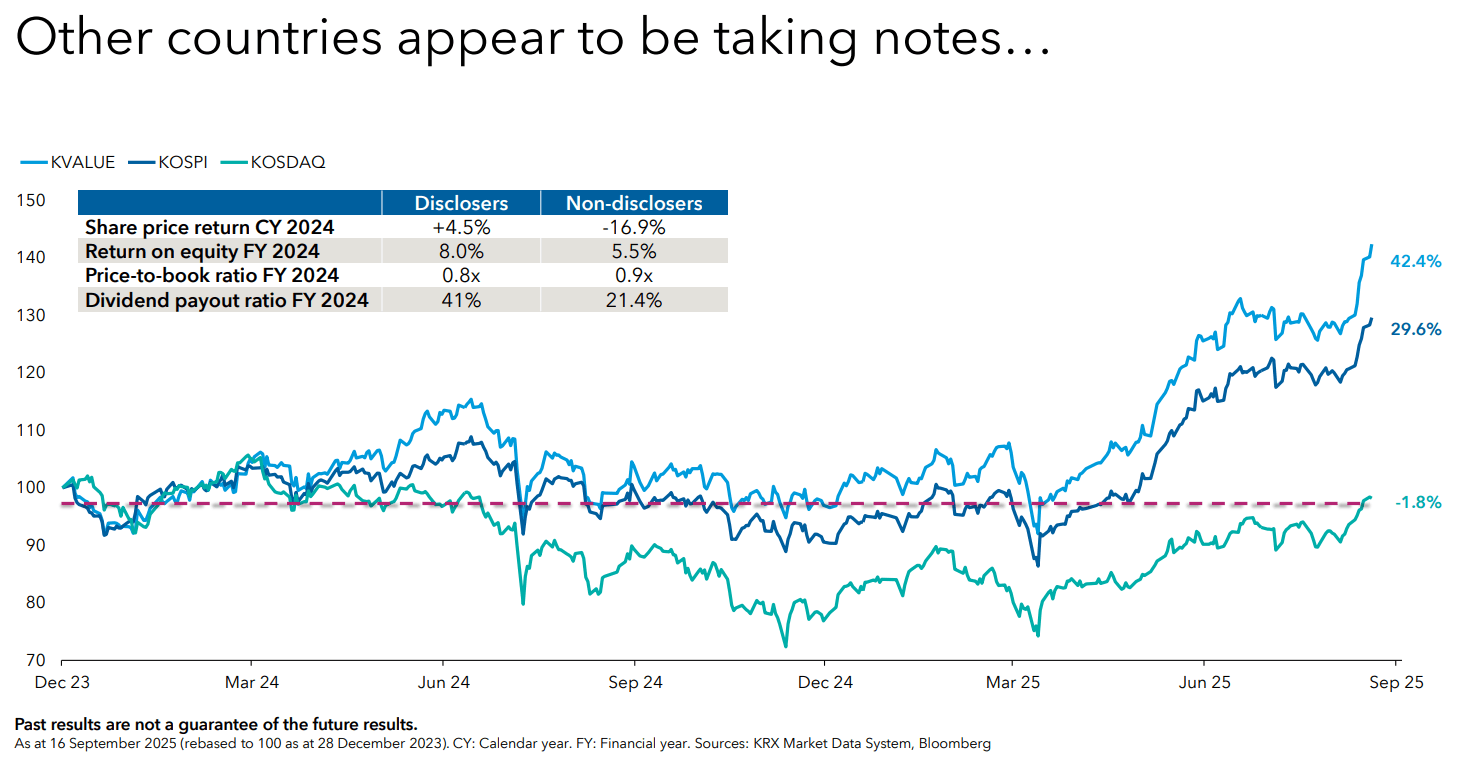
“This has helped investors to trust the US’s institutions – in turn allowing its capital markets consistently to attract flows. What we have been seeing in recent years, though, is that some countries in Asia – notably Japan and Korea – are catching up in terms of regulation, encouraging companies to pay higher dividends and to be more transparent with investors.”
To underline his point, Peró Gala points to the next chart, which illustrates the recent outperformance of the wider market by Korean businesses that have opted into the country’s ‘Value Add’ programme of shareholder-friendly initiatives. “Regulation is such a big aspect overall for investors and the reality is that countries across Southeast Asia are catching up with the US,” he adds. “This is likely to help attract investment flows.”
Source: Capital Group
So what are the implications of the ‘Great Global Restructuring’ for investor portfolios? On equities, Peró Gala says: “All these capital flows are potentially going to divert from the US to other parts of the market – so you want to diversify. Of course, there are particular sectors in the US where it is difficult to find a company in the same leading position as, say, Microsoft or Meta so such businesses can still do very well.
“Nevertheless, we do believe this is the right opportunity to be global. All the fiscal spending that is happening in Europe is going to have a positive impact on domestic markets and stock prices are going to do relatively well. In Asia, meanwhile, these policy changes are going to be supportive. So the first message here is, yes, the US can continue to be stronger for longer – certain companies, absolutely – but diversification is important.
Further idiosyncratic events
“Turning to rates and fixed income, the majority of client portfolios I see have a significant allocation towards domestic government bonds – the UK to gilts, Spain to Spanish bonds and so on. In a world where multiple countries now have debt-to-GDP ratios above 100%, however, it is very likely that over the next 10 years we are going to see further idiosyncratic events that lead to sharp corrections in the rates market.
“We saw it in 2022 in the UK with the Liz Truss mini-budget; we saw it last year in France with the polarised National Assembly; and we have seen it this year in Japan. So, if such events are going to be more common, what can we do? Instead of relying on a static portfolio of domestic government bonds – be more active. Hold government bonds to mitigate the overall drawdown but, if you are active, you can also maximise total returns.”
Moving onto credit, Peró Gala describes the situation as “more nuanced” because, as the following chart shows, dollar-denominated issuance makes up such a large part of the sector. “As you can see, everything is US,” he observes. “So, if you want to have a diversified credit portfolio across sectors and companies, you need to have a meaningful portion in US assets. Here, then, we would encourage investors to have a tilt towards the US.
Source: Capital Group
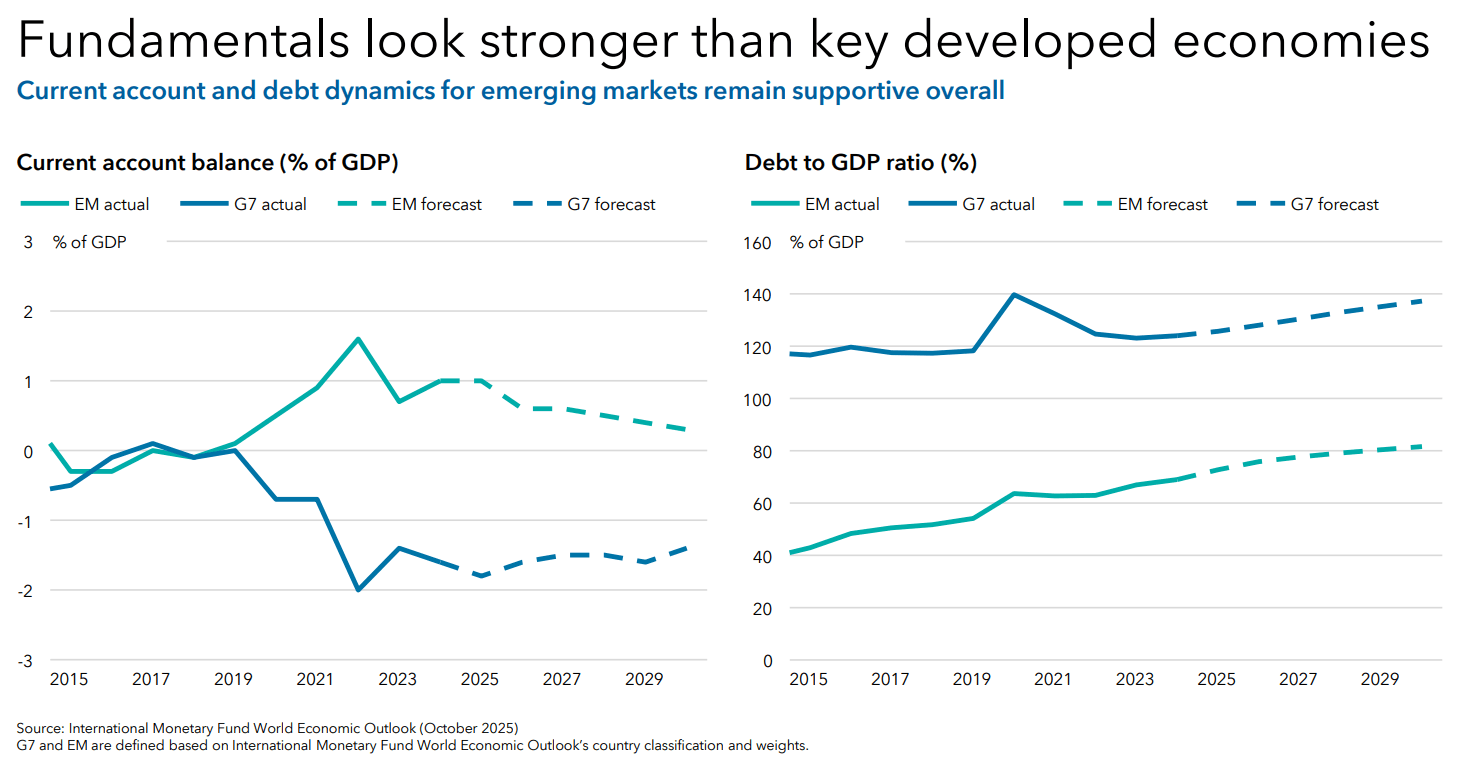
“Lastly, emerging market debt may have been the ‘forgotten child’ of fixed income for a long time but, as this next slide shows, the fundamentals of many EM countries have actually been improving. Not only that, the credibility of many EM central banks has also improved so, while the asset class used to behave in a very high-risk, higher-beta way, the reality is that, during the latest sell-offs, it has been much more resilient.
Source: Capital Group
“That is why we also believe that, particularly when it comes to fixed income allocations, incorporating some emerging market debt – in a combination of both hard currency and local currency – should benefit from all these capital flows that used to be focused on the US but, over the coming years, are likely going to be diverted to certain EM countries.”
Summarising his thinking, Peró Gala identifies four key points. “First, on artificial intelligence, the US and China are leading the race – particularly on the installation phase, although we will have to wait and see on the deployment phase,” he says. “Second, trade and capital flows are going to have a significant impact on stockmarkets – particular for portfolio flows, which tend to be more volatile.
“Third, on US debt, as things stand today the US is in such a strong position that we do not think its debt level is unsustainable. And lastly, on governance, we are seeing signs across multiple countries – and most notably in Japan and Korea – that they are catching up in terms of shareholder-friendly regulation and this is why they are attracting more and more domestic flows.”
This is an edited version of the second half of the keynote speech Capital Group investment director Alvaro Peró Gala presented to the audience of Wealthwise’s Summer Wealth Forum on 25 June 2026. You can read the first half – on AI’s impact on productivity; and trade and capital flows – here while Capital Group’s full report ‘The Great Global Restructuring can be found here