

A quartet of economic, technological and geopolitical themes will be “critical for strategic asset allocation and drive the majority of long-term returns”, Capital Group investment director Alvaro Peró Gala tells the audience of Wealthwise’s Sumer Wealth Forum, which took place last month. This is the ‘Great Global Restructuring’ – an idea that first appeared in a paper of the same name that he and three colleagues wrote towards the end of 2025.
“At the start of last year, the driving narrative was that the US was in a very good spot, begging the question of how much longer it could dominate economic growth,” says Peró Gala. “Our conclusion then was the overall US economy was based on a culture that fosters risk-taking and had the ability to reposition labour very quickly while, importantly, low and quite predictable regulation allowed the speedy adoption of new technologies.
“Interestingly, however – since ‘Liberation Day’ in April 2025 – four underlying trends have been accelerated that we feel will be the dominant drivers for long-term performance across asset classes. The first of these is artificial intelligence – and, in particular, its potential for driving up productivity. An additional question here would be, Which countries are going to benefit more?
“Second, is trade and capital flows – these major shifts that will be driven by Liberation Day and, again, which countries should benefit more? Third is a very hot topic: the sustainability of US debt and, in particular, whether the US dollar could lose its privileged position as the world’s reserve currency. Last, but still very important, is regulation – are we seeing any signs of catch-up here as different countries seek to attract capital flows?”
Why productivity is key
Peró Gala starts with AI, observing: “Right now, it is once again all over the news, with the hyperscalers gearing up to invest trillions of dollars. Just this year, Amazon, Alphabet, Meta and Microsoft alone are going to invest $700bn [£520bn] between them – up from $400bn in 2025. That is roughly equivalent to 1% of the overall growth of the US economy this year – and this is coming from just four companies.”
For Peró Gala, a key question here is, Why is productivity so important? “The basic economics textbooks will tell you the three key drivers for growth are labour, capital and productivity,” he continues. “Labour is about how many people are active and can contribute to growth while capital is about infrastructure, factories, machinery and so forth. Productivity is then about how you can bring all these pieces together to maximise your output.
Read ‘Part 2’ here: Alvaro Peró Gala – the ‘Great Global Restructuring’
“It is important to acknowledge this because the old economic model that many countries followed in the past came down to: I have a larger workforce that is going to expand over the coming years; plus I am generating more capital, so I can build more factories and so on to increase my output. The problem here is that, going forward, this economic model looks likely to become obsolete.”
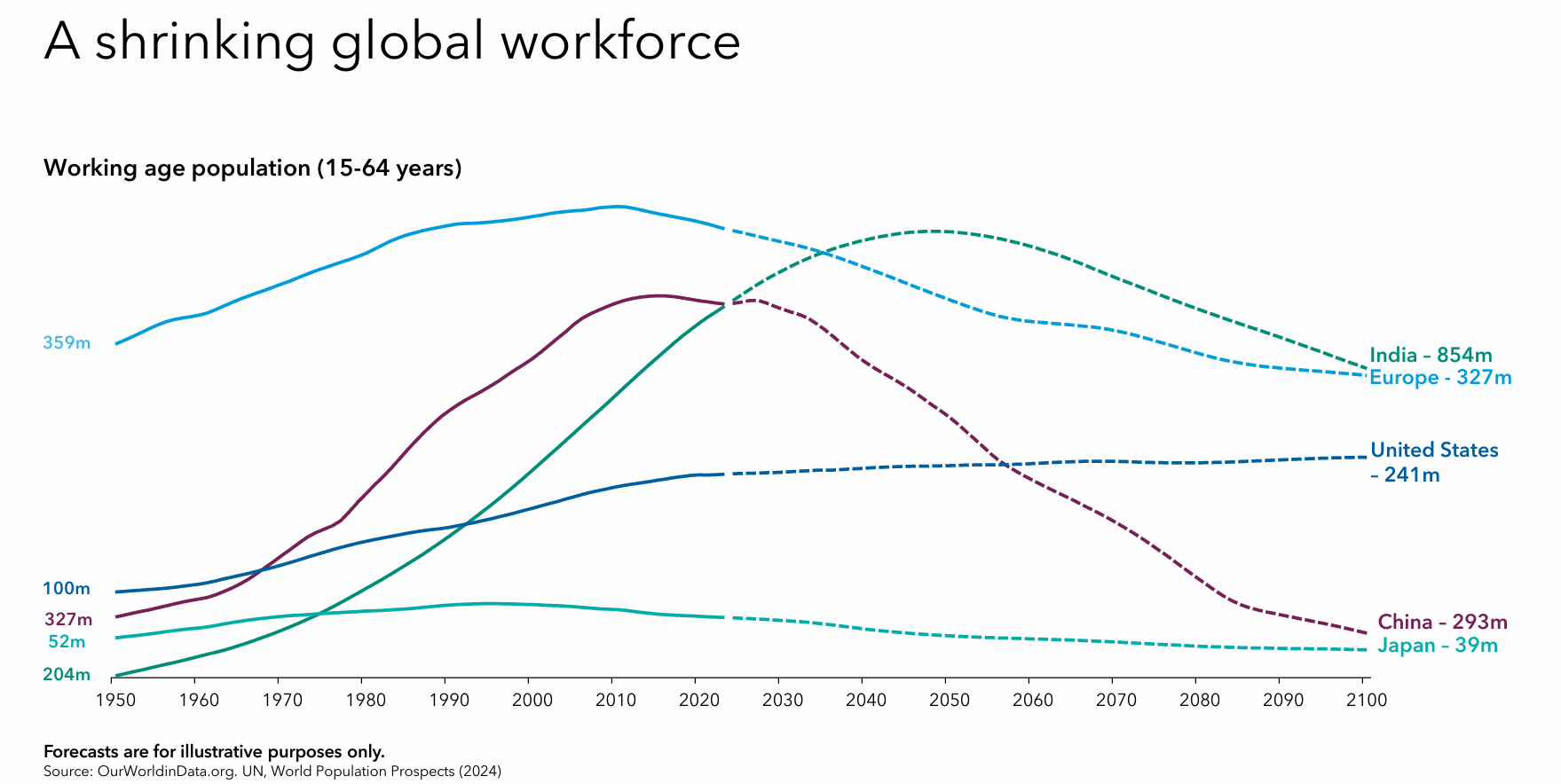
Pointing to the following chart, which shows the global workforce across selected places, Peró Gala says. “As you can see, this is shrinking. For one thing, as countries become richer and richer, families have fewer and fewer children – but this is then amplified by populist policies in Western countries, which are putting more constraints on immigration. As a result, labour seems unlikely to be one of the major drivers of growth going forward.
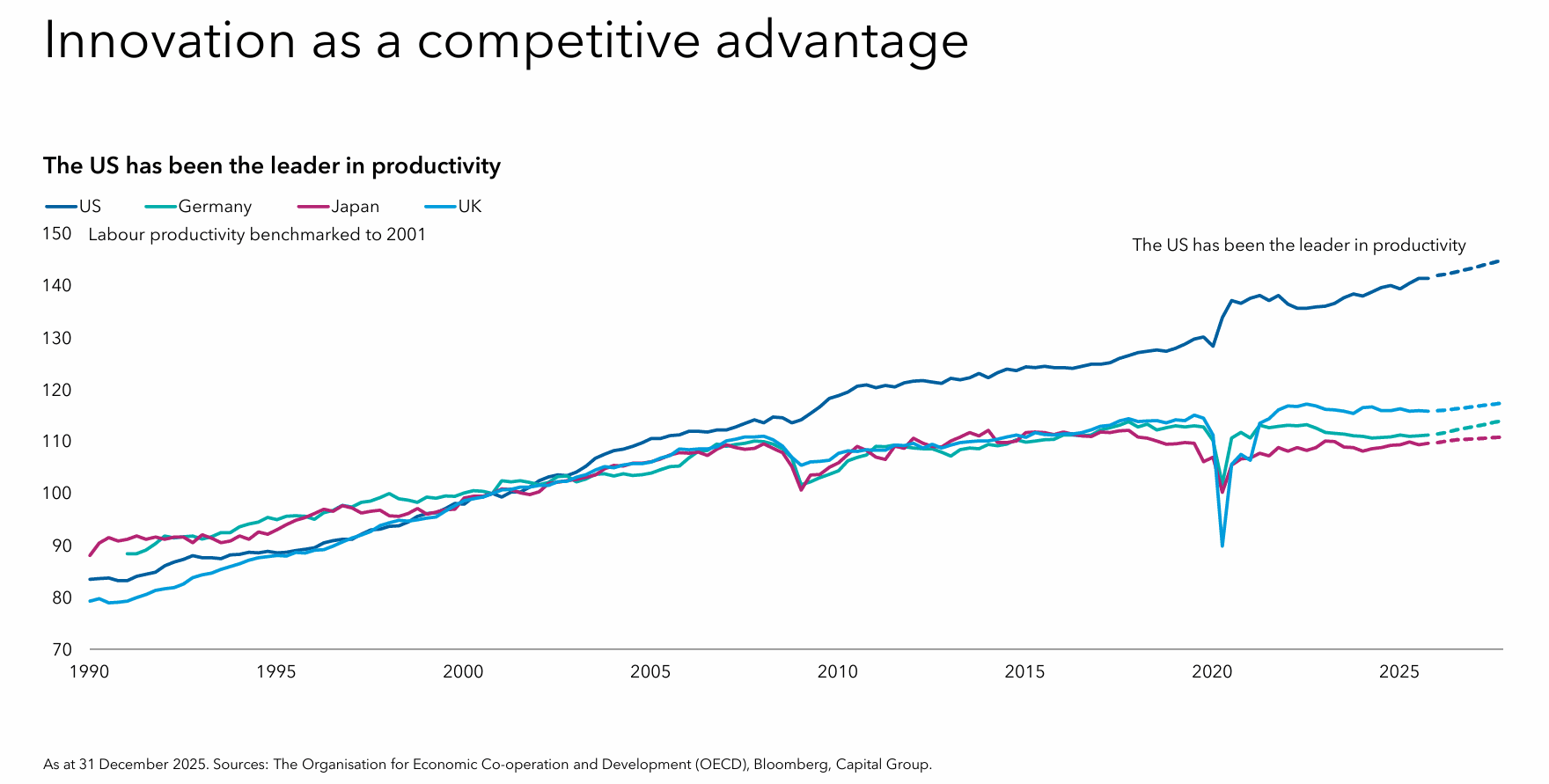
“Since the early 2000s, the US has been the only country across the developed markets that has had a trend productivity line consistently around the 1% mark.
Source: Capital Group
“What about capital? This was one of the principal drivers of growth – especially after the Industrial Revolution as the building of manufacturing infrastructure helped increase output at a very high speed. Now, however, we are facing a period of capital saturation. If a country – particularly a developed market – builds a new port or factory, say, the reality is the marginal benefit is diminishing. So capital will not be a major driver either.”
That leaves productivity, underlining its importance. Pointing to this next chart, Peró Gala explains: “Since the early 2000s, the US has been the only country across the developed markets that has had a trend productivity line consistently around the 1% mark. Look at other countries – Europe, which is super-regulated; Japan with its ageing population – and the productivity of the last two decades is essentially flat.”
Source: Capital Group
To gain an idea of what could happen next, Capital Group analysed past technological revolutions – including the introduction of PCs and the internet in the early 2000s as well as the current AI boom – and their two main phases: installation and deployment. The former is where the tech companies create their infrastructure – for example, the PC and internet companies building servers and networks to enable all the associated applications.
“As for the AI revolution, right now it feels like the US and China are the ones leading the charge on installation, with all this capex that is being invested in data-centres,” continues Peró Gala. “And while installation is of course important, the key phase is what comes next. Deployment is when all the applications have been built – and it is when the majority of the productivity occurs.
“Think about the 2000s – it was only once the iPhone’s applications had been created that you saw most of the real productivity gains. In a similar vein, with artificial intelligence now, think about the AI agents, the large language models, the generative AI – all these businesses are growing as we speak and, in a few years, we will see who the winners are and who is going to deliver sustained productivity.”
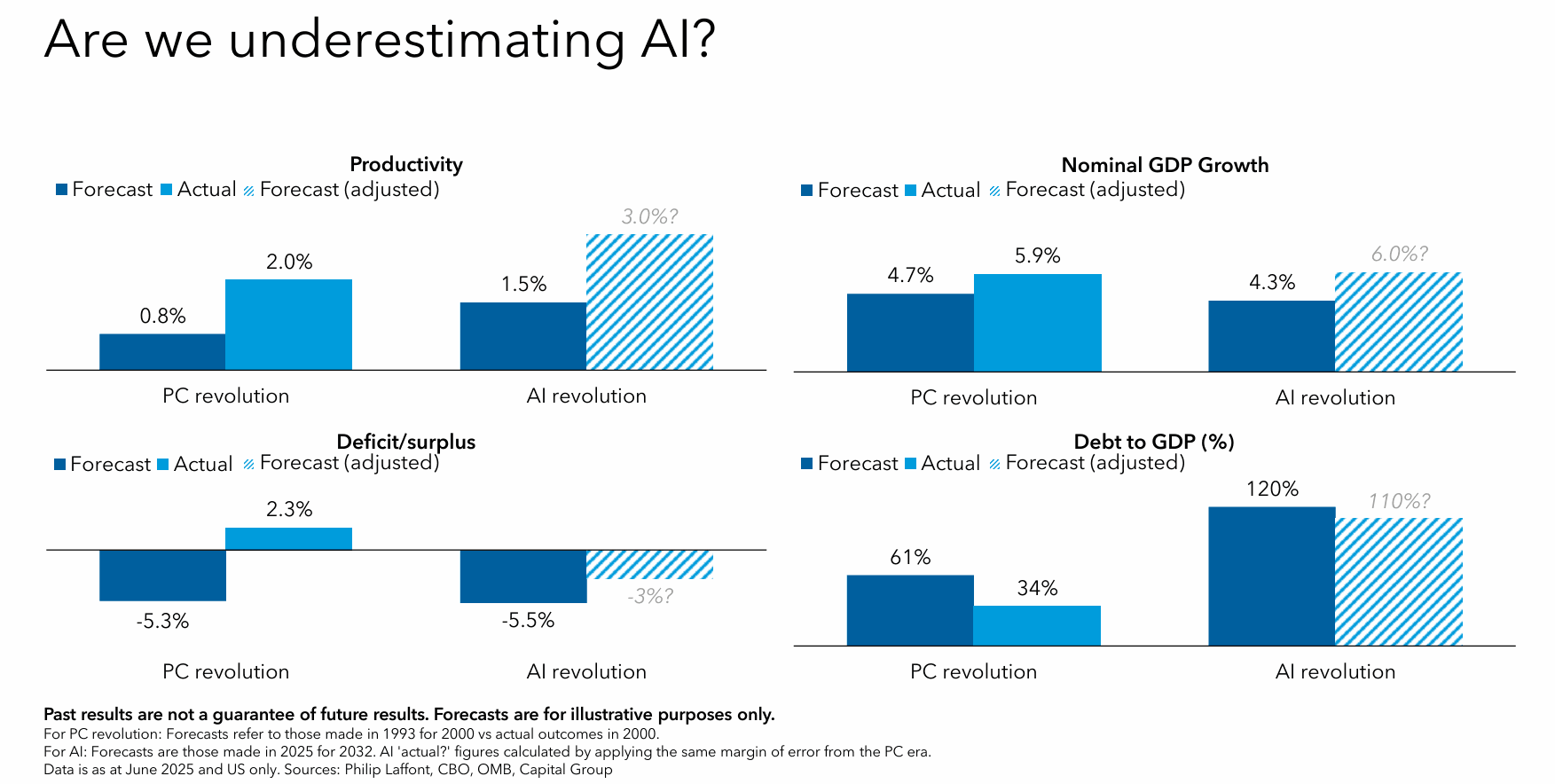
So how much productivity can realistically be driven by this AI boom? “It is very difficult to offer a precise answer but let’s return to our analysis of past booms,” says Peró Gala. “The PC revolution is the closest and, from that, we can draw two main conclusions – the first being the historical pattern suggests people tend to become very excited about the short-term benefits of all these new technologies and so overestimate the overall impact.
“The more important conclusion, however – as the next chart shows – is that, a decade later, we tend to completely underestimate the resulting impact on productivity and growth, and consequently on both deficit and debt. The message here is that, while consensus suggests AI can lift productivity to 1.5%, if history really does serve as a proxy for what could happen in the future, these numbers can be significantly higher a decade later.”
Source: Capital Group
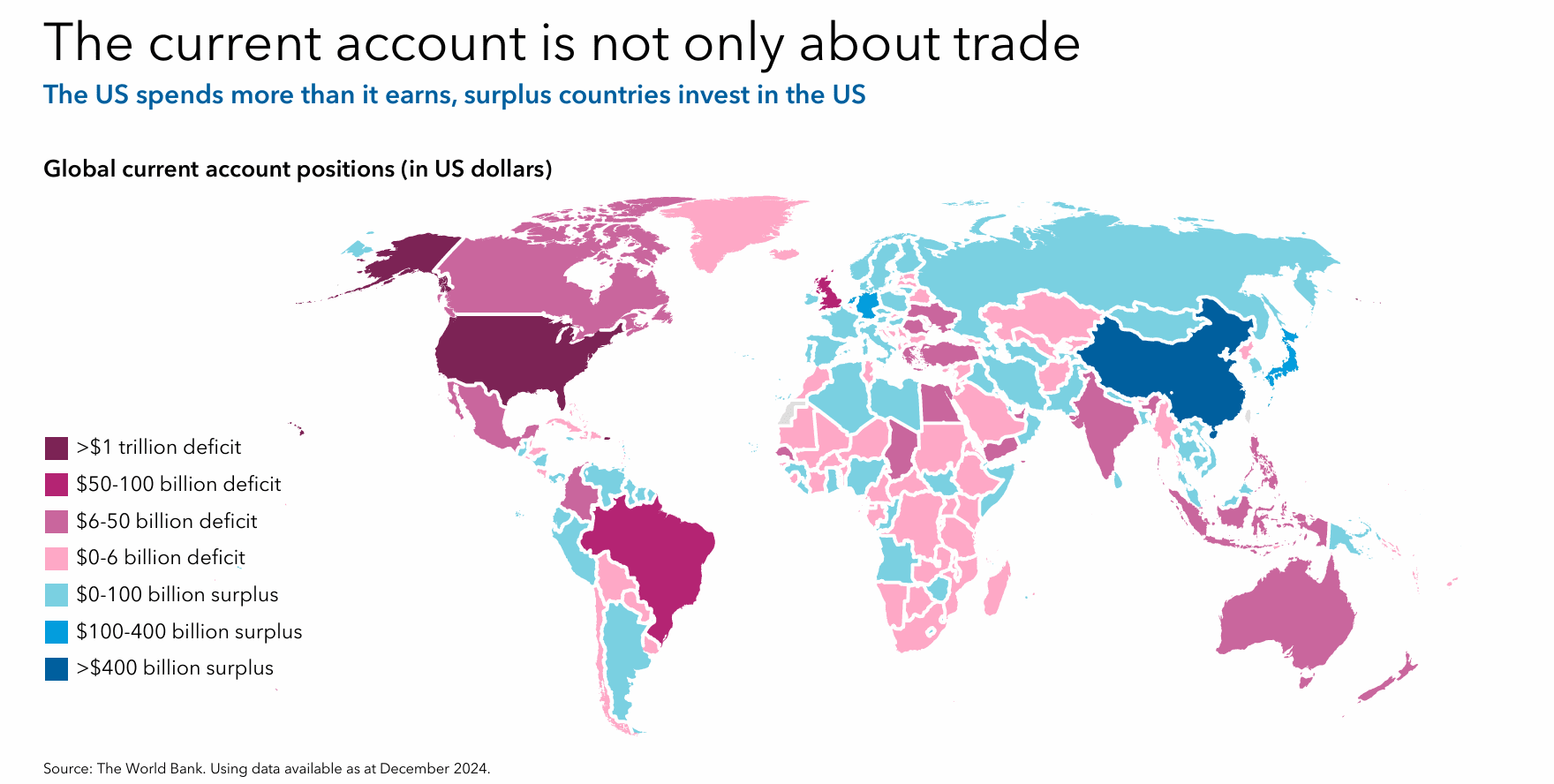
The second underlying trend – one Peró Gala describes as “very important given it has been a major focus of the current administration in the US” – is national trade deficits. Pointing to the next chart, he continues: “The current account in the US is significantly negative and the Trump administration maintains this is because the US has received the bad side of the deal versus other countries. This only tells you part of the story, however.
Source: Capital Group
“If we go back to the Industrial Revolution, the manufacturing sector in the US was actually quite solid. Over multiple decades, however, the US saw increasing capital inflows, which pushed the country’s middle class upwards on the back of higher salaries. At the same time, what might be described as lower-value manufacturing sectors were gradually losing competitiveness to other countries – principally China.
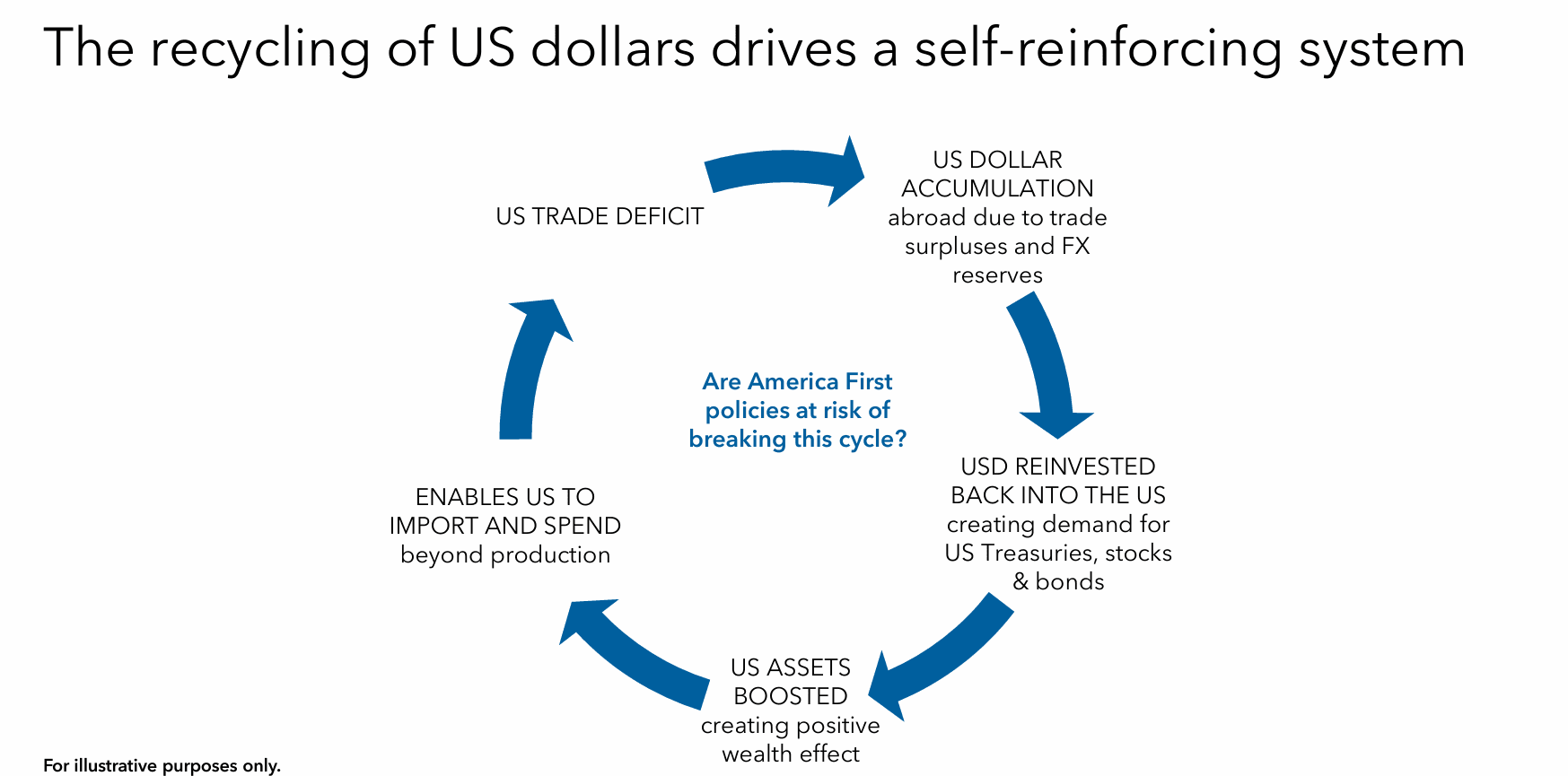
“And this shift, which occurred over many years, does not reflect the fact reality of all the countries coloured blue in the chart. All their surplus – all the extra cash generated from selling goods to the US – has historically been deployed to the US through the cycles you can see in the next chart. In a nutshell, all this surplus is reinvested in the US, which has meant US assets in general – across credit and equities – have risen.”
Source: Capital Group
This served to create a positive wealth effect, which also allowed companies – particularly in the tech sector – to develop much faster. “In turn, this allowed the US actually to spend more – indeed, beyond its current economic capacity,” says Peró Gala. “That is the key point here because, yes, the US is importing more and it is building a trade deficit that is unsustainable at these levels over the long term but, at the same time, capital inflows have helped to develop many other sectors and created a positive wealth effect.
“There are really only two ways to fix this problem, the first being similar to what happened in the mid-1980s. Then, if you remember, Ronald Reagan actually sat down with Germany, with the UK and with Japan to find ways to depreciate the dollar, which was considered very expensive. This was a relatively benign outcome, which took multiple years to effect but, in the end, the US was able to reduce its overall deficit.”
A repeat would likely prove the most benign outcome for markets today but, says Peró Gala, this is not what is happening. “Instead, as we have seen, the US administration imposed tariffs and tried to rebalance everything very quickly, which is hitting the US with a ‘stagflationary’ shock – that is to stay, higher inflation and lower growth – so the overall impact it could have on markets is much more impactful and disruptive,” he elaborates.
Three trends for portfolio construction
Looking ahead, Peró Gala sees three key trends that will be very important for portfolio positioning – the first being repatriation of capital flows to domestic countries. “A great example here is Taiwan, whose domestic market was up 25% in 2025 – its best year for decades,” he adds. “This trend looks set only to increase as governments seek to encourage – via tax incentives – the repatriation of all the capital flows that used to go to the US.
“The second trend is direct investment – all the ‘sticky’ money that goes to factories, warehouses, infrastructure and so on. What is happening here – and particularly with all the money that used to head to the US, which was prioritised on cost-efficiencies, KPIs and so on – is it is shifting more towards countries with strategic alliances. So which countries will benefit most – or indeed are already benefiting – from this ‘near-shoring’ trend?
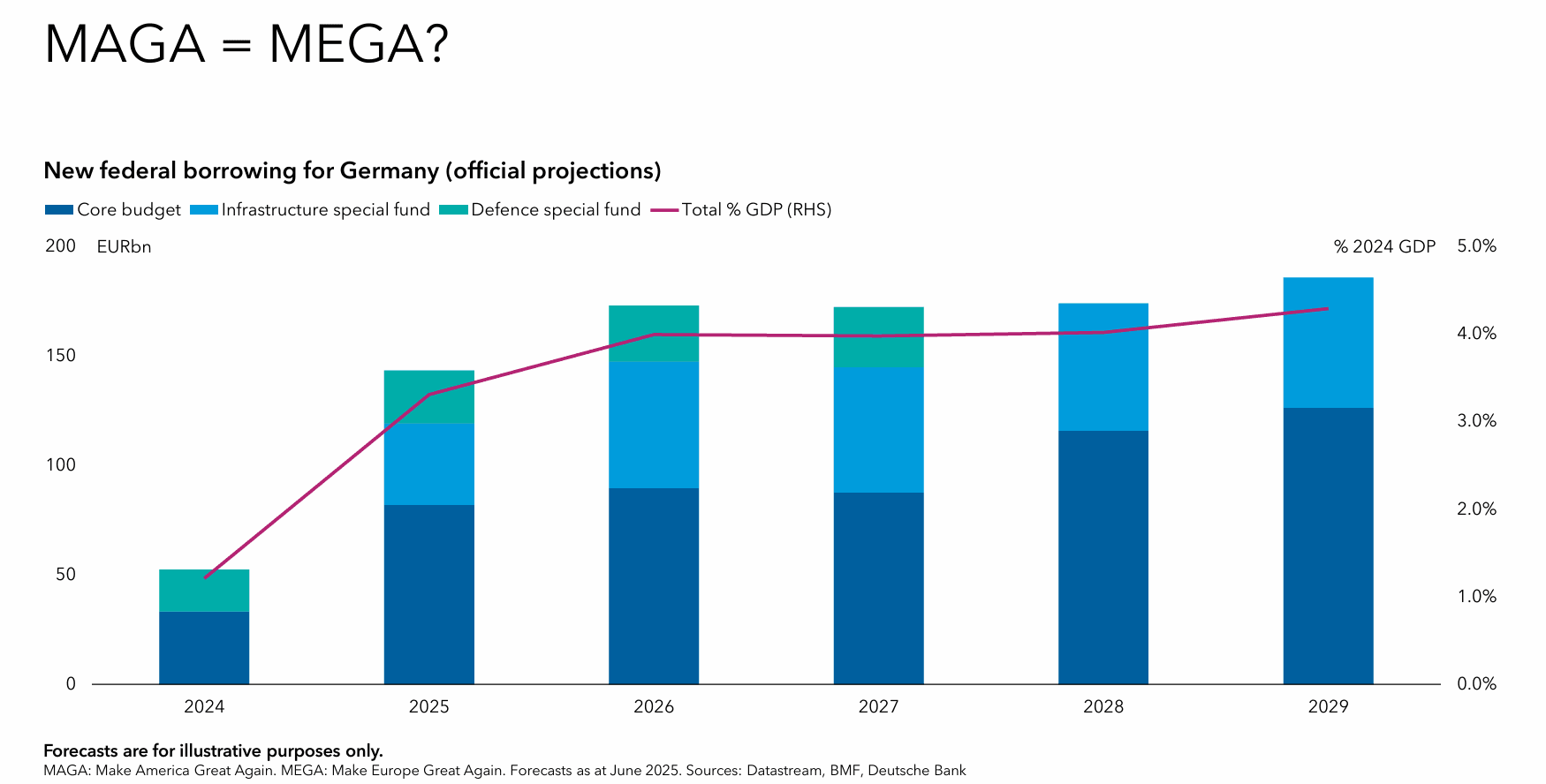
“The first is Mexico, due both to its geography and its position as a strategic partner of the US. Similarly, countries across Southeast Asia are benefitting from tight links to China. So, first, we have capital flows likely heading more to domestic markets; second, we have direct investments going to countries with relatively tight strategic allies; and then the third trend – which is also very important – is neatly illustrated by this next chart.
Source: Capital Group
“As you can see, Germany also wants to play a role in breaking trade imbalances and growing an overall economy that is more domestically-focused. A trillion dollars via higher fiscal spending, which is set to be deployed over the coming years, looks likely have a very positive impact – not just in Germany, where it should foster domestic consumption and enable the economy to rely less on exports to the US, but also more widely across the Eurozone.
“This could therefore prove a pivotal point for many countries as they look to spend more, while aiming to rely less on this trade surplus that, as we saw particularly with China and Germany, has built up over multiple years.”
This is an edited version of the first half of the keynote speech Capital Group investment director Alvaro Peró Gala presented to the audience of Wealthwise’s Summer Wealth Forum on 25 June 2026. You can read the second half – on the sustainability of US debt and the impact of regulation – here while Capital Group’s full report ‘The Great Global Restructuring’ can be found here