
On identifying fund ‘gems’, obscure accountability and an uninvited houseguest
In our regular video series, we interview the wealth sector’s key decision-makers to discover how they think about life, both within the world of investment and beyond it; what brought them into the business and what keeps them here; and what makes them and their companies tick
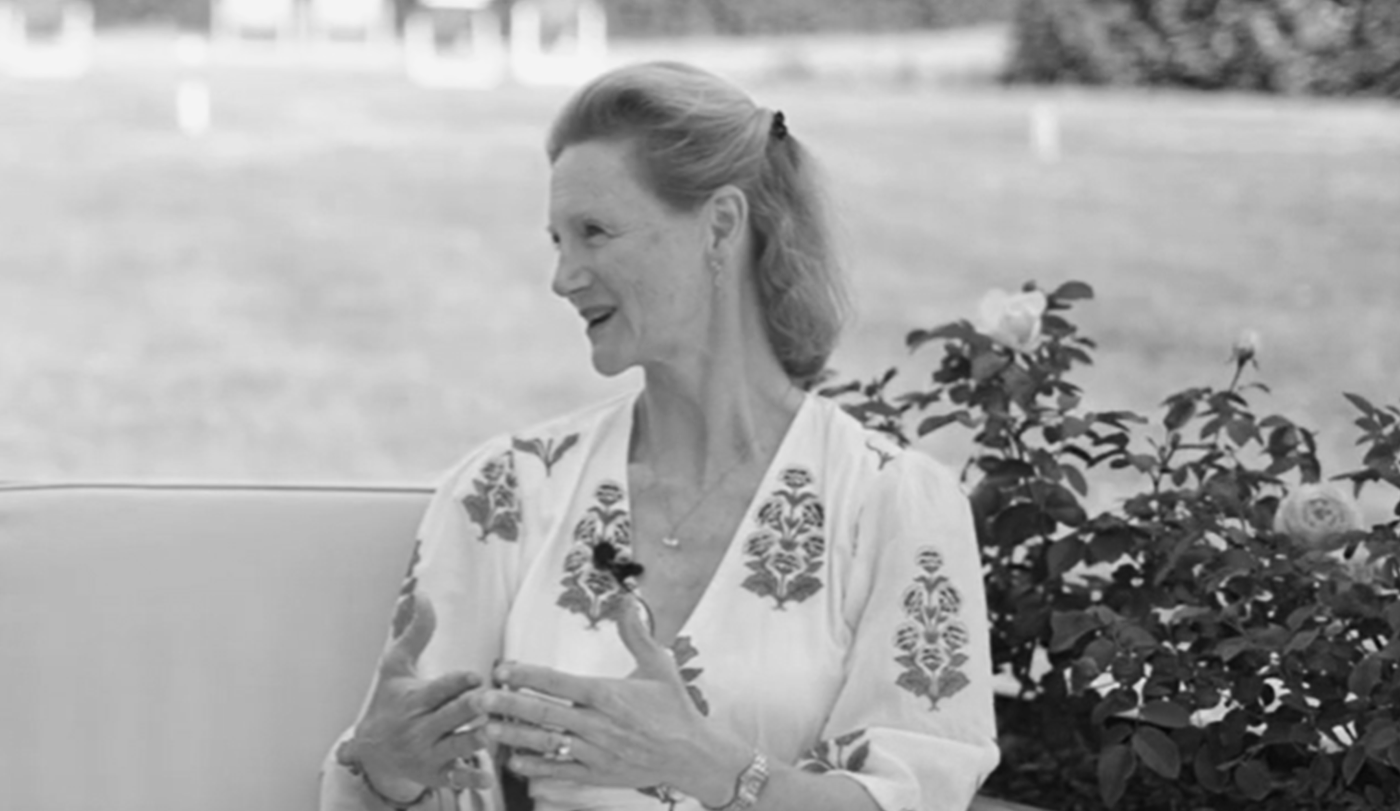
Obviously fund selectors cannot just ‘trust their gut’, says P1 investment manager Jo Benson – but that does not mean their gut is not sometimes proved right. “The bit that keeps you coming back for more in this job is that little tingle of excitement you get when you find something you think is going to be really good,” she tells Wealthwise editorial director Julian Marr in the above video.
“It is a little bit like if you were checking your lottery numbers and suddenly you get to four numbers that match – and then you are thinking, Oh, maybe … Obviously you know there is a very real possibility it will not be a great thing – but you also suddenly have that little buzz about finding something that might be really quite special.
“So you have to go back and you have to do all of the work – of course, you have to do all the work. You cannot just trust your gut instinct but sometimes your gut is proved right about these things and that is always quite a nice moment – when you are doing fund research and you find a real gem of a fund.”
At the end of the day, all of these strategies are run by people – and the human side is quite often where it goes wrong.”
As for investment ‘red flags’, on the other hand, Benson highlights the dangers of “obscure accountability”, elaborating: “Often when you are looking at investment strategies, there will be a very sound investment philosophy and there will be a really sound investment process and you can check through all of the risk controls – you know, that needs doing quite carefully.
“But, at the end of the day, all of these strategies are run by people – and the human side is quite often where it goes wrong. So understanding accountability and understanding how people are working together within fund groups is really important in minimising some of our risk.”
Transfer of wealth
Asked for her take on the future of UK wealth, Benson suggests the difference between best and worst-case scenarios will be how the investment industry approaches the “challenges around transfer of wealth”. “In general, we are going to see wealth transferred down to people who have different financial priorities to previous generations,” she explains.
“They will be carrying more debt from university or more housing debt, for example, so they are going to have other competing priorities that might seem more important to them than saving for their retirement. Coupled with that, obviously, changes last year mean that people with pension pots are probably more inclined to run them down rather than try and pass them on.
“So, in terms of the overall level of investment, I definitely see long-term challenges. And I think, as an industry, it is something we are going to need to try and embrace – to encourage people to save, to demonstrate there is a point to all of this. Over the long term, there is definitely work to do.”
Technological revolution
Earlier on in the conversation, Benson had summarised the positives and negatives of the current investment outlook, noting: “It is not difficult to find things to worry about at the moment. Markets are obviously super-narrow and that should give any investor a bit of pause for thought – and that is before we get started on government debt and politics.
“At the same time, though, there are a lot of good things going on right now. Earnings momentum is good – earnings look really strong for a lot of businesses – and we are just in the midst of a massive technological revolution. I mean, if you are not excited by that as an investor now …”
A full transcript of this episode can be found after this box while you can view the whole video by clicking on the picture above. To jump to a specific question, just click on the relevant timecode:
00.00: What excites you about the current investment outlook? What worries you?
01.31: What do you most look for in an individual investment? What constitute ‘red flags’?
03.59: To what degree should professional investors be thinking beyond so-called ‘traditional’ investments? Towards what?
05.00: What drives your approach to client communications? Should professional investors aim to attract the ‘right’ type of client?
06.04: What was your path into investment – and, if you hadn’t taken it, what do you think you would be doing now?
07.28: What is the biggest investment mistake you are prepared to admit to – and what did you learn from it?
08.59: Outside of work, what is the strangest thing you have ever seen or done?
11.28: What are your best and worst-case scenarios for the future of wealth in the UK?
13.03: What advice would you have given your younger self on your first day in this business?
13.54: Two Choice Words recommendations, please – one a book; one a free choice?
Transcript of Choice Words Episode 41:
Jo Benson, with Julian Marr
JM: Well, hello and welcome to another in our series of ‘Choice Words’ videos, where we get to speak to the great and the good of UK fund selection and UK fund research and find out what makes them tick. I am Julian Marr, editorial director of Wealthwise Media, and today I am delighted to be talking to Jo Benson, who is an investment manager at P1. Hello, Jo.
JB: Hi, Julian.
JM: Thank you so much for doing this and coming to the Wealthwise gardens and estate – as you said beforehand, this is really going to date when this video was recorded! Let’s jump into our first question – what most excites you about the current investment outlook and what gives you most pause for thought?
JB: It is not difficult to find things to worry about at the moment, I think. Markets are obviously super-narrow and that should give any investor a bit of pause for thought – and that is before we get started on government debt and politics … and we could spend a long time on those!
At the same time, though, there are a lot of good things going on right now. Earnings momentum is really good – earnings look really strong for a lot of businesses – and we are just in the midst of a massive technological revolution. If you are not excited by that as an investor now … I mean, it is one of the most exciting times to do this job.
Fund gems
JM: That is a splendidly upbeat start to the interview – thank you for that! Let’s focus in now from the macro to individual investments – what do you most look for when you are analysing investments and what do you see as ‘red flags’?
JB: Look, there is a boring answer to this and I can talk you through all of the usual stuff we have to do when we are looking at funds. That is probably common to a lot of people who have been in the industry for a while and there will be a similar way in which we approach things.
The bit that keeps you coming back for more, though, and keeps you doing this for a really long time is that little tingle of excitement you get when you find something you think is going to be really good. I would say it is a little bit like if you were checking your lottery numbers and suddenly you get to four numbers that match – and then you are thinking, Oh, maybe …
Obviously you know there is a very real possibility it will not be a great thing – but you also suddenly have that little buzz about finding something that might be really quite special. So you have to go back and you have to do all of the work – of course, you have to do all the work. You cannot just trust your gut instinct but sometimes your gut is proved right about these things and that is always quite a nice moment – when you are doing fund research and you find a real gem of a fund.
JM: ‘Maybe, just maybe’ – that was the old National Lottery tagline, wasn’t it?
JB: I think so – I think there is a lot of that – but, you know, you learn lessons over the years because you make mistakes when you research funds.
JM: And we may well get onto that – but, just in terms of red flags, is there anything particular you would pick out?
JB: One of the key things for me, I would say, is obscure accountability. I think that is one of the ways in which things can go wrong because, often when you are looking at investment strategies, there will be a very sound investment philosophy and there will be a really sound investment process and you can check through all of the risk controls – you know, that needs doing quite carefully.
But, at the end of the day, all of these strategies are run by people – and the human side is quite often where it goes wrong. So understanding accountability and understanding how people are working together within fund groups is really important in minimising some of our risk.
Dependable returns
JM: Excellent. To what degree do you think investors should be looking beyond so-called ‘traditional’ asset classes – bonds, equities, cash – and towards so-called ‘alternatives – however you want to define those?
JB: I think there is absolutely a place for alternatives in portfolios. We are all aiming to build diversified portfolios that offer investors a degree of resilience – and there are some really good return opportunities outside of more conventional equities and bonds.
So that definitely has a role to play – and increasingly, taking a cyclical view on equity and bond markets, I think it has got a bigger role to play right now than it has for the last few years. Certainly, as credit spreads become quite compressed, we start to look at other ways in which we can generate dependable returns – and alternatives are definitely part of the landscape for that.
Alignment and understanding
JM: Thank you. Now, what is your approach to client communications and, within that, do you believe there is such thing as the ‘right’ type of investor – somebody who is going to stick with you on the entire journey so they enjoy the full benefit of your and the P1 investment wisdom?
JB: Yes – I mean, that is always the best relationship, right? One where you are both in it together for the long term – and I think quite often they tend to have the best results as well. When I think about some of the clients I have managed over the last few years – in particular, those who have got the most engaged approach and are really keen to work together in partnership quite often are most satisfied with the results they get.
And that is quite a key thing. So I think this speaks to that whole idea around alignment and just trying to make sure there is a really clear understanding about how you can complement each other – between sort of DFM and client effectively. So yes, that is definitely a thing.
Forensic account
JM: Excellent. A more personal question now – what was your route into investment? And, if you had not taken it – in an alternative universe – what do you think you would be doing now?
JB: Well, like probably quite a lot of people, it was by accident. I did a science degree at university and then I was planning, after a year of work, to go back and do a master’s in forensics. For my year out, however, I joined the Aon graduate programme and basically just never looked back. So that was how I started off in the industry – and then I went from there into investment consulting for the first 10 years, working on pension schemes.
JM: And so, in our alternative universe, you are lost to the world of forensics and crime process?
JB: I still do love a mid-paced murder mystery drama, Julian – I think there is a lot to be said for them on a Sunday afternoon when you just do not need anything too taxing! Sadly, though, I think the forensic science service is not what it once was. So no doubt I would have been disappointed by them – and they would probably have been disappointed by me!
‘Hit’ rate is key
JM: Surely not! Investment mistakes – we always try and put a nice learning spin on this. Which is the biggest investment mistake you are prepared to admit to – and what, if anything, did you learn from it?
JB: Well, in the last few years, we have got quite a lot of the big things right. But in a sense – and this is a really slippery answer! – in any portfolio, you have always got a number of decisions to take, and some of them are working and some of them are not. So, in a sense, you are making mistakes all the time – not everything is working the way you necessarily might hope.
But that is part of building portfolios for different environments as well – so, if everything is working together or everything is not working together, then maybe your portfolio construction is not quite what it should be. The important bit is getting the ‘hit’ rate right so we are right more often than we are wrong. So mistakes are very much sort of part of the journey – although I would say, on a personal level, many years ago I owned some shares in Marconi. That did not go well!
JM: No – I can imagine.
JB: And younger investors would probably say, Who is Marconi? And I would be, like, Yes – that is the whole point, really! Anyway, I buy collectives so I do not do that stuff anymore.
JM: Yes, I had a similar experience. It is funny how a lot of answers to this question converge around those early months of 2000, shall we say!
Glass half-full
JM: Everybody’s favourite question in this interview series, now – outside of work, what is the strangest thing you have ever seen or done?
JB: Oh … it is quite hard to come up with something that is not going to bring your organisation – or mine – into disrepute!
JM: Interesting – but let’s avoid that then!
JB: We will avoid that! This is a really weird story from when I was moving between two houses. The lease on one was up and we had a gap of a week before the lease on the other was due to start so a friend – who had just taken on a place but had not moved in yet – had given us the keys and we were going to crash there for a week.
We got through the door and something felt really off – there was a plate and a mug out and we were like, OK, this should not be like this! So, there was a frantic phone call to check we had not missed something – but there was not supposed to be anyone in the house. So we started to look around, went upstairs – and there was a random man asleep in one of the bedrooms. And next to him was a glass tumbler with a glass eye inside – so he quite literally slept with one eye open!
So that was profoundly weird – but then he woke up and we had a very British conversation! And we ended up living with this random chap for about a week – a lovely guy called Nick, who had a glass eye and quite literally said, I cannot feel it so, if I am walking around with only one eye, please remind me to put my other eye in! So does that qualify as strange enough?
JM: Yes, I would say that goes fairly comfortably into our top five – so many congratulations. I respect that!
JB: It was a very ‘Goldilocks’ experience – it was like the ‘Three Bears’!
JM: Do you know – I was just going to say that! He was the most macabre ‘Goldilocks’ I have ever heard about. OK, that was brilliantly bizarre – especially as I assumed he was just going to run out of the house.
JB: No, he stayed. It had a real Wes Anderson sort of tinge to it – it was just very dark.
Different priorities
JM: Very, very good answer – well played. I was going to say we are moving onto a more serious question now – but I am not sure that is quite the right word! A less weird question, perhaps. What do you see as the best and worst-case scenarios for the future of UK wealth – whether that be industry or indeed country? Take your pick.
JB: I think the best-case scenario is everything keeps getting better – and, you know, that’s fabulous – but I am kind of paid to worry. I think there are a lot of challenges around transfer of wealth within the industry.
So I think, in general, we are going to see wealth transferred down to people who have different financial priorities to previous generations – for example, they will be carrying more debt from university and more housing debt, seeing as the housing market has gone up over the last couple of decades, as well. So they are going to have other competing priorities beyond saving for their retirement, which might seem more important to them.
Coupled with that, obviously, changes last year mean that people with pension pots are probably more inclined to run them down rather than try and pass them on. So, in terms of the overall level of investment within the industry, I definitely see long-term challenges.
And I think, as an industry, it is something we are going to need to try and embrace – to encourage people to save, to demonstrate there is a point to all of this. That is the challenge for us as an industry, I think – so, over the long term, there is definitely work to do.
JM: Yes – and whether that challenge is met leads to the best or the worst case, doesn’t it?
‘Act like an owner’
JM: Very good. Now, we are zipping through these questions – only two more. Just a quick one, first – what advice would you like to have given yourself on your first day in the job?
JB: Would I have been sensible enough to listen to good advice on my first day in the job? That is the question! I think definitely to make sure that, when you first go into Pret, you pick a good sandwich because you are going to eat that a lot over the next 20 years – so make sure it is a good one!
Beyond that, I think I would always say to try and act like an owner – just always behave like it is your own business and show your job the same sort of tender loving care that you would if you owned the whole thing.
JM: Oh, nice – and then you probably conjure the ownership aspect into being.
Dead good
JM: Very good. Last question – we call this series ‘Choice Words’ because of the choices you make on a professional level but now we are looking for two recommendations or tips for our beloved audience – whoever you may be. One would be a book – it can be investment-related, does not have to be – and the other one is a free hit. So it can be anything – even a sandwich at Pret. Oh, maybe not – I don’t want to put ideas in your head!
JB: No – we have done enough promotion for the sandwich industry today! OK – book. I would say one of my favourite books of the last couple of years is Unlawful Killings by Wendy Joseph, who was a judge at the Old Bailey and has written a series of chapters or compilations of different cases she had overseen there. It is just absolutely phenomenal – really fun and interesting to read. It is really entertaining but also quite an interesting consideration of what justice is within that. So that is great.
As for something slightly more investment-based, there is a really good book about maritime insurance called Dead in the Water, which is well worth a read as well. It focuses on the death of an expat working in Yemen … there is a lot of death in this!
JM: There is certainly a theme coming through in a lot of these answers. I am actually glad Nick made it out alive … at least, I am presuming he made it out alive from that house!
JB: He definitely did! But that book is well worth a read too. I did make the mistake of reading it while my children were doing their swimming lessons – and I was told it was not appropriate to have that book in hand! But that is another good one to go and look up.
JM: OK. So those are your two recommendations – and we leave the sandwich tips alone. That is fantastic. Really good choices – and it has been a good, if at times strangely grim, conversation! I really enjoyed it, Jo – thank you so much for your time.
JB: Thank you.
JM: And thank you very much for watching. I hope that has left you with plenty of food for thought. Please do look out for further ‘Choice Words’ videos as and when they are published.