
On the commoditisation of intellect, dangers of style drift and consolations of philosophy
In our regular video series, we interview the wealth sector’s key decision-makers to discover how they think about life, both within the world of investment and beyond it; what brought them into the business and what keeps them here; and what makes them and their companies tick
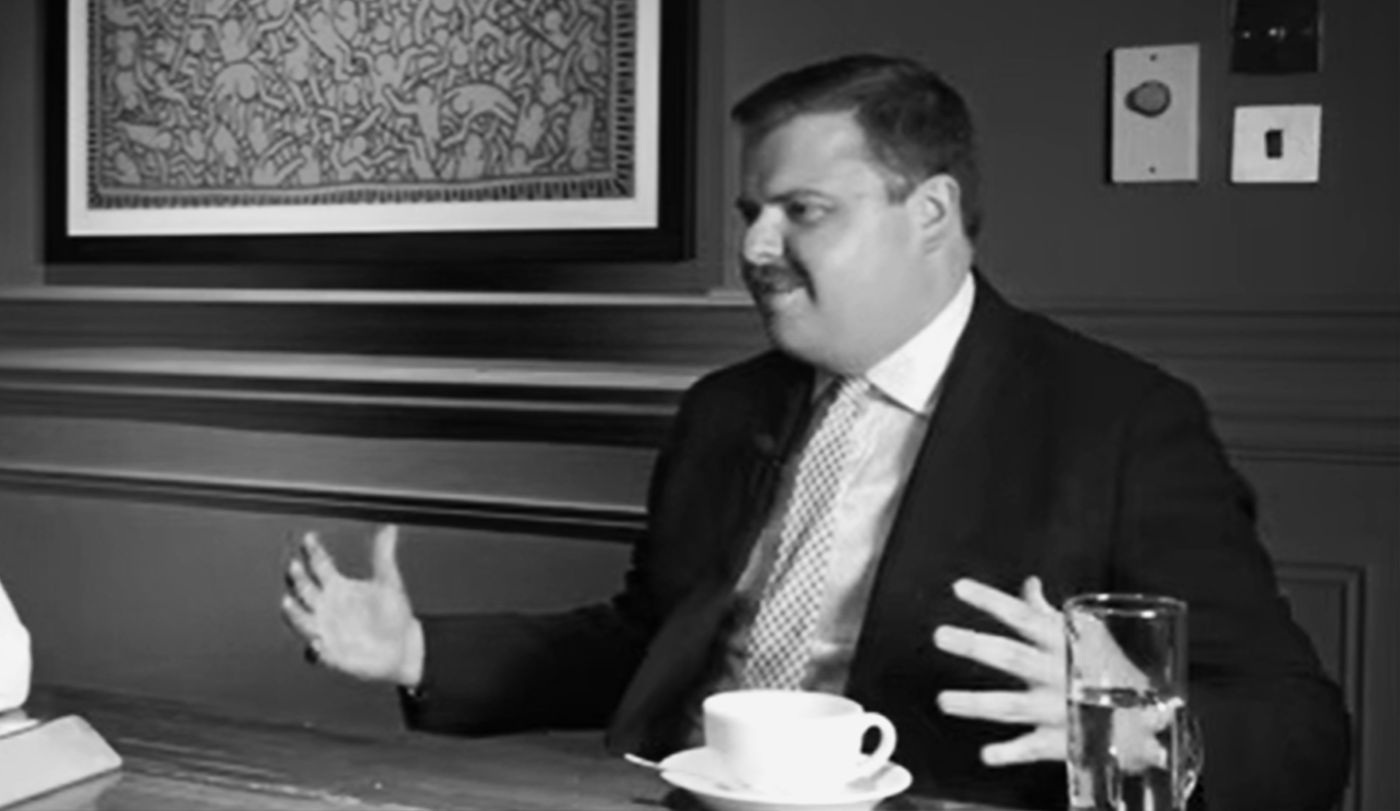
For Ben Gilbert, a partner at Sarasin & Partners, the most exciting aspect of the current investment outlook is also the most worrying: artificial intelligence. “We are in the foothills of one of the most transformative ‘general-purpose technologies’ the world has ever seen,” he tells Wealthwise editorial director Julian Marr in the latest Choice Words video above. “Potentially, it is nothing less than the ‘commoditisation of intellect’ itself.
“If we look back through history, this has added something like 1% to our long-term productivity growth expectations in the US – and, if you wanted to achieve that sort of growth with labour, you would need an extra one and a half million jobs a year. So it is very exciting – and I think there are going to be fortunes made and, potentially, fortunes lost.”
Gilbert’s enthusiasm is tempered, however, by the amounts of cash being splashed by AI businesses. “In terms of the economy and financial markets, there has been a huge amount of capital expenditure on AI – $450bn [£338bn] last year, a trillion this year – it just keeps going up and up and up,” he continues.
What is really important is that our fund managers articulate a clear and unambiguous objective – and then it is for us, as fund selectors, to decide whether we think that objective is sensible or not.”
“As we record this – it is the end of July – we are now through Google’s earnings and it looks like they alone might get to $350bn by 2027. All that capex is going to be searching for a return – and, at the moment, it is quite difficult to anticipate where it is going to come from. Combine that with the fact that tech in total is 30% of the market today – a lot of which is priced to perfection – and you can understand why we see AI as the biggest worry as well as the biggest opportunity at the moment.”
Drilling down to what Gilbert most looks for in specific investments – and what he would consider a ‘red flag’ – he explains: “What is really important is that our fund managers articulate a clear and unambiguous objective – and then it is for us, as fund selectors, to decide whether we think that objective is sensible or not. And then, as we hold them to account, any moving of goalposts or any changing of objectives after the fact is a real red flag.”
Changing times
On the subject of moving goalposts, how does Gilbert guard against ‘style drift’? “That is very topical because you could argue a number of prominent fund managers at the moment are changing their spots,” he replies. “It comes back, though, to how we think about an investment in the first place. If the objective is well-articulated and if it is signposted in advance, we can get comfortable with managers changing their styles – in the face of changing evidence.
“I remember a prominent UK fund manager telling me once they had been in the industry long enough to have seen plenty of fund managers end up ‘flipping burgers’ because they failed to adapt. And, while I do think that line is a bit cruel on fast-food workers, it certainly makes the point that, as investors, you do need to adapt. Markets change and people change so there is no reason why you cannot change your process – but you have to be really careful when you do so.
“We are big believers in the idea that markets move in definable ‘regimes’, where certain styles or approaches are in and out of favour. And we have moved from a sort of ‘secular stagnation’ regime – deficient demand, ultra-low interest rates, ultra-loose monetary policy – to one where growth is actually a bit easier to come by today, if you look at the AI infrastructure boom.
“So inflation is higher, interest rates are higher and it is just a very different environment to invest in. So, as a fund manager, you can do one of two things: you can say, I am going to stick to my guns and be very stubborn about this. Or you can face the world as it really is and adapt. And I think, as long as you do that in advance, rather than chasing performance after the fact, then we would be willing to listen.”
A full transcript of this episode can be found after this box while you can view the whole video by clicking on the picture above. To jump to a specific question, just click on the relevant timecode:
00.00: What excites you about the current investment outlook? What worries you?
02.34: What do you most look for in an individual investment? What constitute ‘red flags’?
03.25: What are your thoughts on style drift? And what processes do you have in place to spot it early?
05.48: To what degree should professional investors be thinking beyond so-called ‘traditional’ investments? Towards what?
07.18: What was your path into investment – and, if you hadn’t taken it, what do you think you would be doing now?
08.31: What is the biggest investment mistake you are prepared to admit to – and what did you learn from it?
09.58: Outside of work, what is the strangest thing you have ever seen or done?
10.58: What is the best piece of advice you have ever been given?
11.59: What would be your ‘top tip’ for professional investors to help them do a better job?
12.39: Two Choice Words recommendations, please – one a book; one a free choice?
Transcript of Choice Words Episode 43:
Ben Gilbert, with Julian Marr
JM: Well, hello and welcome to another in our series of ‘Choice Words’ videos, where we get to meet the great and the good of UK fund selection and UK fund research and find out what makes them tick. I am Julian Marr, editorial director of Wealthwise Media, and today I am delighted to be talking to Ben Gilbert, a partner at Sarasin & Partners. Hello, Ben – great to see you.
BG: Hello Julian. Delighted to be here. Thanks for having me.
JM: An absolute pleasure. Let’s jump into my first question straightaway. What excites you most about the current investment outlook? What gives you pause for thought?
BG: Yes – that is two questions, isn’t it?
JM: Yes – I have been told off for that before! You get all revved up to answer the first part and then the second one comes along. It is just bad interview technique, I know – but we struggle through!
BG: Well, I may get told off for giving you one answer – because it is the same for both those questions – and that is AI. I think what is exciting is we are in the foothills of one of the most transformative ‘general-purpose technologies’, as economists call them, or ‘GPTs’ – so not the other ChatGPT – that the world has ever seen. Potentially, it is nothing less than the ‘commoditisation of intellect’ itself.
And, if we look back through history, this has actually added something like 1% to our long-term productivity growth expectations in the US – you know, if you want to achieve that sort of growth with labour, you would need an extra one and a half million jobs a year. So it is very exciting – and I think there are going to be fortunes made and, potentially, fortunes lost.
On the worrying side, obviously, with the commoditisation of intellect, there is a certain amount of personal anxiety – we all work in the information or the intellectual sphere, as it were, as white-collar workers. But on a more serious note, in terms of the economy and financial markets, there has been a huge amount of capital expenditure on AI – $450bn [£338bn] last year, a trillion this year … it just keeps going up and up and up.
As we record this – it is the end of July – we are now through Google’s earnings and it looks like they alone might get to $350bn by 2027. And all that capex is going to be searching for a return – and, at the moment, it is quite difficult to anticipate where it is coming from.
Combine that with the fact that tech in total is 30% of the market today – a lot of which is priced to perfection – and it really could leave you staying up at night worrying about those sorts of things. So AI is both the biggest opportunity and the biggest worry for us at the moment.
JM: It is a very good, very succinct answer. And as for the ‘commoditisation of intellect’, is that actually a book yet? It feels like a title in search of a book.
BG: Well, I have not heard anyone say it, actually, so hopefully it is not too well used …
JM: Very good – copyright it now!
Clear objective
JM: Good start, as I say. From that wider look at things, let’s drill down to, What do you look for in specific investments – and what do you see as ‘red flags’? Sorry – that is another double question.
BG: Well, I can be a bit more succinct with this one, I think. What it comes down to for us – what is really important, with my fund selection hat on – is we just want to see from our fund managers a really clear and unambiguous objective.
And then it is for us, as fund selectors, to decide whether we think that objective is sensible or not. So, if someone says, We want to achieve cash plus 1% and we want to do it with loads of risk and no potential downside protection, that is not a very good objective.
Still, once someone has articulated a really clear objective to us, that is the main thing we want. And then, of course, the red flag comes where you hold them to account. So any moving of the goalposts or any changing of their objectives after the fact is a real red flag to us.
Regimes change
JM: You have sort of touched on it there but what are your thoughts on style drift? And what processes do you have in place to spot it early?
BG: Yes – it is a very topical thing to be asking at the moment because, clearly, you could argue a number of prominent fund managers are changing their spots. It actually comes back, though, to how we think about the investment in the first place. So, as long as the objective has not changed, whether you are a quality or a growth manager, say, that is not an objective in and of itself – those are tools or frameworks for thinking to help you achieve your objective.
And so, if the objective is well articulated and if it is signposted in advance, we can get comfortable with managers changing their styles – in the face of changing evidence. I remember one prominent UK fund manager – who I won’t name – telling me once they had been in the industry long enough to have seen plenty of fund managers end up flipping burgers because they failed to adapt.
And, while I do think that line is a bit cruel on fast-food workers, it certainly makes the point that, as investors, you do need to adapt. Markets change, people change so there is no reason why you cannot change your process – but you have to be really careful when you do so.
JM: Very good – although I cannot say I have ever spotted an ex-fund manager working at Burger King! Now, you said you have noticed a number of managers ‘changing’ their spots – is that mainly because they are trying to find a way to crowbar AI into their portfolios, even if they are value managers, or something else?
BG: It could be – that is one example. Also, you know, we are big believers in the idea that markets move in ‘regimes’ – these definable regimes where certain styles, certain approaches, are in and out of favour. And we have moved from a sort of ‘secular stagnation’ regime – deficient demand, ultra-low interest rates, ultra-loose monetary policy – to one where growth is actually a bit easier to come by today, if you look at the AI infrastructure boom.
So inflation is higher, interest rates are higher and it is just a very different environment to invest in. So you can do one of two things: you can sort of be bald-faced and say, I am going to stick to my guns and be very stubborn about this. Or you can face the world as it really is and adapt. And I think, as long as you do that in advance, rather than chasing performance after the fact, then we are willing to listen, I would say.
Smooth returns
JM: Let’s move on to alternative investments now – however, you want to define that. To what degree do you think investors should be moving in that direction and, if so, towards what?
BG: So I will not be the first person to say we think they should be moving in that direction – and it harks back to what I was just saying. You know, the environment we were in was, in many ways, a sort of ‘Goldilocks’ environment for Wall Street – even if it did not feel like it for Main Street – where you had very high levels of decorrelation between equities and bonds and ultra-loose monetary policy lifted all boats.
Whereas we have moved into an environment where that is categorically not the case. And so, if we want to deliver the same sort of smooth returns for our investors, we need to look outside of equities, bonds and cash – to what we would define as ‘alternative investments’ – and we would include in that assets such as commodities, including precious metals; infrastructure; and alternative sources of income like high yield bonds and, potentially, local currency emerging market debt.
For the right client – though not for all clients – private equity is a great potential vehicle. We would also say there is a place for insurance protection, in the form of put option protection, in portfolios in order to mitigate some of these very specific risks you can take on markets – for example, we talked about keeping an eye on concentration risk a little bit. So we think there is a place for all of those in portfolios today – and it is one of the reasons we launched our managed fund so we could get that ubiquitously for all of our clients across platforms.
Kicking on
JM: Very good. A more personal question now: What was your path into investment and, if you had not taken it – in an alternative universe – what would you be doing now?
BG: Well, we were talking earlier about the World Cup and, obviously, like a lot of kids, I always had this trajectory to be a professional footballer. I very quickly realised that was no going to be the case for me so I was looking for something more solid that I thought would be a profession that could see me through my career.
I initially started thinking about getting into the building profession – but I very quickly realised I wasn’t very good with my hands. So then I thought, Actually even better, all you are trying to do when you are building is to earn money – so, if I can get good with money, that will help. I did not have a huge amount of family or a network in the finance industry but I was really enthusiastic – and friendly enough – so I eventually managed to wangle myself an interview at a company called Bestinvest.
It still exists today – it is a great ‘consumer champion’ platform business – and it was actually a really great home to start your career because you got to meet the great and the good of the UK and global fund management industry. We had great fund researchers and so you got a very wide perspective – and that is how I ended up in in the industry, really, and I have never looked back.
JM: But a great loss to the Premier League?
BG: A great loss to Division Four, maybe!
Humbling moment
JM: Different sort of personal question now. What is the biggest investment mistake you are prepared to admit to? And turning a frown upside down, what did you learn from it?
BG: I mean, after 17 years, the scars are pretty deep these days – but the biggest one I think about and which gives me pause for reflection was in 2022. Like a lot of investors, we think about our composite benchmarks and we think about our external risk ratings and providers – that is really important for the advisers who invest with us.
And so we could see the global economy emerging from Covid-19 and the crunching together of supply chains starting to cause inflation – which was, of course, then exacerbated when Russia invaded Ukraine. And then we looked at our portfolios, anticipated the interest rate rises, anticipated the consequences for bonds and quickly moved to the bottom of our parameters in bonds across portfolios …
And when we looked up from our desks, we were expecting to be rewarded for having delivered some outperformance by being significantly underweight bonds – and of course realised that investors cannot eat relative returns and they care about absolute returns.
And I think it is just important for us – by which I mean the whole industry – to stay focused on what we are actually trying to achieve. And, actually, often that is not outperformance of composite benchmarks – it is beating inflation and beating your peers. So I think that was a real humbling moment – amongst many!

Is it a bird? Is it a plane? No …
JM: Big drum roll now for everyone’s favourite ‘Choice Words’ question – outside of work, what is the strangest thing you have either seen or done?
BG: Well, I am very glad you said ‘outside of work’ because that does narrow it considerably! I think the strangest experience I can remember is when I was in Minorca in Spain – at just the right time of night – and I looked up at the night sky and saw a train of fast-moving light objects. I am no conspiracy theorist but I just could not explain it – I could not see what was happening.
It was not shooting stars, it was not a plane but I looked it up later and it turns out it was actually the launch of Starlink – now of SpaceX fame – Elon Musk’s company’s satellites and they formed this incredible pattern in the sky.
And it was a very strange experience because it sort of flipped you from being slightly unnerved and not understanding what was going on to being really inspired by what we can achieve with human technology. That is the strangest experience I can remember anyway.
Truth of the matter
JM: Nice answer. What is the best piece of advice you have ever been given?
BG: Yes – I am searching through the depths now! The best answer I can think of to that is Bertrand Russell was asked exactly the same question – and he gave one intellectual answer and one moral one. I don’t think the moral side is necessarily my place! But, on the intellectual side, he said, When you are considering any matter, any philosophy, ask yourself only, What are the facts – and what is the truth those facts bear out?
And I think there is a lot in that for us as investors. Don’t get distracted by what you wish would be the case. Don’t be distracted by what you think would be good if it was the case. Just ask yourself, What are the facts – and what is the truth that they bear out? I thought that was very good advice.
JM: Wow! And the first time we have had Bertrand Russell quoted on Choice Words – so kudos on that!
BG: I am not sure that was a direct quote!
JM: Even paraphrased – even just referenced!
Think more, calculate less
JM: Now, I suppose it could be the same answer but maybe try and be creative here because, having received that advice indirectly – presumably – from Bertrand Russell, what would be your top tip for professional investors to help them do a better job?
BG: I think it is related – and it is to think more and maybe calculate less sometimes. We are an industry that is, quite rightly, obsessed about numbers and risk and spreadsheets but, sometimes, that distracts you from what you are trying to achieve for clients in the first place.
So I think that advice is really important for investors – think more, calculate less sometimes. JM: And that goes for any regulators listening as well! I am sure you would never say that but I will just add that in.
On the consolations of philosophy
JM: Last question – we call this series ‘Choice Words’ because of what you do for a living but we are looking for some personal choices now. One is a book – it can be investment-related, but it does not have to be – and the other is a free hit. It can be anything. I am not even going to give examples now as we have had so many extremely weird and wonderful answers. So over to you – book first?
BG: On the book, I am going to resist the urge – as I know a number of your contributors have – to pick an investment book and I will instead stick with the Bertrand Russell theme. It has been 20 years now that I have not been on holiday without taking a copy of A History of Western Philosophy with me.
I have always been a big advocate of ‘It is not really what you think, it is how you think’ – and this book is just a great exploration of lots of different thinkers in the Western tradition over a very long period of time. So that would be my book.
JM: And the free hit?
BG: Well, I am also a big fan of documentaries as well and – I think it is on Prime at the moment but other streamers are available! – there is one called The Thinking Game, which is all about the rise and rise of DeepMind, now Google DeepMind, and Demis Hassabis, who is a really inspirational character.
And for all of us here in the UK, it is a reminder of the whole story of AI and brings a bit more balance to it. It is not a wholly Silicon Valley story – and the story of DeepMind and Demis Hassabis is one that is well worth an hour or an hour and a half of your time, if you can watch the documentary.
JM: Very good – and also neatly circular back to the AI world. Very interesting Choice Words choices, Ben. Thank you for those – and thank you indeed for this conversation. It has been great. Lovely to meet you.
BG: Great to meet you.
JM: And thank you very much for watching. Please do look out for further ‘Choice Words’ videos as and when they are published.