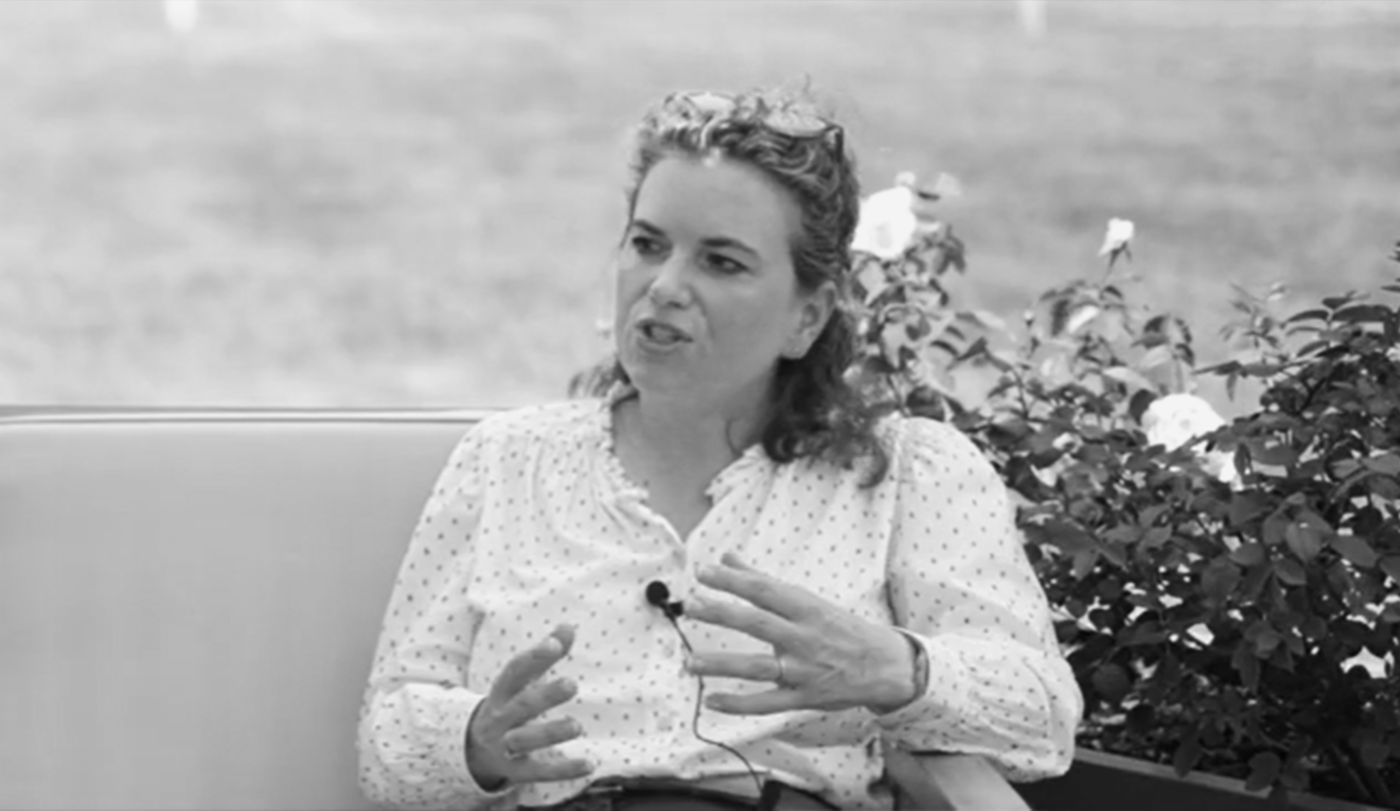

On capturing catalysts, the power of simplicity and lessons from sailing blindfolded
In our regular video series, we interview the wealth sector’s key decision-makers to discover how they think about life, both within the world of investment and beyond it; what brought them into the business and what keeps them here; and what makes them and their companies tick
The potential to capture a catalyst in a particular asset class is top of the list of qualities Amanda Sillars – investment manager and ESG investment director with the Independent Funds Merlin team at Jupiter Asset Management – is looking for when building a portfolio.
“Trying to find the right fund is crucially important because it can add so much value to our clients,” she tells Wealthwise editorial director Julian Marr in the above video. “So, if you have an asset class that should be delivering positive returns – for whatever reason that may be – and then you can find a fund that will actually capture the kernel of that, that is a great ‘green flag’ per se. Japan is a super example at the moment.”
Another ‘red flag’ is arrogance and hubris because I always worry that, if fund managers are so busy listening to themselves, they are not listening to the market.”
Other green flags Sillars identifies are liquidity, simplicity and transparency while the red variety include “when one finds an investment process that is not connected with the returns that fund is actually delivering”. “As a very simple example, if you say your process is a value manager but, in value times, your fund is not performing well, that definitely is a red flag,” she continues.
“And then, for me personally, another red flag is arrogance and hubris – because I always worry that, if fund managers are so busy listening to themselves, they are not listening to the market. And they can be wrong for a very long period of time which, yes, means bad performance for them – but, from the client perspective, it could be disastrous.”
‘Complexity is the enemy’
Along with clarity, simplicity and transparency crop up more than once in the conversation and Sillars returns to these qualities in the context of client communication. “As the decades have progressed, they are becoming more important,” she argues. “I was chatting to this lovely young lady – a new IFA in Newcastle – and she was saying, ‘My clients, don’t understand finance – it is a foreign language.
“It is not taught at school and it is often not taught by parents so I have to spend the first four or five hours talking about, What are interest rates? What is inflation? How does that link to you and your mortgage and your this and your that? Before I ever get to investments.’ So in response, on the Merlin team, we have recorded a series of two to four-minute, bite-sized, educational, generic pieces for our website.
“So our approach is extremely clear, simple and transparent – and I think that goes a long way to attracting the ‘right’ clients, who know what outcomes to expect and know what communication to expect from us. This is so important because that actually builds trust – it really does – and complexity is the enemy of that.”
Simple but effective
As for the Choice Words ‘signature question’ – the strangest thing ever seen or done outside of work – Sillars picks out the time she crewed in the Fastnet Race. “This is one of the more challenging yacht races in the British calendar, where you sail from Southampton to around a rock off the southwest coast of Ireland and back again,” she explains.
“I did this, before I got married, with a crew that was over half visually impaired or otherwise blind. During the qualifying races, they blindfolded me and sent me below and said, ‘Bring up a life harness’ – and they had hidden them all and of course I couldn’t find one. And it was a fantastically simple but effective way of putting me in their shoes – and also making me understand the importance of rigour and self-discipline, sticking to process and so on, which I have tried to hold onto because it was such a clear lesson.”
A full transcript of this episode can be found after this box while you can view the whole video by clicking on the picture above. To jump to a specific question, just click on the relevant timecode:
00.00: What do you most look for in an individual investment? What constitute ‘red flags’?
02.43: To what degree should professional investors be thinking beyond so-called ‘traditional’ investments? Towards what?
04.12: How would you explain risk to someone who does not work in investment?
04.56: How would you define value for money in the context of investment?
05.24: What qualities drive a successful wealth management business?
07.50: What drives your approach to client communications? Should professional investors aim to attract the ‘right’ type of client?
10.59: What was your path into investment – and, if you hadn’t taken it, what do you think you would be doing now?
14.28: What is the biggest investment mistake you are prepared to admit to – and what did you learn from it?
16.34: Two Choice Words recommendations, please – one a book; one a free choice?
18.30: Outside of work, what is the strangest thing you have ever seen or done?
Transcript of Choice Words Episode 40:
Amanda Sillars, with Julian Marr
JM: Well, hello and welcome to another in our series of ‘Choice Words’ videos, where we get to meet the great and the good of UK fund selection and UK fund research and find out what makes them tick. I am Julian Marr, editorial director of Wealthwise Media, and today I am delighted to be talking to Amanda Sillars, who is an investment manager with, as well as ESG investment director on, the Independent Funds Merlin team at Jupiter Asset Management. Hello, Amanda.
AS: Good morning.
JM: And welcome to the Wealthwise garden, where we are currently conducting our Choice Words interviews! Let’s jump into the first question – when you are looking at individual funds, what are the qualities you are particularly after? And what do you see as red flags?
AS: Well, thank you, first, for inviting me to be here on this beautiful – and hot! – morning. As a fund selector and asset allocator, on behalf of the Jupiter Merlin portfolios, trying to find the right fund is crucially important because it can add so much value to our clients.
And therefore, for us, the ‘green flags’ are a fund that is likely to capture a catalyst that we have identified in a specific asset class. So if you have an asset class that should be delivering positive returns – for whatever reason that may be – and then you can find a fund that will actually capture the kernel of that, that is a great green flag per se. And Japan is a super example of that at the moment.
Other green flags are liquidity, simplicity and transparency – and then, to the second half of your question, ‘red flags’ are when one perhaps finds an investment process that is not connected with the investment returns that fund is actually delivering. So, if you say your process is a value manager but, in value times, it is not performing well, as a very simple example, that definitely is a red flag.
And then, for me personally, a red flag I’m afraid is arrogance and hubris – because I always worry that, if fund managers are so busy listening to themselves, they are not listening to the market. And they can be wrong for a very long period of time which, yes, means bad performance for them – but, from the client perspective, it could be disastrous. So I think that is quite dangerous.
JM: That is a great answer. At this point, I would love to ask you for details of various arrogant managers you have come across – but maybe that is one for a different time. Brilliant – we are up-and-running.
More predictable performance rhythm
JM: Sticking with types of investment, to what degree do you think that individual investors, and by extension those who invest for them, should be looking beyond the traditional asset classes of equities, bonds and cash – and towards what?
AS: It is a really interesting question at this point in time because private assets and private credit – quite apart from crypto – have really taken off. I was lucky enough to be invited to a conference a while ago and my fellow delegates, said, ‘It is not a question of ‘if’ – it is a question of ‘how’ to access private markets’.
Whereas we think that, for most individual clients, traditional assets are actually a better fit for the ‘green flags’ – to keep that analogy going – in that the performance rhythm is more predictable because the underlying assets are not locked in. Whereas, with a private company, you are locked into owning that. The transparency is obviously much better; the simplicity is obviously better; and liquidity – you know, the ultimate risk control for you and our lovely cameraman and me is to actually sell. And if you are locked into an asset, you cannot.
JM: Good answer. And thank you for mentioning our cameraman! I never give him any credit – Rich, I never give you any credit! What a nice thing to do.
Protect the downside
JM: You mentioned ‘risk’ just then, which is a good segue to our next question – how would you explain risk to someone who does not work in investment?
AS: I would say, It is really simple – it is the permanent destruction of capital or, secondly, the inability to access your savings or your capital. That is very much the lens our investors in Jupiter Merlin have and so it is one we have really prioritised.
All the Merlin portfolios price daily and we are obsessive about making sure that, both at the fund level and the underlying investment level, there is liquidity and we try and protect on the downside.
Performance, tailoring, service
JM: Thank you for that – and, while we are defining financial ideas, how would you define value for money in the context of investment?
AS: A return that is, first of all, positive – as my boss John always says, Even you cannot spend a relative return, Amanda! – and, second, ideally ahead of peer groups and benchmarks over time, after fees. Simple.
JM: Good stuff – we are speeding through here. Now, you obviously get to deal with a lot of wealth management groups so – from your perspective – what sort of qualities define a successful wealth management business?
AS: Well, you are asking me individually and so my response is quite personal …
JM: Yes – obviously we do not blame Jupiter for anything you are going to say! These are your views.
AS: So, for me, I would say the lion’s share is performance – because, if someone has responsibility for my hard-earned savings, I need those. So I would say performance is really important – over time. I would also say tailoring and service.
Four words of advice
JM: Let’s just talk a bit more about tailoring then – does that have to be to an individual or can it be to a broader group of people? How do you balance that – again, from your perspective?
AS: I have to say, I am a great fan of IFAs. Why? Because, when we got married, my brother-in-law said, ‘You two, at some stage, if you have children’ – which, as my husband and I got married quite quickly, we had never really discussed – ‘you might want to start saving for them, and I am going to introduce you to an IFA’. Which he did.
And we sat there and we had very, very few assets – I was very early in my career and my husband, while quite senior, was working in the military – and since then our adviser has been just giving us the best advice ever. But he tailored it perfectly to us – and said one of the best four-word lines I have ever heard.
I had my first-ever bonus – it was £220 – and I was over the moon. I telephoned him and said, ‘Hello. I have got a bonus. What shall I do with it?’ And he said four words – it took him less than five seconds – ‘Pay … off … your … mortgage’. And hey – that is tailored advice. It took him four seconds. I don’t even think I was charged for that one-minute call. That is good-quality advice.
JM: For sure. I thought you were going to say the four best words were ‘I have a bonus’ – but, as a journalist, I can only dream of such things!
‘Complexity is the enemy’
JM: Now, we have talked a lot about comms, obliquely, all the way through this conversation – but what is your approach to client communication? I know you communicate brilliantly at Jupiter – and we use a lot of it on Wealthwise when Cherry is writing the Monday Club for us – but how would you describe the Merlin approach to client communications? And I always add this one in – should professional investors be looking to attract the ‘right’ type of client? And by that I mean somebody who comes on board and then sticks with you through the whole journey to get the full benefit of the Merlin wisdom.
AS: Well, firstly, thank you for working with us – we really appreciate that. And, to my mind, your question is very closely linked – because, if you express things correctly and identify what outcome clients might expect, they are more likely to be the ‘right’ investors and stay with you.
And then the other thing is articulating what is going on – at all times, but particularly in downsides. I am jumping right to the end here but a good example of exactly that was during the Covid crisis, when we had a webcast. We used to give them every quarter and we would have about 100 people dialling in, which is roughly what we are doing now – except it is every month.
But, during Covid, we had a webcast every week – and we had about 250 or 350 people dialling in. So it is a really good example of, where you have downside, you need to articulate and be clearer and communicate far, far more.
Jumping back to your original question, though, we are huge believers in being utterly clear, simple and transparent – and actually, as the decades have progressed, that is becoming more important. I was chatting to this lovely young lady – a new IFA in Newcastle – and she was saying, ‘My clients, don’t understand finance – it’s a foreign language. It is not taught at school and it is often not taught by parents.
‘So I have to spend the first four or five hours talking about, What are interest rates? What is inflation? How does that link to you and your mortgage and your this and your that? Before I ever get to investments.’ So in response, on the Merlin team, we have recorded a series of two to four-minute, bite-sized, educational, generic pieces for our website.
So our approach is extremely clear, simple and transparent – and I think that goes a long way to attracting the ‘right’ clients, who know what outcomes to expect and know what communication to expect from us. This is so important because that actually builds trust – it really does – and complexity is the enemy of that.
‘Providing oxygen to the best runners’
JM: Good answer and, appropriately enough, well-communicated! Thank you. Let’s go with a more personal question now. What was your path into the wonderful world of investment and, in an alternative universe, if you had not taken it, what do you think you would be doing now?
AS: OK – so this is very unorthodox, Julian …
JM: Good!
AS: … in that my passion when I was younger was art history. I then graduated and wanted to follow my friends to London – but realised I couldn’t because I couldn’t afford it in that profession. So I was casting around, having to change and completely open my mind, and I was chatting to a friend – a friend of a friend, actually – and he said to me, ‘Amanda, have you ever considered the City?’
And I said, No – why should I? And he said, ‘You have missed so much. We have several competitive, structural, durable advantages. The world speaks English as a business language – you do too. Here we use GMT – now called ‘UTC’ – so we can speak to Asian clients in the morning and American clients in the afternoon. ‘We have a rule of law that, over centuries, has attracted companies to that hub of London – and therefore the diversity of the companies listed here and the depth of the markets is far greater than one might expect.’
And fourthly – I would add – it is a meritocracy and, as a girl, I have huge respect and gratitude for the fact that I am allowed culturally, in this country, to have a job that is meaningful. And to get married and have children and have other responsibilities outside work, which is something I do not take for granted. I have worked with fund managers in other cultures where that is so not the case.
I would then make one addition – which is more an advertisement, really, for the industry – but I have found over time that, if you are fortunate enough to be in a strong team and do your job well, you can not only provide savers’ capital to companies that are doing their job really well, providing great products and services in the right way – so you are essentially providing oxygen to the best runners – but also you are delivering superior financial returns to your clients. So you are helping them on their journey too. What’s not to like?
JM: And in that alternative universe, therefore, would you be working at the Courtauld or what else would you would be doing in art history? Or what do you think you would be up to?
AS: Oh, really good question. I guess I don’t really know because I’ve just been so busy and had to so focus on changing career, eight years of exams and so on and a lot of hard work, to be honest. But probably a teacher because I am passionate about learning and about empowering people to fulfil their dreams – to have the dreams and then fulfil them. That is one of the reasons I was a governor of an academy for 12 years. I just think it is such an important facet – and responsibility for all of us.
‘Exit’ signs
JM: Nicely done. I suppose this is a bit of a teaching/learning question – what is the biggest investment mistake you are prepared to admit to and what did you learn from it?
AS: Lots! The biggest – or the one that scarred me the most – was early in my career, which I think is often the case. Many listeners probably will not have been investing then but it was in the run-up to the tech bubble crash – when I was working at J.P. Morgan. I was a junior on a fund of funds and the team decided valuations had become too extreme – and this was December 1999.
So we did a look-through – and, at this time, it was all manual – to work out how much exposure the fund actually had to TMT – technology, media and telcos stocks – and it was 47%. And we halved that and the rally continued right up – like a hockey stick. The lesson? We should have cut and cut and cut the whole way up until mid-March, when it finally completely crashed.
And what is really irritating for me is that I relearned that lesson in January this year. The Jupiter Merlin portfolios were long gold – our best-performing asset class, despite being a modest holding – and, come late-January, again … hockey stick. And I suggested halving but John [Chatfeild-Roberts] and David [Lewis], who are the team co-heads, said ‘Exit’ – and they were absolutely right in that the price of physical gold as we speak is 25% lower than it was on that exit price. So, yes, the industry keeps you humble all the time!
JM: That is very interesting. And, indeed, that is the point of being a member of a team.
AS: And a good team!
JM: There you go – absolutely!
Eye-openers
JM: Just two more questions – and we are going to invert two of our standard one here. First then, we call this video series ‘Choice Words’ because of what you do for a living but we are now looking for a recommendation or two. We discussed this earlier and I believe you were thinking of a book.
AS: Yes, I guided you towards that, Julian, because there is one book I would love everybody to read – almost as an A-level year standard reading sort of thing; maybe post A-levels – and it is called China’s Asian Dream by a chap called Tom Miller. And, on the one hand, it is a fantastic page-turner and it has a handy little map at the beginning of each chapter for those, like me, whose geography isn’t quite what it should be.
But, on the other hand, it is an absolutely superb account of China’s brilliance in pursuing their ‘String of Pearls’, which are the little atolls and stuff they have built out and militarised, and their maritime ‘silk routes’ – but also their ‘Belt and Road’ initiative, which is their extraordinarily successful land-based ability to stretch and stretch their tentacles, creating essentially the new ‘silk routes’. And I think it is something that everybody should be aware of.
There are a whole host of other books, like The Traitor and the Spy, which is brilliant as well, about Oleg Gordievsky, written by Ben Macintyre, which I would also commend. Again, it is another brilliant page-turner – and, again, entirely true – that opens your eyes about Russian espionage. So there is so much out there to read.
Not-so-plain sailing
JM: Two good choices – and we have not had either of those before. Last question then – and saving the best to last because it is everyone’s favourite question on Choice Words – outside of work, what is the strangest thing you have ever seen or done?
AS: There is a lot of choice but the one I have chosen is the Fastnet Race, which is one of the more challenging yacht races in the British calendar. You basically sail from Southampton to around a rock off the southwest coast of Ireland and back again – which I did, before I got married actually, with a crew that was over half visually impaired or otherwise blind.
And, during the qualifying races, they blindfolded me and sent me below and said, ‘Bring up a life harness’ – and they had hidden them all and of course I couldn’t find one. And it was a fantastically simple but effective way of putting me in their shoes – and also making me understand the importance of rigour and self-discipline, sticking to process and so on, which I have tried to hold onto because it was such a clear lesson. And so I thought that might be a useful one to quote.
JM: It is a good answer. All I ask for with that question is a good answer – and you have you come up with that. Superb – interesting answer and a lovely conversation. Thank you so much for coming on Choice Words, Amanda.
AS: It was a great pleasure. Thank you for having me.
JM: And thank you very much for watching. Please do look out for further ‘Choice Words’ episodes as and when they are published.