
On evolving manager selection, two sides to AI and a true appreciation of New Zealand garage
In our regular video series, we interview the wealth sector’s key decision-makers to discover how they think about life, both within the world of investment and beyond it; what brought them into the business and what keeps them here; and what makes them and their companies tick
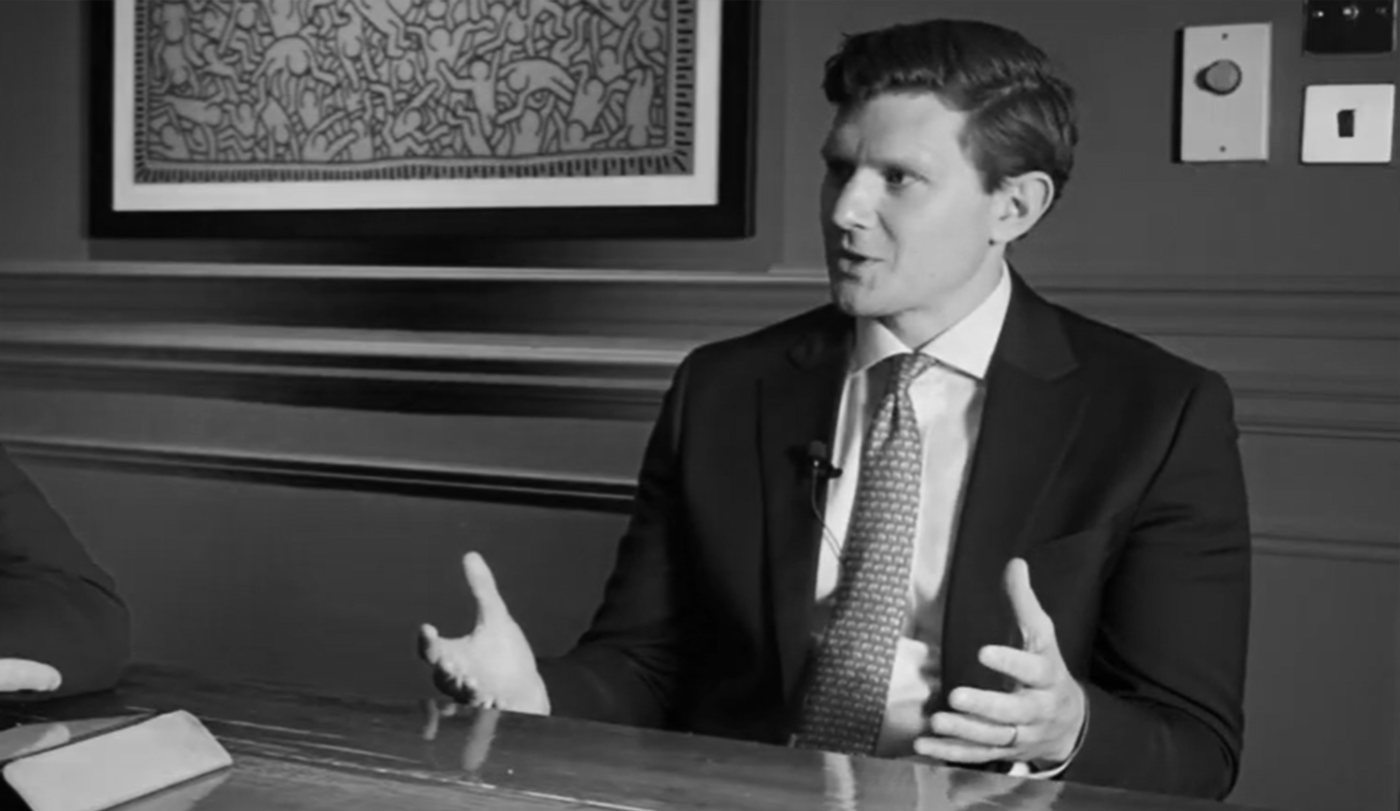
Wealth managers may be constantly on their guard against ‘style drift’ in the funds they hold but, argues One Four Nine Portfolio Management CIO Bevan Blair, they should also be conscious of the opposite risk in their own investment approach. “You can become too style-biased in your own manager selection and you need to be broader in that,” he tells Wealthwise editorial director Julian Marr in the latest Choice Words video above.
“What excites us as investors is active managers who have a really good long-term thesis and stick to that – but we have changed our view and the way we look at active managers down the years,” he continues. “In an environment now where weighted-average cost of capital is going to be substantially higher, you actually need to focus on bits of the market where there are more dependable cashflows – and at the short end rather than the long end.”
That is not to do down quality growth as a style, he adds quickly, but more to highlight the need to focus more on the value of a company. “It comes back to Ben Graham, to be honest,” Blair continues. “Find a company, understand its intrinsic value – in your paradigm – compare that to the market, give yourself a ‘margin of safety’ and then you can invest in that company.
When there are different voices in the room, different outcomes happen – so we just sell straightaway if a manager leaves.”
“It is not value investing per se – but, at higher discount rates, you need to be much more cognisant of where growth is coming from, how it is going to be delivered and what a business’s economic moats are. Certainly, AI is disrupting the economic moats of companies that, just three or four years ago, we thought were always going to be ‘bomb-proof’ – and they are not anymore because of evolving technologies.
“So we are shifting – and have shifted – our portfolios around to focus more on companies that pay dividends. Income is very, very important because ultimately, as an owner of a share in a company, you have to value that on the cashflows. And, as an investor, the only cashflow you get is a dividend – and even then, that is not guaranteed.
“So now we are trying to find those managers – because we are fund of funds – that embrace that ethos. It is not throwing quality growth completely out – because there is still a place for that in portfolios – but I think you need more style diversity and, if you are looking at that quality growth space, you need to have a valuation discipline in that. That is just good management for the client.”
‘Different voices’
As for what might make him reconsider owning a fund, Blair picks out changes in both manager outlook and personnel. “For me, ‘red flags’ in terms of a fund, are either a departure from what a manager stated they were going to do, or a re-evaluation of their investment philosophy,” he says. “In fact, it is not really even a change in investment philosophy but a change in a statement of their investment outlook – their investment journey.
“The other thing is, looking at funds, you do tend to buy process and philosophy – but that is almost always uniquely driven by the people at the top. Even if it is a team-based approach, the managers at the top set the culture for the underlying staff in their team who are working to deliver the returns.
“And, if those people leave – or even if some of them leave and some of them stay – there are going to be different voices in the room. And when there are different voices in the room, different outcomes happen – so we just sell straightaway if a manager leaves.”
A full transcript of this episode can be found after this box while you can view the whole video by clicking on the picture above. To jump to a specific question, just click on the relevant timecode:
00.00: What excites you about the current investment outlook? What worries you?
07.04: What do you most look for in an individual investment? What constitute ‘red flags’?
15.18: To what degree should professional investors be thinking beyond so-called ‘traditional’ investments? Towards what?
18.35: What drives your approach to client communications? Should professional investors aim to attract the ‘right’ type of client?
20.45: How would you explain risk to someone who does not work in investment?
23.13: What was your path into investment – and, if you hadn’t taken it, what do you think you would be doing now?
26.01: What is the biggest investment mistake you are prepared to admit to – and what did you learn from it?
30.20: Outside of work, what is the strangest thing you have ever seen or done?
32.22: What advice would you have given your younger self on your first day in this business?
33.24: Two Choice Words recommendations, please – one a book; one a free choice?
Transcript of Choice Words Episode 44:
Bevan Blair, with Julian Marr
JM: Well, hello and welcome to another in our series of ‘Choice Words’ videos, where we get to speak to the great and the good of UK fund selection and UK fund research and find out what makes them tick. I am Julian Marr, editorial director of Wealthwise Media, and today I am delighted to be talking to Bevan Blair, who is CIO at One Four Nine Portfolio Management. Hello, Bevan.
BB: Hello, Julian. Thanks for having me.
JM: Let’s head straight into the first question – although, ‘It is our pleasure to have you’ is what I should have said and then carried on from there!
BB: My pleasure!
JM: Excellent. What excites you – apart from being here! – about the current investment environment? And what gives you pause for thought?
BB: In terms what excites me – and it is also what scares me – it is the rise of AI. I think that has been a tremendous boon to markets over the last, well, four years since really we got those first models. But the excitement is tempered by a reticence because I don’t think any of us really know how this technology works or what it is going to mean going forward.
We are only four years into the first ChatGPT – it was December 2022 when that came out – and I did not really understand what the effect was going to be long-term on company profits and on the economy and what that means at a societal level as well. And that is the bit that scares me because companies are talking about productivity gains they could get from it and we are seeing earnings increasing – or, at least, the belief earnings will increase – on these productivity gains but we don’t quite know what they mean by that.
And is that actually a loss of human labour from the work pool, which I think is a real societal problem we are going to have to address at some point? I know people have talked about maybe we can have guaranteed minimum incomes or something like that to address that – but there is clearly a pivot point around a change in the labour force and what the labour force can do.
And I still think we are really grappling with how we use these technologies and what these outputs actually look like from the input we give them. So I do think it is a massive opportunity. And we have seen that in markets where anything AI-related or anything around computing power has done very, very well on the equity side – and a lot of other stuff has been left behind.
So there is that opportunity but I have to temper that with the caveat that, actually, the market may not get the gains it is expecting and therefore we could see – and we probably are in – some kind of bubble around that now. But how and when that bursts – that is the $64m question, which I don’t think anyone can answer particularly. But unfortunately I tend to focus on the downside rather than the upside in everything we do …
JM: I have noticed that!
BB: I think that is always tempered by where you start your career – and I started my career in February of 2000, straight out of university. Now, in New Zealand, I could do 10 years at university so I was a little bit older than the typical 22-year-old grad – I was nearly 30 – and it was right at the top of the dotcom bubble.
And, at the time, that was a very nascent technology where we didn’t quite know who the winners and losers were going to be and it took a long time for us to discover that – well over a decade, if not more. And of course, everything got bid up. You remember Pets.com – the penny share in the US that got bid up to crazy levels and then just collapsed.
Now, I don’t think this current AI bubble – in inverted commas – is like that dotcom frenzy in the late 1990s and early 2000s. I don’t think it is that because there is some underpinning of earnings from those companies at the front of it coming through – although, admittedly, the two biggest ones are still private. Let’s wait till Anthropic and OpenAI come to market and actually have proper price discovery and analysts can pore over their balance sheets, their earnings and everything they talk about.
But I think it is different this time – and yet there are similarities as well. And of course, what happened with the dotcom bubble was the market wobbled at the sort of ‘Nasdaq end’ and it took a while for the main market to then wobble as well. Then we had other things coming through that exacerbated that – terrorist attacks, accounting scandals and whatnot – so we had three years of just relentless down-markets.
And you forget the S&P500 dropped 50% from its peak in December 1999 to March 2003, when we had a war to bolster it up! Unfortunately, wars this time don’t seem to be doing the markets any good! And I will come to that because that is the thing that really scares me about the investment environment now – the effect of this ongoing conflict in the Middle East.
So I think there are differences now to back then but we need to be very cautious around that. Valuations are at all-time highs by any measure – ‘Cape’ ratios or whatever – and it doesn’t matter which jurisdiction you are in. The US, the UK, Japan and emerging Asia, relative to their own history, are at very elevated levels, which means actually you have lower expected returns for equities going forward – unless AI does deliver the productivity gains and the earnings growth the market is expecting.
Now markets don’t work like that, unfortunately – markets don’t work on the fact that prices are going to stay stable while they let earnings catch up. It never works like that. Prices will come down, even as earnings catch up – and that is when the bubble might pop.
JM: Well, I will be honest, Bevan – we have had more upbeat starts to these chats! But, of course, I cannot deny the reality of what you are saying. It is very grounded and has set a picture – and the only way is up! No – I know what you are saying and I completely agree.
When the voices in the room change
JM: Let’s drill down from your macro view to when you look at individual investments – what are you looking for? And what do you see as red flags?
BB: What excites us is active managers who have a really good long-term thesis and stick to that – but we have changed our view and the way we look at active managers down the years. I think you can become too style-biased in your own manager selection and you need to be broader in that.
And I think, in an environment now where weighted average cost of capital is going to be substantially higher than we have enjoyed from 2010 to 2022, you actually need to focus on bits of the market where there are more dependable cashflows – and those are more dependable cashflows at the short end rather than the long end.
That is not to do down quality growth but it is this idea of ‘it doesn’t matter what valuation you pay for a company, it is all about the growth and potential growth and earnings’ – I think now, in a higher weighted average cost of capital environment, you need to discount that back. So you need to focus more on the value of the company.
It comes back to Ben Graham, to be honest: you know, find a company, understand its intrinsic value – in your paradigm – compare that to the market, give yourself a ‘margin of safety’ and then you can invest in that company. And I think that is coming back – it is not value investing per se because people sometimes get value investing mistaken with just ‘buy any old rubbish at low valuations and we can go’. There are value traps – there are all sorts of things around that.
But, at higher discount rates, you need to be much more cognisant of where that growth is coming from, how that growth is going to be delivered, what those economic moats are – and I will come back to AI here. AI is disrupting some of those economic moats of companies that three or four years ago we thought were always going to be, just bomb-proof – and they are not anymore because of evolving technologies.
So we are shifting – and we have shifted – our portfolios around to focus more on companies that pay dividends. Income is very, very important because ultimately, as an owner of a share in a company, you have to value that on the cashflows – and, as an investor, the only cashflow you get is a dividend. And even then, that is not guaranteed.
So, yes, you can participate in growing earnings and, yes, if the company reinvests those earnings at a better rate than you could reinvest yourself, that is a good place to be – but in this higher discount world, that is a tougher decision to make and tougher choices to make.
So now we are trying to find those managers – because we are fund of funds – that embrace that ethos. It is not throwing quality growth completely out – because there is still a place for that in portfolios – but I think you need more style diversity and I think that, if you are looking at that quality growth space, you need to have a valuation discipline in that. That is just good management for the client.
JM: Sure – thank you. And the flipside of that – the ‘red flags’?
BB: ‘Red flags’ for me, in terms of a fund, are either a departure from what they stated they were going to do, or a re-evaluation of their investment philosophy – indeed, it is not really even their investment philosophy. It is a statement of their investment outlook – their investment journey – if that changes …
I will give you an example. Years ago, like everyone else, we invested very heavily with Neil Woodford at Invesco – and then, when he moved out on his own, we invested with him again. He was a great manager. And he always said, Look, I am trying to achieve between 7% and 9% long-term growth in my portfolios – and that really resonated with us because one of the things we look for in a fund manager is to grow the wealth of a client.
It seems anathema – surely everyone is trying to grow the wealth of a client – but, actually, managers who just try and beat the market? That is not good enough for me. It is that, long term, they want to make you richer – slowly but in a sort of measured way – and that was always Woodford’s stated aim.
Then I remember him coming into the offices – this must have been 2017 or thereabouts – and he had changed that objective. That objective had gone from high single-digits to low double-digits – and that, to me, was a big shift. Now, maybe that was driven by his view that certain biotech and technology stocks were a growth engine and he was pivoting towards those – I can get that. You can do that – but this was a real change in the stated aim and objective of what the manager was trying to do. And so, when those objectives and aims change, that is something we see as a red flag.
The other thing for me is, looking at funds, you do tend to buy process and philosophy – but that is almost always uniquely driven by the people at the top. Even if it is a team-based approach, the managers at the top set the culture for the underlying staff in their team who are working to deliver the returns. And, if those people leave – or even if some of them leave and some of them stay – there are different voices in the room.
And when there are different voices in the room, different outcomes happen. So we just sell straightaway if a manager leaves. We had that last year, when the two managers of First State Asia Pacific Leaders left the fund – we sold it pretty much that day. We still monitor it – still think it is a very good fund, a very good team, a very good house – but the voices change in the room and so you have to go back and completely re-evaluate that. Even if it takes time for those voices and the portfolios to change, that would be a red flag.
JM: That is really interesting – I love the idea of the ‘change of voices in the room’.
No ‘magical excess return’
JM: Let’s switch slightly now to alternatives, however you want to define that – to what degree do you think investors – and, by extension, those advising them – need to be thinking beyond traditional investments?
BB: You are talking to the wrong person about alternatives – we have no alternatives in our portfolios. I am fundamentally of the opinion that if you cannot generate enough return and grow wealth for your clients from the ‘old’ building blocks of cash, long-only bonds and long-only equity, you are not going to somehow generate some magical excess return over those. They are the foundations of financial markets. They give you a very good return – and it becomes very difficult.
Now you could buy – and I have done it in the past – you know, Ucits-style hedge funds, alternative investment stuff – and you know what? They have all underwhelmed every single time. Take the huge HFRX Global Hedge Fund Index, which measures hedge funds around the world – and I include the Ucits alternative strategies one might buy in those – since 2005, that has struggled to beat cash. After fees, admittedly, but you are paying very large fees to only generate a tiny bit above cash – maybe 0.5% to 1%.
Now, don’t get me wrong – there are idiosyncratic individual managers who have shown they can, from time to time, do very well. The problem is, their returns are lumpy. And ultimately, who is my client? My clients are people sitting around the kitchen table like me – you know, they do not have huge amounts of wealth. And then you are asking them to put their faith in you investing in complex financial instruments – where they don’t need that complexity and where you can generate returns just as well from bonds, cash and equity.
And we have done so over the last six or seven years at One Four Nine. So I just don’t think you need it now. You can go into other areas – you could talk about property or you could talk about private equity, private credit, commodities, gold … If I look at those first three, they are illiquid asset classes. They are asset classes you need to hold for the very long term – longer, actually, than most people’s investment horizons … or lives.
And I don’t think the liquidity profile they give and the excess returns they give are worth the investment in there. As for gold, that is just a punt, in my opinion. So we don’t do alternatives – we think we can generate decent returns without them. They can offer some diversification occasionally but, again, they have failed to deliver on that, in my opinion.
JM: Well, you say you re the wrong person to speak to but it may be, in a few years’ time, we look back on this and find out you were exactly the right person to have spoken to. Which, oddly enough, does take us on to the world of client communications, which you were very expressive around there.
Staying in lane
JM: So what is the One Four Nine approach to client communications?
BB: Look, our clients ultimately are IFAs – not the underlying clients. We work on an agent-as-client basis so, for me, it is communicating with the financial advisers – and our financial advisers are internal, so they have access to me 24/7, which is a real selling point for them, I think. So the aim is to give them comfort and to give them enough knowledge and teaching materials to go out and talk to their clients.
We will occasionally talk to the underlying client and I will only ever do it with the financial adviser – because that is where the relationship sits. I see myself as ‘an arm’s-length guy’. I am running five risk-rated portfolios in an MPS and we have thousands of clients in each of those portfolios. Every one of those is an individual but they have completed a risk assessment – the financial adviser knows them intimately – and so we are just trying to deliver a portfolio that meets their risk needs.
And so we spend a lot of time talking to our own internal financial advisers. We have monthly calls with them. We write stuff for them. Importantly, when we do a rebalance of portfolios – we have just done a big one – we spend a lot of time walking them through what the changes to portfolios are. Because those clients who do look at their portfolios on a regular basis – and it is only a small proportion who do – will see those changes. So it is important the financial advisers are armed with the information to talk to them. But we are not doing mass-communication to underlying clients.
JM: No – you are staying in your lane, which is probably no bad thing.
Risk as loss
JM: Sticking with comms, how would you explain risk to someone who does not work in investment?
BB: Risk is loss. We have lots of different terms for risk in our industry, right? And I did my PhD in volatility modelling – you know, risk modelling – and the minute I say that, I get eyes glazing over!
JM: Well, maybe we will save it for a future interview!
BB: Yes! But, look – risk is loss. No-one picks up the phone when markets are going up – and you are still running the same level of risk. When market goes down, everyone picks up the phone – why have I lost 10%? And the only way you can explain to the person around their kitchen table, who has made you a cup of coffee and given you a digestive, is to say, Right, if your portfolio fell by 15% – you know, if your million-pound pension fell by 150 grand – how would you feel? And they go, Oh, OK. That is risk.
Risk is loss. Whether that be permanent or transitory – because markets will go up and down, you cannot control them and you know you will have those short-term losses. Hopefully, you can make them back. You want to avoid that permanent loss of capital – that is certainly clear – but you couch it in terms of risk. So we manage our portfolios to a value-at-risk – how much could we potentially lose over a certain period of time? With what probability?
Technically, we call it a shortfall probability and a shortfall return – but we would not use those concepts with an underlying client, for whom it is probably just jargon, jargon, jargon. It is gobbledygook – and we don’t want that. What we want to say to them is, Look, risk is loss and loss is two things: it is the willingness and the propensity – and the FCA is very clear on that.
You might be willing to lose a lot but you cannot afford to lose a lot. So those two things always pull at each other but it is talking about, Well, in a year, if I came back and said your portfolio has done this, how would that make you feel? Oh no, I wouldn’t like that – that would scare me. Right – then we need to reduce your risk and reduce your propensity for loss or your willingness. It might be higher, it might be lower – but it is loss. That is how you explain risk.
‘Big Bang on Steroids’
JM: Very good. A more personal question now – or a couple in a row. You mentioned a PhD so I am guessing that might be involved – but what was your path into investment and, in an alternative universe, if you had not taken it, what do you think you would be doing now?
BB: I think, fundamentally, I always wanted to be in investment – even as a teenager. I was born in the early 1970s so I was doing my equivalent of GCSEs in 1987 in New Zealand, when the stockmarket crashed. That was a big thing – in fact, the New Zealand market has never recovered from that peak in 1987. That is 40 years ago – it has never recovered from it.
And when I was 12 or 13, we had a new government come in and, while you had the ‘Big Bang’ in 1986 here in the City, in New Zealand we had ‘Big Bang on Steroids’, moving from huge capital controls. I remember my dad coming to the UK in 1984 and he could only take out 200 New Zealand dollars – that was all he was allowed to take out of the country – and then it changed to pretty much unfettered, unregulated free flow of capital from New Zealand. The stockmarket went right up – and then it crashed.
But, of course, I was 15 or 16 around then and I thought, This looks fun! I started reading the financial papers and whatnot – and I was really interested in mathematics and statistics. So I did a Mathematics degree at university, but with some economics and finance in it, and then as I progressed through my Bachelor’s degree into my Honours, into my Masters, I narrowed down the area of finance I wanted to study, which was volatility.
That was really the main thing and I think that interest was piqued round about that crash in 1987 – how markets can really fall, what the effect of that is and how we can model that. So whether I wanted to be doing asset management like I do today or something else, I don’t know – but I think always wanted to do something in economics and finance with a statistics and mathematical bent.
JM: No alternative universe then?
BB: Not really, no. I mean, maybe in an alternative universe, I could have been an epidemiologist. I suppose it would have been statistics-applied too. And when Covid hit, I was looking at all the modelling they were doing because I understand the statistics and the stuff behind that – because, when you do a statistics degree, there are lots of broad techniques you can apply to many different data-sets. But it was always statistics – but applied to economics and finance. That was always the thing that really interested me.
The illusion of liquidity
JM: Nice twist. What is the biggest investment mistake you are prepared to admit to – and what did you learn from it?
BB: Right – so just after the Great Financial Crisis, in 2009/10, obviously there was a period where inflation was starting to come back again and it looked like central banks were cutting rates. We then had the eurozone crisis in 2011 – and Greece was almost about to default. At that point, we decided what we really needed in our portfolios – I say ‘we’ but I was part of the collective at the firm I was working for, Ingenious Asset Management; we all agreed on this – was two things.
We wanted inflation protection in portfolios and so we bought index-linked gilts – really long-duration index-linked gilts, because we did not really think about duration risk. Now, that kind of worked out because rates continued to come down – but, allied to that, we felt that sterling was going to come under real pressure and that we wanted commodity-producing countries and we wanted exposure to their currencies. So we bought Norwegian-krone bonds, Swedish-krone bonds, Singapore-dollar bonds – basically, as a bet against the UK.
That was not a big loss but it never worked out because, while the thesis was right – that these were countries operating trade surpluses, the UK was in a trade deficit and sterling would come under pressure against those currencies – what we didn’t factor in was the propensity of central banks to come in and absolutely destroy our thesis. So we put the trade on and what was the first thing the Norwegian central bank did? Raise rates – and then it all worked against us. The value of the bonds fell and then people were getting worried about the currency as well.
The other learning I had over that period, which I think is more prescient today, was like a lot of other asset managers in the early 2010s, we had an allocation to commercial property in our portfolios – and it was an allocation to open-ended funds. Look, we were in some of the big ones and they were all very good – and, when Brexit happened and they all shuttered and gated because everyone was wanting to pull out of commercial property in the UK, we realised that was actually a sort of ‘false’ investment.
We felt we were in these open-ended, daily-dealing funds that bought bricks and mortar – and bricks and mortar are not easily tradable and they are not very liquid. And the best thing I ever learned from that is you can never be more liquid than the underlying – and these funds just gave you the illusion of liquidity, through either operating large cash balances or buying property shares.
They are very different things – you know, a property fund that had 30% in cash to give you liquidity and 70% in property was only a 70% play on the asset class you wanted exposure to. Now, because of the way they priced and how they did it, yes, they had mathematically low correlations and no volatility … until they didn’t – until you couldn’t get out of the things. And that ‘liquidity trap’, as I called it, was one of my biggest learnings.
So then we thought, right, we will go into closed-ended funds because at least they are tradable. And they are tradable – but, when the market is at stress, they trade at a significant discount. And that is not where you want to be either. So I just walked away from any kind of real asset or commercial property and today, where we do have real assets and commercial property in the portfolios, it is via listed securities and we treat them as equity rather than anything else.

North courier
JM: Everyone’s favourite Choice Words question now – outside of work, what is the strangest thing you have ever seen or done?
BB: Yes … I saw this question – and it is a family show, right?
JM: It is.
BB: When I was at university, I spent three seasons in Scotland as a ‘ski courier’, which was quite fun.
JM: At Aviemore or something?
BB: Yes – Aviemore and Glenshee and some of the others. I had met this Scottish guy – this was the mid-1990s – and he would get busloads of people from Basingstoke and Reading and round London and he would organise a weekend of cheap ski holidays in Scotland. They would catch a bus at 4 o’clock on a Friday morning – and I was studying at Lancaster University on the M6 at the time.
So they would come into Lancaster about midday to pick me up – and I was the bloke on the microphone for the weekend. I would have a list of all their names, they were put in ski groups and I would go around, introduce myself, tell them which group they were in, which hotel they were staying at, what the weekend was going to look like and so on. I was their point person.
It was great fun because we would get to the hotel, the next day they would get their skis on and away they would go – and I would either sit on the bus or go skiing myself and I would get the princely sum of £40 for the weekend. That was a lot back then – it paid for a lot of beer down the student union, I can tell you that! This was before cheap flights to Europe, right? This was sort of skiing to the masses – but it was real masses …
JM: Yes – I am not going to ask you to define that!
Stay humble
JM: Just two more questions left and the first is a quick one – what advice would you give your younger self on your first day in this business?
BB: Don’t get hung up on short-term performance – that is really important. Try and look through that noise. In my early days, we were hung up – when I was working on the institutional side, we would be going in and saying, Oh yeah, we outperformed by three basis points yesterday or five or six. You know, you can lose that easily in an hour, in a day.
That short-term nature of it, it is hard to ignore – really hard – but you just have to try to ignore that because you need to set out your investment store, your philosophy, and you have to believe it is going to work out. You will not get everything right – you will get things wrong – so, also, be humble around that. Just admit to mistakes, learn from them and move on – and say to people, Look, I don’t get everything right all the time.
School of hard Knox
JM: Very good. Last question, then – we call this series ‘Choice Words’ because of what you do professionally but now we are looking for two personal choices. One is a book – it can be investment but does not have to be. The other one is a free hit – and we have done 40-plus of these now and there have been some weird and wonderful choices. Still, apart from a weekend skiing in Aviemore, what would you recommend?
BB: I mean, there are all sorts of books but I will stick to investment books. I am a big fan of Robin Wigglesworth, the FT journalist, and he has literally published a book – just last week – called A Fabulous Debt. I am only halfway through it but it is a history of the bond market from the 12th Century through to today – how it has evolved, how it has changed. What I like about how he writes is he tells it as a story. It is not technical so anyone can pick it up and read it, he really writes at a good clip and it is fascinating because it builds in all sorts of history.
The other one he wrote was called Trillions, which was all about the passive investment market and its rise. And what has been fascinating around that is not that the passive investment market has risen because, looking back, you can see there is a natural home for it – given all the academic literature would say an average active manager cannot outperform the market, particularly in the US. But actually, it is the stories behind a lot of the M&A and the dark stuff that goes on between some of these companies and what they do and how they bought each other out – and how the passive managers themselves are very active. I think those two books written by him are absolutely superb.
JM: And a free hit?
BB: A free hit – look, I am a big music fan and ‘more eclectic’ would be my music taste. So when I was growing up as a teenager, I only listened to New Zealand garage independent music. I eschewed anything like Guns ‘N’ Roses – that was complete anathema to me – which really set me apart in New Zealand, actually. So my ‘free hit’ would be that you need to check out a band called The Tall Dwarfs.
Its lead is a guy called Chris Knox, and he is the most avant-garde person I think you could ever meet – as well as the most opinionated person you could ever meet! Unfortunately, he had a stroke about 15 years ago, so he cannot quite reach the peak he had but, if you listen to his back catalogue – and it takes a bit of time to get into it – I would highly recommend that. It is all on Spotify. This is not the BBC so …
JM: Yes, other streaming services are available!
BB: In 1984, he released an album called ‘Slugbucket Hairybreath Monster’, which sort of shows you the type of person he is!
JM: No, that is fantastic – and it could have done for your strangest thing as well, perhaps! This is why we ask these questions – to cut to the heart of what our audience needs to be looking at. Slugbucket hairybreath monsters and the rest – this is why I do the job I do! Actually, I thought you were going to pick Split Enz or something like that – but no, it is The Tall Dwarfs.
BB: Split Enz – I am surprised you even know them!
JM: Well, I try and be eclectic too – I just cannot remotely match you! Bevan, thank you for this wide-ranging conversation – peaking, I think, right at the end! And thank you so much for your time today.
BB: Thank you so much for having me, Julian.
JM: It has been a pleasure. And thank you very much for watching. Rush off to Spotify now – or else just please do look out for further ‘Choice Words’ videos as and when they are published.