


The rise of model portfolio solutions (MPS) investing has been quite extraordinary over the last 10 years – and particularly so over the last five.
Since the Retail Distribution Review (RDR) at the end of 2012, advisers have accepted they are not necessarily in the best position to be managing clients’ portfolios. Indeed, it has been generally acknowledged this element of financial planning should be left to dedicated asset managers – albeit with some exceptions, such as where larger nationals and networks have the resource and expertise to run their own asset management arm.
Looking at the different outsourcing solutions, we now see multi-asset funds and discretionary managed portfolios as the main options but this has not always been the case. Multi-asset funds have been around for decades, although some have been through a couple of unofficial re-brands – originally ‘funds of funds’, then more commonly known as ‘multi-manager’ and now widely known as multi-asset.
By the time the RDR was implemented, then, multi-asset funds were to some extent already an established market and well-known to advisers. Of course, discretionary management has probably been around a lot longer than funds, though not so much MPS as an outsourcing solution.
It is only since RDR that discretionary MPS investing has started to gain some traction as advisers looked for an alternative to funds as an outsourcing solution. By the time of the RDR, multi-asset investing in funds was already a popular option for advisers so, with the added boost of advisers now being encouraged to outsource, the penny finally dropped with discretionary managers there were significant assets to capture.
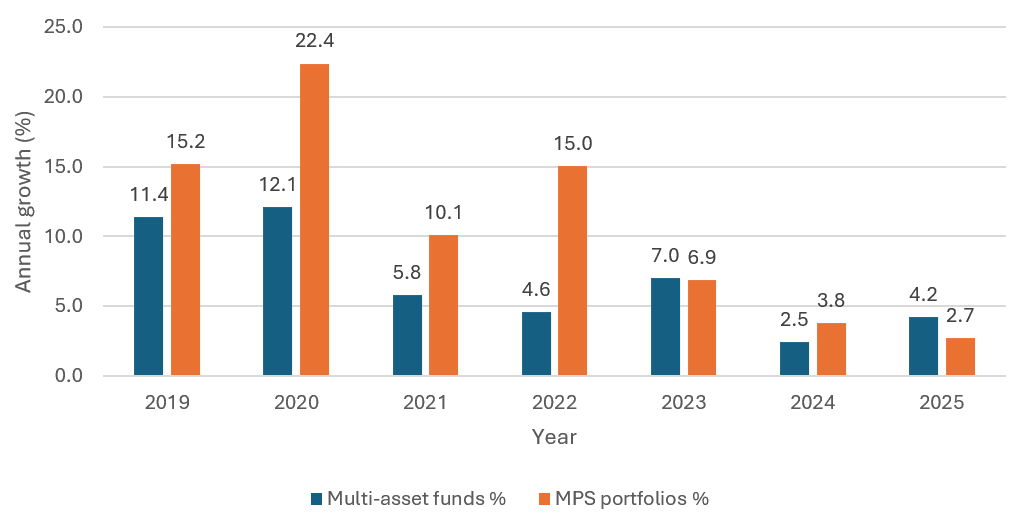
Fund and portfolio launches are quite a good indicator of where the industry sees support – in particular from advisers, who to some extent lead the demand. The following chart indicates launches of multi-asset funds versus MPS portfolios over the last seven years.
Universe growth has slowed on both sides – MPS expansion has cooled sharply
“There will always be market, technical or regulatory reasons why multi-asset funds or MPS portfolios – or both – will take a pause for breath.
Source: Defaqto
Bearing in mind that multi-asset funds were already an established market, it is still clear from the above – especially during the four-year period up to the end of 2022 – that the focus was very much on the creation and expansion of the MPS market.
We should of course bear in mind that a significant proportion of fund managers will already have multi-asset funds in the market – and those that do not have started to bring propositions to the table. It does seem as if the heyday of portfolio launches is behind us – for now. Is this symptomatic of a stalling of interest in the outsourcing market? Or, as seems more likely, are both sets of players considering themselves as established, with just a few latecomers bringing options to market?
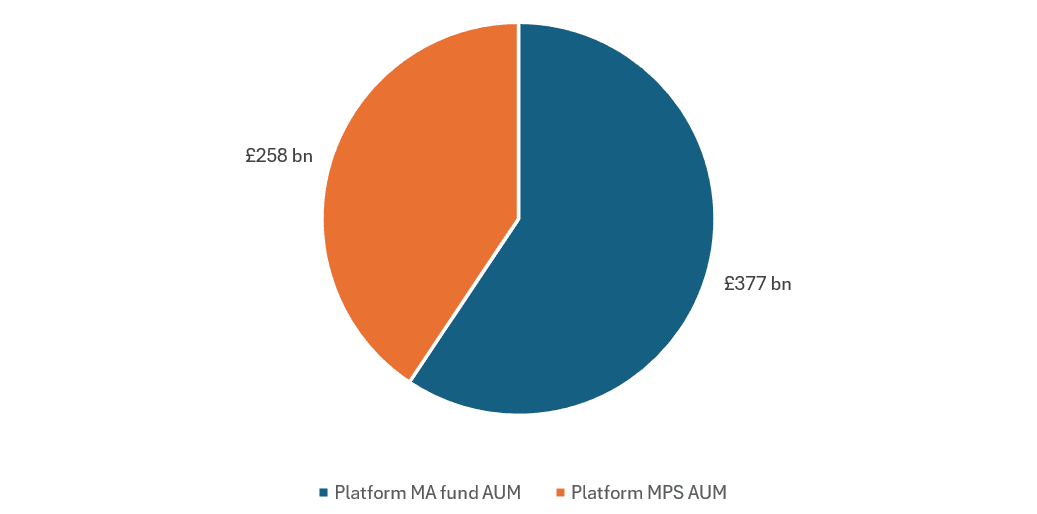
Our next chart illustrates how that expansion of portfolios has aligned with the split of assets under management on UK platforms.
Size of the UK platform multi-asset market
Source: Defaqto
It shows almost exactly a 60/40 split in favour of multi-asset funds. Given MPS started at pretty much zero at the time of the RDR in 2012, this is impressive. A year ago, furthermore, the split was 65/35 so, on the face of it, MPS continues its march.
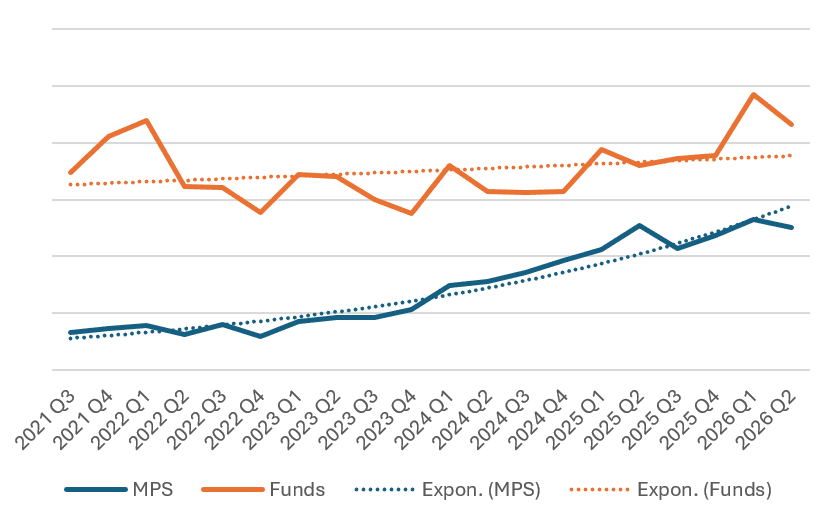
Having looked at the number of propositions and distribution of AUM, the next chart shows the trend in recommendations by value, quarter by quarter over the last five years through Defaqto Engage, the adviser research software used by more than 30% of advisers in the UK.
Recommendation value as a percentage of total recommendations
Source: Defaqto
What we see over the most recent quarter (Q2) is a bit of a cooling off in recommendations for both multi-asset funds and MPS portfolios. Look more closely, however, and we can see multi-asset fund recommendations over the last year have been keeping pace and at times exceeding, those into MPS portfolios.
So what has been going on in the multi-asset market? The key is likely to be how well-established each market is. What do I mean by that? Well, the multi-asset funds market has been a significant part of the outsourcing landscape for several decades – well before RDR implementation – so has had the advantage of existing traction with advisers.
There has been nothing short of a tsunami of MPS portfolio launches over the last 10 years as interest from advisers has led to discretionary managers all wanting a piece of this outsourcing pie. What we are left with, however, is an established multi-asset funds market and a MPS portfolio market still finding its feet as the next pair of graphs indicate.
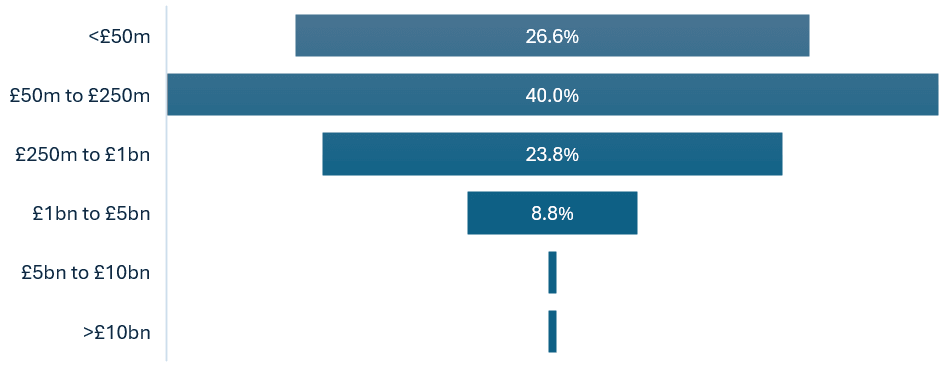
With £50m to £100m generally seen as the line of profitability for funds, the fund sizes in the multi-asset graph (below left) are broadly what you would expect from a more established market. The 27% or so sub-£50m generally represents newer funds or those whose performance has made it difficult to gain traction. Whereas, when we look at the MPS portfolio distribution (below right), this has a different shape altogether.
Platform multi-asset funds (left) and platform MPS (right) – AUM distribution
Source: Defaqto
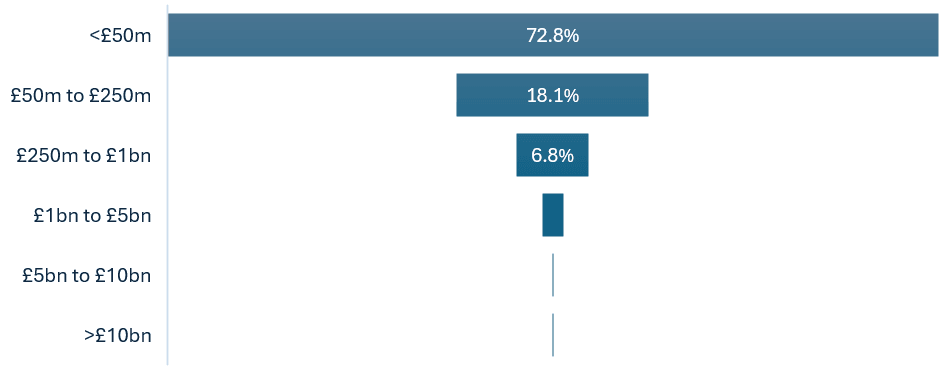
This latter distribution shows the majority of portfolios are sub-£50m in size – the main reason being that most portfolios are relatively new, which means many have limited performance metrics to support them. Launches have come over a relatively short period of time, with over 30% of platform portfolios created in the last five years – and into an increasingly crowded market – making competition very tough.
The obvious question remains, Will we see consolidation in the MPS market? There may be some – yet this question has been asked in the wealth world for as long as I can remember and the number of funds over time still continues to grow. While there will undoubtedly be some consolidation, we do not see the numbers of MPS portfolios dropping by any significant amount.
We are all waiting for the outcomes of the eagerly anticipated regulatory review of the MPS market, which we discussed in more detail in Checks and balances. And we can speculate that MPS investing is to be brought in line as much as possible with the very structured and legally bound funds market.
With the Rathbones review by the regulator identifying several shortcomings that will be costly to put right, it is likely all DFMs will be given pause for thought – and, inevitably, advisers will be wondering what it is they do not know. This uncertainty may also have contributed to a hiatus in support.
Ultimately, despite a slight pause of late, the outsourcing market continues to go from strength to strength in terms of AUM. There will always be market, technical or regulatory reasons why multi-asset funds or MPS portfolios – or both – will take a pause for breath, with one type of solution usually holding sway over the other.
We would suggest that, in a year’s time, we will see assets for both will have grown further. We would also expect, in coming years, to see MPS portfolio size distribution of MPS portfolios begin to look more like that of the multi-asset funds. What does seem clear, though, is the two can live in harmony together in both CIPs and CRPs.
Andy Parsons is head of insight at Defaqto