


Here at Rancho Defaqto, we have had a growing number of discussions around thematic investment in the context of model portfolio services. It is certainly an interesting topic that warrants further and wider debate.
The thrust of many of the conversations has been: ‘Why do MPS portfolio managers invest so little in thematic funds?’ Of course, an important point to address from the outset is whether the data even supports that thesis – which is why the first thing we did was measure the overall percentage of thematic funds invested in MPS portfolios.
Before we go any further, though, let’s be clear about what we mean by thematic funds for the purposes of this article. There are some funds that invest thematically – that is, they invest in a number of researched and favoured themes, often for the long term – but we are not talking about these. There are also a very large number of funds that, on the face of it, could be described as investing in a macroeconomic theme – for example, utilities, infrastructure, climate change and so on. But, no, we are not talking about these either.
What we are referring to here are funds that invest wholly in a specific area of the market with industries focusing on solutions. Examples of this would include clean energy and the energy transition, cybersecurity and the digital economy, defence and security, healthcare innovation and biotech and water and waste. There are also a number of borderline funds, based on our definitions – but, in the end, it is about the breadth of the opportunity set.
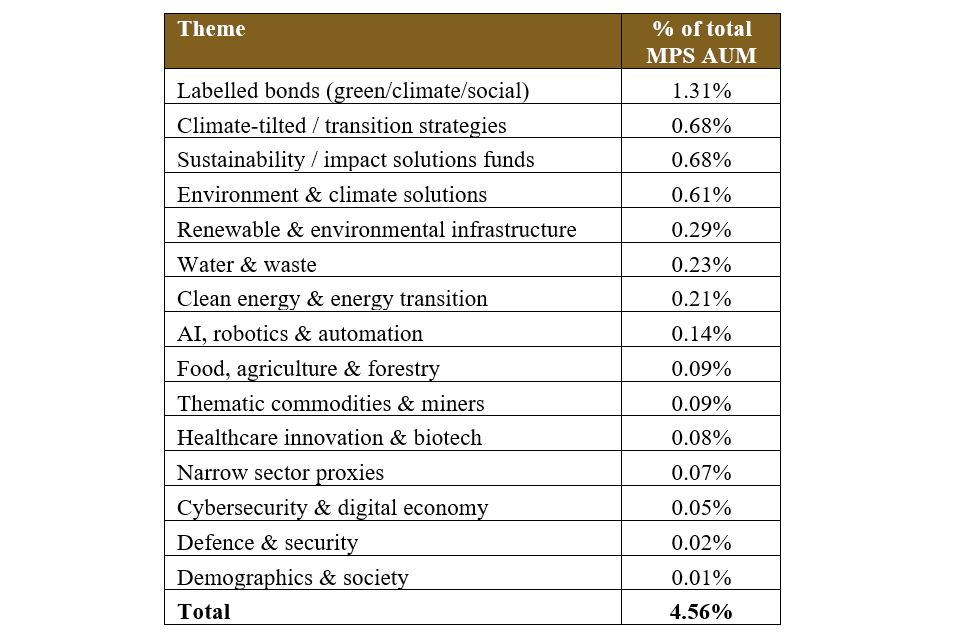
Again, there are some grey areas about what we would consider to be a focused thematic fund – but, for the purposes of this piece, we will allow some of the borderline funds. And, even allowing for those extra inclusions, the table below does support the argument that thematic funds do not make up a significant proportion of the underlying investments held within MPS portfolios:
“Total MPS investment into themed funds is less than is invested overall by MPS in just the top three non-themed funds – which, incidentally, are all trackers
Source: Defaqto
As you can see, less than 5% of the total AUM held in MPS portfolios – both platform and direct, and in the more than 2,000 portfolios where we have full visibility of underlying holdings – is invested in thematic funds.
Furthermore, these investments appear only 150 times in total and, of course, there are some funds that will be investing in more than one theme. And, looking at green, climate and social bond funds, we see that 1.31%, is invested in an area that we would consider borderline under the category of thematic.
Another way to put this into context is to note that total MPS investment into themed funds is less than is invested overall by MPS in just the top three non-themed funds – which, incidentally, are all trackers.
Investment mandate
So why could this be? Superficially, it could be argued that active managers are always generally considerate of certain themes – in its broadest sense – depending upon considerations such as valuation. This would then beg the question as to why managers who may have potentially aligned with, say, a tech/AI theme are not usually prepared to invest in a fund specifically aligned to that theme.
The answer probably lies in a manager’s investment mandate. The portfolio managers are, usually, tasked with ensuring clients achieve their goals within strict risk parameters that are suitable for the individual client. Taking a very focused position in a particular narrow theme could be considered taking unnecessary risk.
As a consequence, most MPS portfolios are fairly beige, with – we have noticed – increasing proportions of passive funds. The index funds themselves ensure diversification as well as keeping costs down. In addition, there is a certainty with more generalist funds and index funds that some of the more esoteric themes will be covered as a matter of course – possibly to quite high percentages, depending on market sentiment.
Which in turn begs another question – is there a need for specialist themed funds? Naturally, those who do invest in them would argue there is. There will, for example, be portfolio managers who feel strongly about a particular investment theme and may decide that index or generalist funds do not mirror the strength of conviction. In most cases, analysts are not going to be absolute experts in some narrow themes, so what better way to invest than to ‘outsource to an expert’?
Thematic managers
So who are these thematic managers? Of the 130 or so funds that have been selected by MPS portfolio managers across the 2,000-plus portfolios, 49 are provided by just seven asset managers. Here, iShares are at the top of the list with 15, while L&G are next with eight – all of these being ETFs. The first truly active fund manager on the list is Pictet, which provides seven funds.
Ignoring the ETFs for a moment, the biggest contribution to MPS portfolios from an active manager is the Regnan Sustainable Water and Waste Fund, which accounts for 0.145% of overall MPS AUM. While still a small percentage overall, it is actually more than L&G’s eight funds in total.
Of course, there is the flipside of the argument. Defaqto recently measured the on-platform MPS portfolio market as approximately £258bn so even 4% or 5% of that – call it £10bn – is still a good number to go at.
The question remains though: Why is there not more traction in this market? While we have hinted at some of the possible reasons – valid or otherwise – we are constantly being told the MPS market needs to innovate and portfolios need to differentiate themselves. Perhaps a little more diversification into themed funds could help to achieve this.
One final observation – it is only anecdotal but, as often as not, when sampling multi-asset funds, themed funds can seem to crop up more frequently.
Andy Parsons is head of insight at Defaqto