


The essential rationale for quality investing is well understood by UK fund selectors and other investment professionals – after all, in any global equity allocation, it makes sense to identify businesses with strong brands, high returns on capital, recurring revenues, resilient margins and capable management teams.
Sometimes, however, what is marketed as a quality investment can be too broad. Many quality funds own businesses that score well on certain quantitative metrics but are in fact less durable than they appear.
Companies with high margins, for example, may also be over-earning and attract more competition over time; those with high growth may be enjoying a cyclical high rather than durable long-term growth; and those that appear in resilient financial shape today may have already begun losing relevance with their customers.
Merely observing the traditional quality metrics can therefore be deceiving when trying to assess the durability of a business. Investors also need to think about whether these quality traits can persist and then be disciplined enough to react when early signs of business fade appear. This argues for a more discerning definition of quality, where selectivity, durability and valuation matter as much as headline financial metrics.
A more selective portfolio naturally raises the hurdle for inclusion – when only a limited number of companies can be owned, each investment must justify its place. This creates ongoing competition for capital and reduces the risk that holdings remain simply because they have historically been considered high-quality.
Furthermore, a discerning quality approach should begin with the business rather than the benchmark. That can mean accepting meaningful differences from an index and avoiding industries where outcomes depend heavily on commodity prices, regulation or financial leverage.
The focus instead is on resilient, well-managed and financially strong businesses capable of compounding value with a relatively low risk of disappointment. As the following table illustrates, the result can be a portfolio that looks meaningfully different from both the index and conventional quality strategies:
“In addition to the traditional quality investing approach of focusing on what makes a company good, there is also value in inverting this and thinking about what causes good companies to fade.
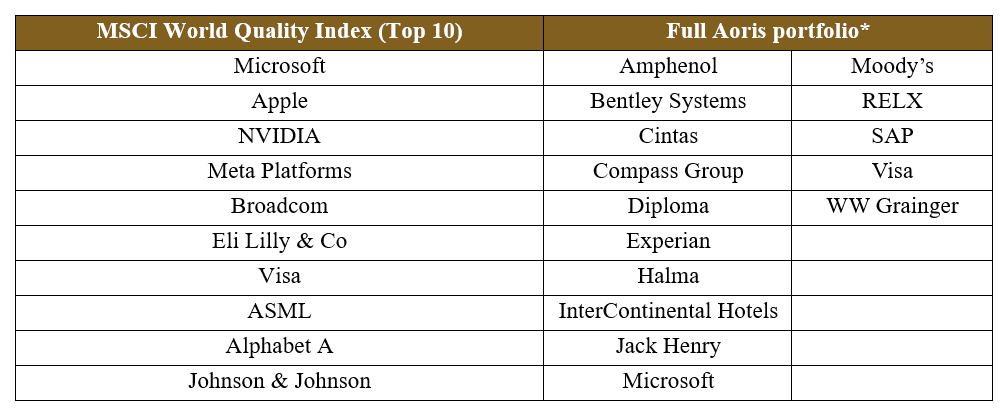
SourceAoris. *Holdings as at 31/08/26
A more selective approach also helps address an often-underappreciated weakness of traditional quality investing: assuming that quality is permanent. Customer relevance can fade. Competitive advantages can narrow. Growth can become more dependent on acquisitions. Management teams can become complacent. A brand that once seemed unassailable can lose connection with the next generation of customers.
The challenge is thus to identify deterioration before it becomes fully reflected in financial results – which makes selling discipline an essential part of true quality investing. Companies must continue to demonstrate improving competitive positions, customer relevance and financial strength rather than relying on their historical reputation. A previously exceptional business should not retain its place in a quality portfolio when evidence suggests its quality is beginning to fade.
Two pertinent examples here are LVMH and Nike. Both boasted many of the traits quality investors typically admire – and indeed both generated good returns for our own strategy. Yet both were sold from the portfolio when our assessment of their future durability changed.
LVMH was sold in October May 2024 after concerns grew that it was overearning and that its products had become over-proliferated post-COVID. For its part, Nike was sold in June 2023, after it became clear it made a grave error in removing supply of its products from third-party retailers, which coincided with heightened competition from new entrants into the sportswear market, such as On Running and HOKA.
A more selective quality strategy does not need to chase themes. It has the benefit of being able to wait for evidence in a business’s leadership position, growth, profitability and adaptability.”
In both instances, the selling decision was not driven by a short-term earnings miss – rather, it reflected a deeper reassessment of long-term business quality. Since we sold these positions, both companies’ quality attributes have faded and they have seen a 50%-plus decrease in share price.
These are examples of the importance of discipline in portfolios – illustrating that, in addition to the traditional quality investing approach of focusing on what makes a company good, there is also value in inverting this and thinking about what causes good companies to fade.
Quality’s valuation paradox
Valuation is another important distinction. After all, there is a paradox in a traditional quality investing approach in that, while quality companies are often popular, paying too much for a wonderful business can still lead to poor returns. This is especially relevant after periods when investors crowd into perceived winners.
Quality alone is not enough, therefore – the purchase price must also offer an attractive prospective return relative to a considered assessment of ‘fair value’. Growth and value should not be treated as opposites: the best investments usually require both – a business capable of compounding value, and a purchase price that leaves room for attractive returns.
The current enthusiasm for artificial intelligence is well worth considering in this context. AI may create meaningful opportunities for many businesses. Some companies will use it to improve products, serve customers better and operate more efficiently. Not every AI story, though, will translate into durable profits.
A more selective quality strategy does not need to chase themes. It has the benefit of being able to wait for evidence in a business’s leadership position, growth, profitability and adaptability. It enforces discipline in not buying into hype, while still allowing participation in genuine business improvement.
A selective, evidence-led quality allocation can also diversify the investment process within a broader global equity portfolio – behaving differently when markets favour highly cyclical industries, speculative businesses or a narrow group of perceived winners.
For investors already holding broad market exposure, that difference can be a feature rather than a drawback. For investors considering a quality allocation, meanwhile, the key question may be how rigorously quality is defined, monitored and valued over time.
Clinton D’Silva is co-head of distribution of Syndney-based investment manager Aoris, which recently made its strategy available to UK investors via a Non-UCITS Retail Scheme in the form of an OEIC