


To be considered a viable proposition by wealth managers in a space now dominated by multi-asset and model portfolio strategies, received wisdom holds investment trusts must be a certain size. Membership of the ‘Billion-Pound Club’, as it were, is increasingly viewed as commanding sufficient liquidity to satisfy even the biggest wealth management players – and yet, the reality turns out to be rather more nuanced.
Some factors remain unarguable. First off, investment trusts are not widely used in MPS – only around a third of portfolios include them. And where they do, they tend to be the largest trusts with the most liquidity – the likes of Polar Capital Global Technology, RIT Capital Partners or HICL Infrastructure.
In essence, investment trusts are difficult for conventional MPS because they exaggerate existing problems with rebalancing, platform availability and risk-rated portfolios falling out of sync.
It is the same reasons that many MPS groups curtail the use of ETFs. Equally, the wealth manager marketplace is seeing significant consolidation – Liontrust’s agreed acquisition of the Hawksmoor businesses being only the latest example. Other high-profile deals for Evelyn Partners, Invesco, Rathbones and Schroders Wealth have created larger players, who need bigger lot sizes and greater liquidity.
There has also been criticism of the ‘commoditisation of MPS’, with providers gravitating to the largest and most liquid funds – usually to the exclusion of investment trusts.
That said, the worst would seem to have passed for the investment trust sector. According to the AIC in its 2026 Ownership of Investment Companies report – which uses data from Argus Vickers – after two years of decline, investment trust ownership by wealth managers has stabilised.
The report shows wealth management firms held 24% of investment company shares on behalf of their clients at the end of 2025 – unchanged from the previous year and versus 27% in 2022 – while the value of their holdings ticked up from £49bn to £50bn. As the following table shows, Brewin Dolphin, Evelyn, Quilter Cheviot and Rathbone now hold a little over 10% of the investment company universe between them.
Top 20 wealth manager holders of investment companies
“The appropriate size will depend on the individual trust, the asset class in which it invests and, importantly, the liquidity of the underlying assets.
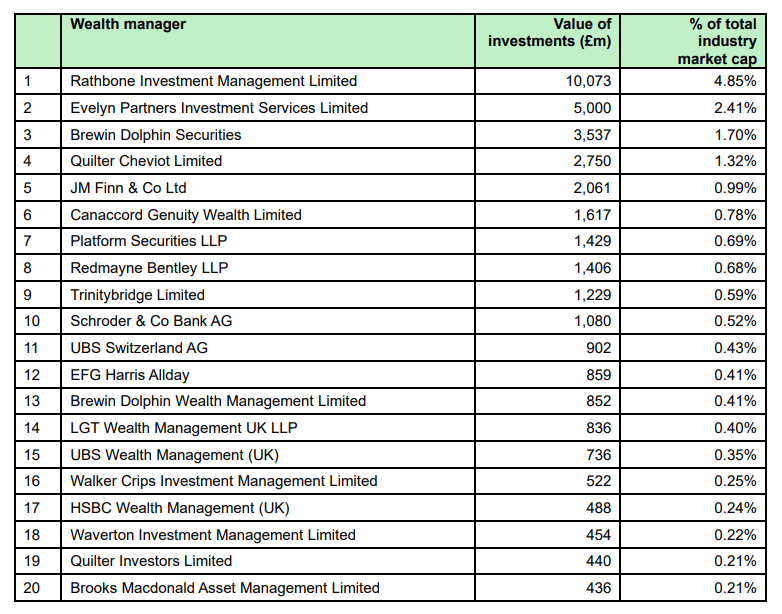
Source: theaic.co.uk; Argus Vickers
Liquidity constraints
Many wealth managers assert they do not have a set cut-off size for investment trusts. “We do not apply a strict minimum size threshold to investment trusts,” says Matt Ennion, head of fund research at Quilter Cheviot, for example. “The appropriate size will depend on the individual trust, the asset class in which it invests and, importantly, the liquidity of the underlying assets.
“Smaller trusts can still have a place in portfolios where they provide exposure to a specific opportunity or meet a particular investment need. This is especially true where we are not seeking to deploy capital across our wider client base.”
The firm is careful on liquidity, Ennion adds, monitoring both position sizes and prevailing market conditions, supported by strong relationships with brokers and trust boards. “The liquidity visible through London Stock Exchange trading volumes often provides only a partial picture,” he elaborates.
“In practice, liquidity can be sourced through a broader network of market participants, trading venues and broker relationships. As a result, the true investable liquidity in a trust can be materially deeper than headline exchange volumes alone might suggest.”
Unitisation also makes a difference. “We do not set minimum size levels,” says Ben Conway, chief investment officer at Hawksmoor Investment Management, “but maybe that is because we run funds as opposed to managing a ‘buy’ list for a large wealth manager, who might require minimum size and liquidity levels. This is one of the advantages of running multi-asset funds – we can cope with the illiquidity of smaller trusts via positioning sizing.”
Quilter Cheviot also adopts a ‘building blocks’ approach for its MPS – the unitised blocks, allowing the firm to address the liquidity and platform issues associated with a conventional MPS.
This approach chimes too with Newton head of multi-asset Paul Flood, who uses investment trusts to gain specific exposure in his multi-asset portfolios. “We are careful on how much of an investment trust we would own, both as a house and in an individual fund,” he adds, however. “It is really around the kind of liquidity we think we can obtain – and so we will spread that more widely.”
Targeted exposure
Wealth managers generally appear more concerned about the type of exposure provided by investment trusts – for example, at 46%, they make up a disproportionate proportion of shareholders in the AIC Technology & Technology Innovation sector, with the Allianz Technology and Polar Capital Technology trusts key holdings.
The AIC report also shows wealth managers are significant holders of Infrastructure investment companies, where they account for 32% of share ownership, alongside a higher weight in the Specialist category, of which they own 43%. They also comprise 36% of the ownership of the Biotechnology & Healthcare sector.
As FundCalibre research analyst Chris Salih points out, some strategies have a role to play in portfolios that are simply unavailable in larger trusts. “We can look at microcap trusts, which are unlikely to be more than £200m in size, given the nature of the companies they invest in,” he says as an example. “In fact, some sectors would actually struggle with being a £1bn trust in terms of being able to move quickly enough to take advantage of market opportunities.”
This being so, trust consolidation can be useful – albeit not for its own sake. “One trust we liked was AJOT [AVI Japan Opportunities], which merged with Fidelity Japan in November 2025,” says Salih. “The move saw two-thirds of investors roll over into the AJOT portfolio, which consequently grew to more than £400m in size.
“AJOT seeks to invest primarily in undervalued companies listed or quoted in Japan – particularly within the small and mid-cap space – with a strong focus on constructive engagement with company management aimed at unlocking shareholder value. The combination with Fidelity Japan has thus given AJOT extra flexibility to increase their stakes and engagement with these firms.”
Read more on this: Is £1bn now the magic number for investment trusts?
Salih also highlights the merger of the JPMorgan UK Small Cap Growth & Income trust with the JPMorgan Mid Cap fund. “Combining the assets created a larger vehicle with better liquidity and pricing, while also allowing shareholders to benefit from economies of scale,” he says. “Furthermore, it also gave the trust an enhanced 4% dividend policy, without fundamentally changing the managers’ investment process.”
Consolidation is not, of course, a panacea and Quilter Cheviot’s Ennion points to the proposed £5.3bn merger between HICL Infrastructure and The Renewables Infrastructure Group – officially abandoned last December after a shareholder revolt – as a good example of a transaction that did not offer investors appropriate benefits, despite increasing the overall size.
Investment trusts may not be well- suited to conventional MPS offerings but they are still being used by wealth managers in unitised solutions and in their multi-asset funds. Wealth managers will be diligent about monitoring liquidity but size is not a dealbreaker in many cases.
Ultimately, they still want investment trusts for specialist exposure to certain assets – notably smaller companies, infrastructure and individual sectors such as technology or healthcare – so, for now at least, differentiation largely continues to trump size.
Cherry Reynard is the 2026 AIC Freelance Investment Trust Journalist of the Year (and 2025, 2024, 2022, 2021 and 2020 …)