

The phrase ‘This time it’s different’ is widely considered to comprise the four most dangerous words in investment but running it a close second has to be ‘Once upon a time’. As you would expect, behavioural economists have a clever name for this idea and its associated dangers – ‘narrative fallacy’ – but another way of putting it would be ‘People do like a bit of a story’.
Up to a point, that is wholly understandable and perfectly fine – not to mention great news for the dwindling band of us clinging to the title of ‘financial journalist’. As Jason Zweig, one of the profession’s leading lights, once confessed in the Wall Street Journal: “My job is to write the exact same thing between 50 and 100 times a year in such a way that neither my editors nor my readers will ever think I am repeating myself.”
It is a great line – all the more so for being painfully true – but, for the purposes of this column, the pay-off lies in Zweig’s follow-up. “The temptation to pander is almost irresistible,” he continues. “And while people need good advice, what they want is advice that sounds good.” In other words, data is all very well but what investors tend to prefer is some kind of story that can help them feel better about the decision they are weighing up.
KLF fever dream
The snag with adding any kind of narrative gloss to an investment scenario, however, is it can cloud an objective analysis of the available facts. Elon Musk is a genius who sees opportunities no-one else can? AI businesses have no alternative but to burn through cash like a KLF fever dream? The US government is selling billions of euros to shore up the yen purely as a gesture of kindness to Japan? Well, maybe …
On the other hand, as professor Ellroy Dimson memorably put it: “Risk means more things can happen than will happen.” So the moment we sign up to a single narrative, we are favouring one version of the future over all others – even though, clearly, we have no idea if it is the one that will play out. Worse, we risk becoming overly attached to this prediction, which can cloud the interpretation of any awkward new information that appears.
All of which brings us – as of course it must – to the parallel world of fantasy football, to the start of a new season and to another outing for the Mean Reversion Machine portfolio. This column’s regular reader – and, as always, your unswerving perseverance is much appreciated – may already be aware but, in case anyone new has stumbled by, let’s run swiftly through its aims.
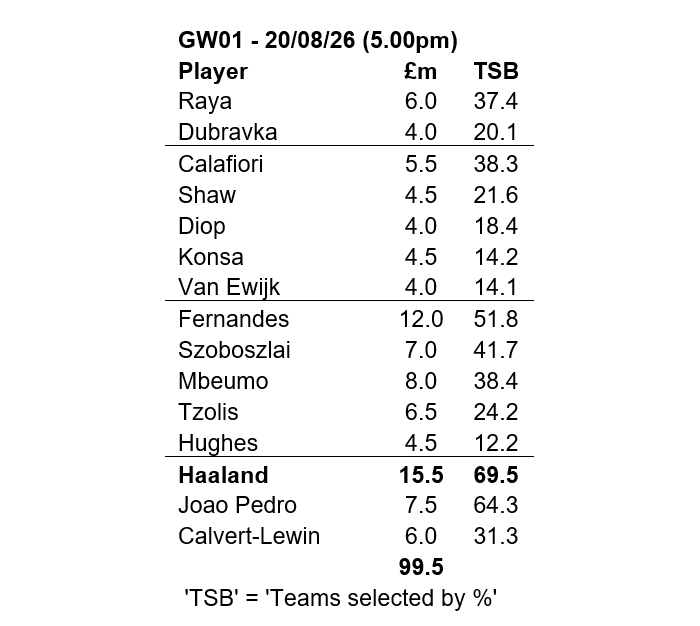
Inspired this time last year by the demise of the deeply missed – if only by creators Adam Lewis and me – Back of The Net Asset Value podcast, the Mean Reversion Machine is a squad of as many of the most-owned Fantasy Premier League (FPL) players the £100m budget allows me to cram in. ‘Enabled’ by the most-owned cut-price players in each position, it is then ‘rebalanced’ as and when appropriate. This was the result for Gameweek 1:
“The moment we sign up to a single narrative, we are favouring one version of the future over all others – even though, clearly, we have no idea if it is the one that will play out.
Source: Fantasy Premier League
Now, as we learned last season, this is not going to be a perfect mirror of the most-owned players – at least, not immediately – although, first time out, eight out of the first 11 is not bad result. Arsenal’s Raya is the most-owned goalkeeper and his colleague Calafiori the most popular defender while United duo Fernandes and Mbeumo and Liverpool’s Szoboszlai are the three most popular midfielders.
My suspicion is that Arsenal’s Tzolis – currently included as a sort of halfway house between the moderately cheap and the very well-owned – could soon be there on merit. Even if not, all three strikers – City’s Haaland, Chelsea’s Joao Pedro and Calvert-Lewin of Leeds – certainly are, while Dubravka of Spurs and Crystal Palace’s Hughes tick the necessary boxes for highly-owned, bargain-basement enablers.
And so it is really only in defence where we have fallen down this week. Despite being owned by some 30% of all squads, the chunky £8m price-tag slapped on Arsenal mainstay Gabriel was always going to be a stretch for the portfolio. Yet with other premiums such as O’Reilly, Virgil and Porro also popular, budget has meant that, in addition to Calafiori, the portfolio can only stretch to the third, seventh, 10th and 11th most-owned defenders.
Two of these – Ipswich’s Diop and Van Ewijk of Coventry – are the cheapest possible £4m while the other two are £4.5m. One is United’s Shaw, who would have been in the portfolio regardless; the other is Konsa – until recently of Aston Villa – which is perhaps where the portfolio adviser has played fastest and most loose. This is for two reasons – both related to his being confirmed as an Arsenal player pretty much as I type.
Conviction taken into consideration
For one thing, it means we inadvertently own one too many players from that part of North London, which will have to be addressed next time we rebalance; for another, Konsa is the one asset included for more qualitative than quantitative reasons – the portfolio adviser’s conviction that, as a cheap Arsenal defender, he will be in the benchmark on merit sooner rather than later (even if his popularity briefly drops in the immediate term).
In taking this view, I appreciate the portfolio immediate risks falling victim to the siren call of narrative fallacy although, frankly, where does that differ from the thinking behind the selection of so many of the most popular FPL assets as the new season of football, both real and fantasy, gets underway – especially after a World Cup summer and just the nine new club managers confirmed since June?
So Haaland always starts the season with a bang (regardless of an anaemic showing in the Charity Shield)? Mbeumo has been scoring for fun pre-season (even if pre-season means nothing – except when it confirms our prejudices)? Bruno is United’s talisman (regardless of his late return post-World Cup)? Szoboszlai has so many different routes to points, including penalties (although he may not have penalties)?
Calafiori is the most attacking Arsenal defender (well, at least since he scored in the Charity Shield)? Raya plays behind the best defence in the country (regardless of an infusion of new blood in said defence and one key player missing long-term)? And Joao Pedro has been scoring for fun pre-season (even if pre-season means nothing – except when it confirms our prejudices)? Well, maybe …
On the other hand …