

How has the Mean Reversion Machine portfolio ended Gameweek 7 comfortably inside FPL’s top million teams? As its name suggests the project was supposed to illustrate the irresistible pull of reversion to the mean, highlight the madness of crowds and, from time to time, allow us to smirk at the wilder instances of herd mentality – all the while mimicking a passive vehicle by buying the market’s most-owned assets.
At the start of last season, my expectation had been that the project’s self-imposed rules would naturally see performance bouncing merrily between the middle of the second quartile and the top of the third. Add in the game’s inherent element of wastage – as many managers’ early optimism fades to apathy and single-week teams increasingly clog up the system – and, come May, we might reasonably hope to find ourselves first-quartile.
Yet, currently ranked an overall 877,249th out of almost 11.1m FPL players, even if we say there are already a million ‘dead’ teams, that still leaves the portfolio top-decile. That just feels wrong – and I am not just saying that because, for the first time ever, Mean Reversion Machine has overtaken the team run in a much more active way by your portfolio’s adviser.
“Parenthetically – confessionally, even – let me share the worst outcome of a single decision I have experienced in some 25 years of playing this game.
The ‘moron premium’?
(‘Much too active’, some might say. Parenthetically – confessionally, even – let me share the worst outcome of a single decision I have experienced in some 25 years of playing this game. Spooked by injury concerns around two of my players and with 15 minutes left to last Saturday’s deadline, I chose to make a second transfer, taking a four-point ‘hit’ to bring in Hall of Newcastle in place of Forest’s Aina, who had stunk up my team for weeks.
I also ‘reasoned’ that playing both Brighton goalkeeper Verbruggen and his out-of-position gem of a defender teammate De Cuyper away was not smart. One goal from Sunderland and I would be sunk. As it turned out, De Cuyper – now first on my bench – bagged 15 points, while Hall brought me precisely zero from his game against Coventry. Total cost of that stupidity? 0 – 15 – 4 = -19. This one is going to sting for a while.)
Meanwhile, back in the land of the passive approach to fantasy football, there is no such mental torture. As the second most-owned defender in the game, De Cuyper’s position was never in question and, while the portfolio had also invested in Hall and his ‘nul points’ – well, that was simply because the wider market’s enthusiasm for the player had led us to do so.
Back to the original question, then – why is the Mean Reversion Machine portfolio doing so well? In these AI-oriented times, my first instinct had been to blame the rise of all the algorithms and other digital tools now on-tap for fantasy football players looking for a little agentic inspiration to aid their team selection – and I certainly reserve the right to return to the topic further down the line.
For now, however, I wonder if the answer could be rather more straightforward – not to mention thematically appropriate for this column – and that is that mean reversion has yet to kick into gear. It is a fact of FPL life that the crowds always buy into the high-fliers of the first few weeks of the season – it is just that, this season, the high-fliers have kept on flying high.
Take De Cuyper – after his 17 points in his first outing, he has only blanked once in the next five and is now the game’s joint highest scorer. The other is his teammate Gross, who was also swiftly into our portfolio, and has only blanked twice. For their part, Joao Pedro and Arsenal’s Calafiori both scored a goal in their first match and have only blanked twice each since, while Chelsea’s Rogers has returned in each of his last five matches.
Given all five of those are decently priced, FPL managers have had no trouble fitting some or all of them into their squads – along with premium players such as Haaland, who has incidentally returned in each of the last five games. And thus they all find themselves Mean Reversion Machine assets and, as you can see below – and at least for the time being – the portfolio mostly keeps pulling its weight:
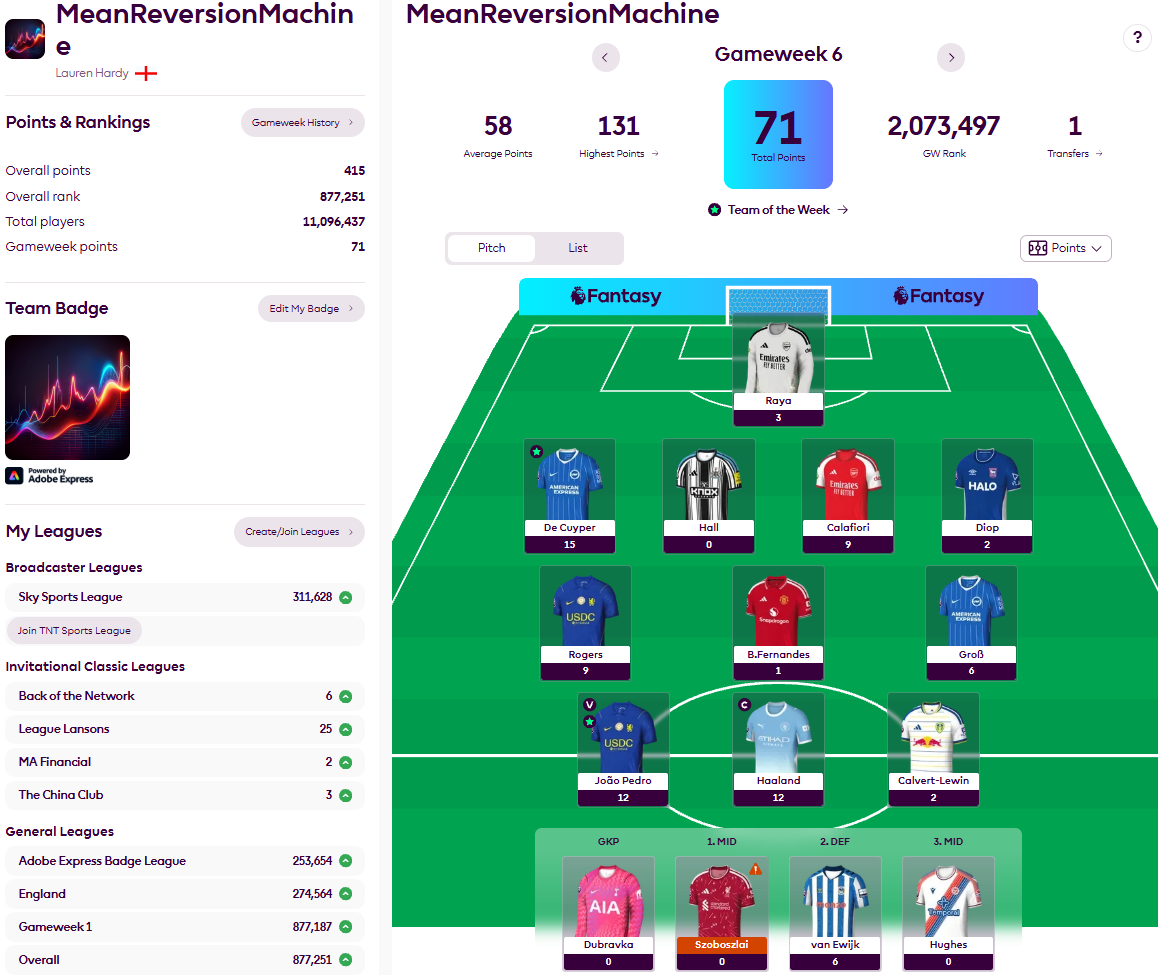
I say ‘mostly’ – the obvious exceptions are Manchester United talisman Bruno Fernandes and Liverpool dynamo Szoboszlai. Both frequently touted as ‘offering multiple routes to points’ – goals, assists, penalties, defensive contributions and so on – over the last four week all those routes have been thoroughly congested. Not surprisingly, both have been heavily sold over the last week – by roughly half a million managers each.
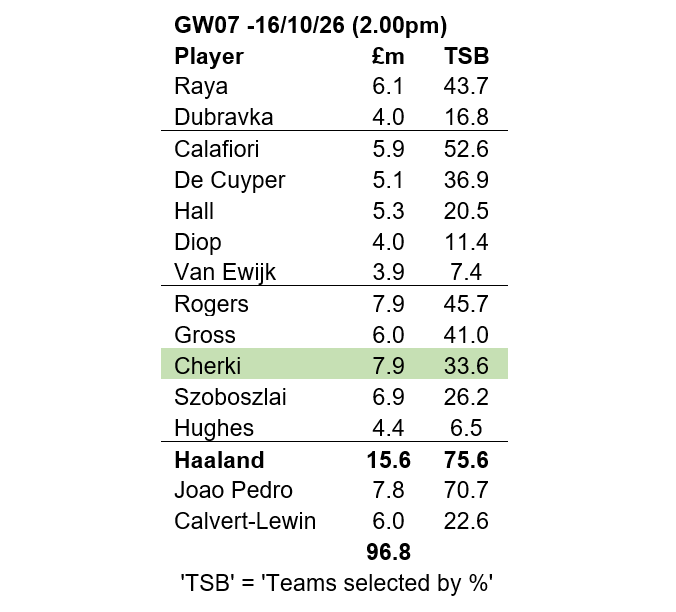
The portfolio, however, only has the wiggle room to sell one for free – to bring in Manchester City’s Cherki, who has been heavily bought by the market ahead of a home tie against Ipswich and is now the third most-owned midfielder in the game. While a lingering question mark over Szobo’s fitness makes him the preferable ‘sell’, that would leave us short of cash – so out goes the Unite captain.
Bruno has dropped from being around 50%-owned in Gameweek 3 to nearer 30% as I type and, with his team playing as poorly as they have been, a tricky set a fixtures ahead – starting away to Leeds – and this former prince of FPL apparently even nursing an injury of his own, it is an easy move. Of course, mean reversion works both ways but, the deed is done and leaves the portfolio looking like this:
Source: Fantasy Premier League
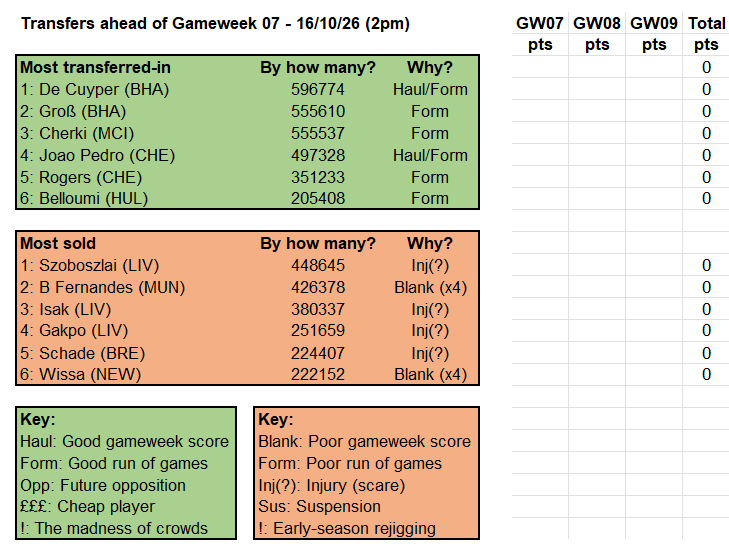
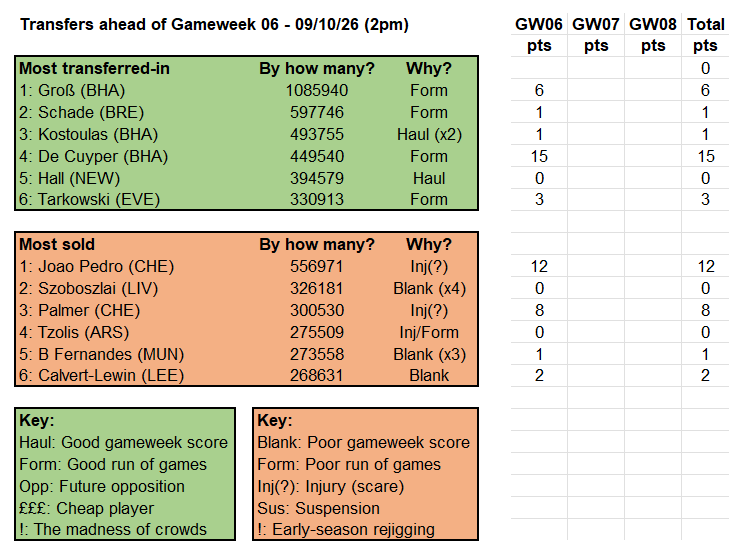
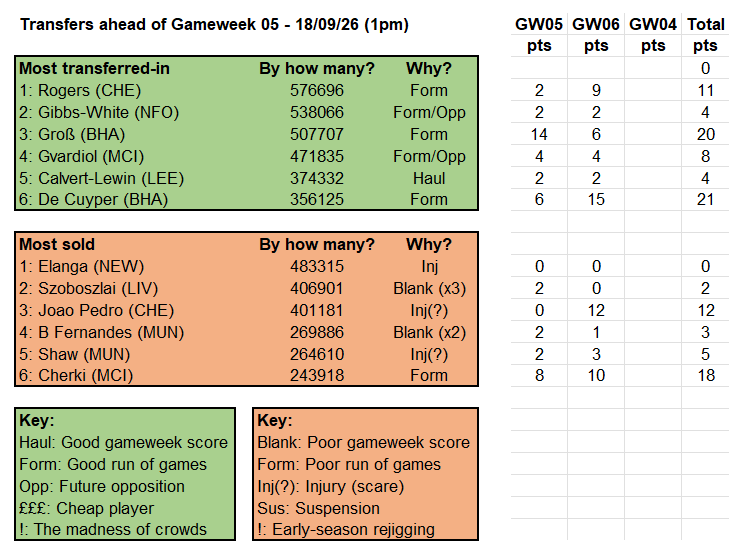
Turning briefly to our ‘Herdwatch’ tables of the most bought and sold assets in the game, the top-left shows those high-scoring Brighton boys at the top of the buys, with new portfolio asset Cherki in third place. For what it may or may not be worth, the last time De Cuyper was top of the buy charts – ahead of Gameweek 2 – he went on to ‘do a Hall’ and bag his new owners zero points. As already noted, Bruno and Szobo lead the ‘sells’.
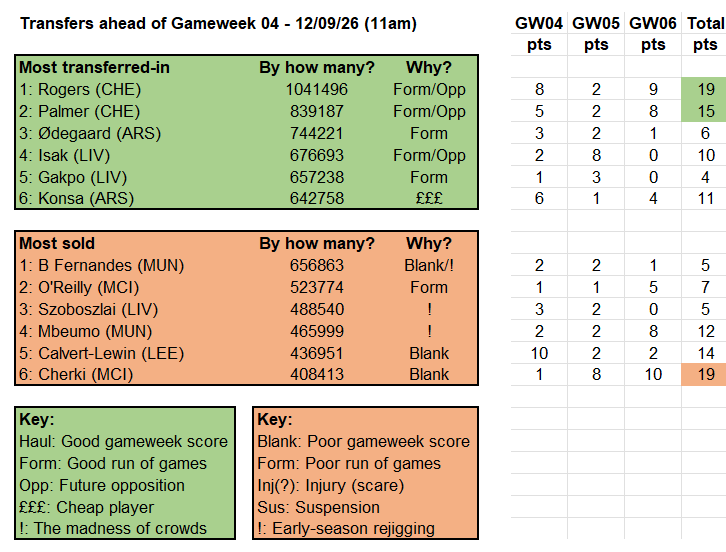
Elsewhere, the top-right ‘sell’ table starkly illustrates the dangers of shipping out a flagged player – Joao Pedro immediately punishing his half a million or more doubters with a 12-point haul last weekend. Marginally longer-term, the Chelsea striker’s attacking partners, Palmer and Rogers, have rewarded the combined two million or so FPL managers who brought them in ahead of Gameweek 4. Those who sold Cherki at the same time, however, will be feeling less happy – and presumably a fair few will have U-turned last week.
Source: Fantasy Premier League