
On wealth preservation, liquid alternatives and targeting funds that behave as expected
In our regular video series, we interview the wealth sector’s key decision-makers to discover how they think about life, both within the world of investment and beyond it; what brought them into the business and what keeps them here; and what makes them and their companies tick
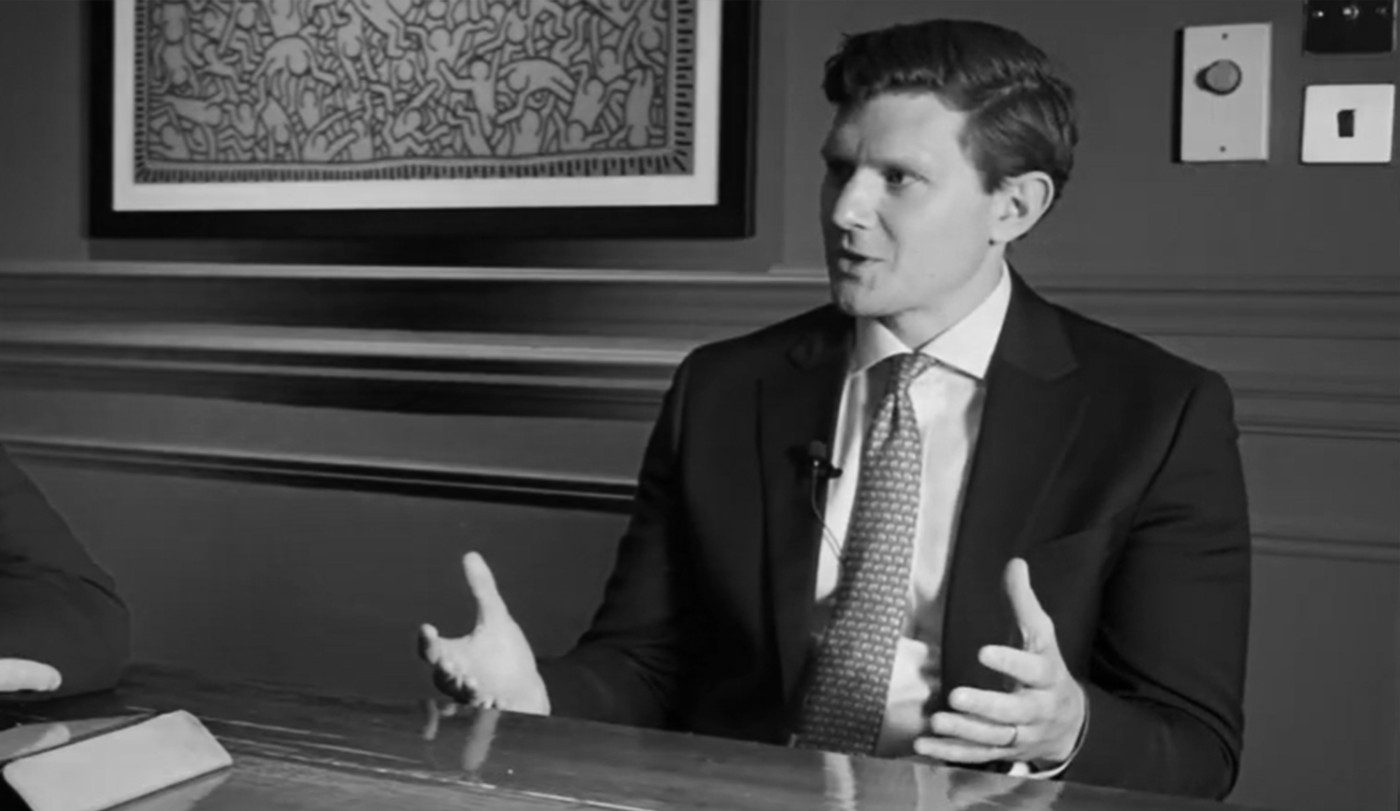
In the constant fight to preserve client wealth as much as grow it, the twin prospects of enhanced liquidity and greater diversification are leading Jonathan Unwin, UK head of portfolio management for Mirabaud Wealth Management, increasingly to consider alternative assets.
“Since 2022 – when we had a horrific year as investors, where the correlation between bonds and equities was so close – we really need to be filling our portfolios with assets that are genuinely uncorrelated and can do something a bit different to simply holding bonds or equities and moving percentages between the two,” he tells Wealthwise editorial director Julian Marr in our latest Choice Words episode, above.
“In that space, we particularly like liquid alternative funds – so ones we can get in and out of, should we need to, and that move in a way that is just different to those more traditional asset classes.
“It could be long-short equity, it could be long-short credit, it could be a commodities fund, it could be a macro strategy with a number of different strategies embedded within it – and I would include gold within that as well. Really, though, we like to see assets that just do their own thing.”
While the US economy is undoubtedly slowing down, it is still pretty robust – led by the consumer, who doesn’t seem too fussed at the moment.”
Asked what most enthuses him about the investment outlook, Unwin highlights the ‘Goldilocks’ scenario currently being enjoyed in the US. “Interest rates are falling there – and we most likely expect another two cuts by the Federal Reserve this year,” he continues.
“At the same time, corporate earnings in the US remain pretty strong, tech companies are beating expectations by large numbers and, while the economy is undoubtedly slowing down, it is still pretty robust – led by the US consumer, who doesn’t seem too fussed at the moment. All in all, that points to a benign environment for risk assets.”
Focusing in from the macro to the micro, what does Unwin most look for in an individual investment? And what would constitute a ‘red flag’? “I focus mainly on active funds and ETFs in the portfolios I manage so really I look for consistency of approach – a consistent philosophy and an investment that performs as we would expect it to in any given scenario,” he replies.
“I am not particularly bothered if something goes through periods of underperformance, if the wider market or style is struggling, but I want it to behave as I expect. Meanwhile, for us, ‘red flags’ would include big changes in personnel or a big change in process. Or a sudden large movement in the underlying securities – that would also be something we would worry about.”
A full transcript of this episode can be found after this box while you can view the whole video by clicking on the picture above. To jump to a specific question, just click on the relevant timecode:
00.00: What excites you about the current investment outlook? What worries you?
01.07: What do you most look for in an individual investment? What constitute ‘red flags’?
02.05: To what degree should professional investors be thinking beyond so-called ‘traditional’ investments? Towards what?
03.43: What drives your approach to client communications? Should professional investors aim to attract the ‘right’ type of client?
04.52: What was your path into investment – and, if you hadn’t taken it, what do you think you would be doing now?
05.48: What was the biggest investment mistake you are prepared to admit to – and what did you learn from it?
06.52: Outside of work, what is the strangest thing you have ever seen or done?
07.40: What do you see as the best and worst-case scenario for the future of UK wealth management?
08.49: What advice would you have given your younger self on your first day in this business?
09.20: Two Choice Words recommendations, please – one a book; one a free choice?
Transcript of Choice Words Episode 25:
Jonathan Unwin, with Julian Marr
JM: Well, hello and welcome to another in our series of ‘Choice Words’ videos, where we get to meet the great and the good of UK fund selection and UK fund research. I am Julian Marr, editorial director of Wealthwise Media, and today I am delighted to be talking to Jonathan Unwin, UK head of portfolio management for Mirabaud Wealth Management. Hello, Jonathan.
JU: Hi Julian.
JM: Straight into the first question, as I now know is the best way to do it – looking at the current investment outlook, what excites you most? What gives you pause for thought?
JU: I think what excites me the most is the current ‘Goldilocks’ scenario we are in. Interest rates are falling in the US – and we most likely expect another two cuts by the Federal Reserve this year. At the same time, corporate earnings in the US remain pretty strong, tech companies are beating expectations by large numbers and, while the economy is undoubtedly slowing down, it is still pretty robust – led by the US consumer, who doesn’t seem too fussed at the moment. All in all, that points to a benign environment for risk assets.s
No surprises
JM: That is a nice, positive start to conversation. Drilling in, then, from the macro to the micro, as it were, when you are looking at individual investments or assets, what do you look for most? What do you see as red flags?
JU: I focus mainly on active funds and ETFs in the portfolios I manage so really I look for consistency of approach – a consistent philosophy and an investment that performs as we would expect it to in any given scenario. I am not particularly bothered if something goes through periods of underperformance, if the wider market or style is struggling, but I want it to behave as I expect.
So that would be the main criteria for a fund while ‘red flags’ always include big changes in personnel or a big change in process. Or a sudden large movement in the underlying securities – that would also be something we would worry about.
Liquid assets
JM: Those would definitely raise questions. I know you are looking at collective investments but to what degree do you think investors should be looking beyond the ‘traditional’ – equity, bonds and cash – into more alternative assets? And where?
JU: It is increasingly important. I think, since 2022 – when we had a horrific year as investors, where the correlation between bonds and equities was so close – we really need to be filling our portfolios with assets that are genuinely uncorrelated and can do something a bit different to simply holding bonds or equities and moving percentages between the two.
In that space, we particularly like liquid alternative funds – so ones that we can get in and out of, should we need to, and that move in a way that is just different to those more traditional asset classes. It could be long-short equity, it could be long-short credit, it could be a commodities fund, it could be a macro strategy with a number of different strategies embedded within it – and I’d include gold within that as well. Really, though, we like to see things that just do their own thing.
JM: Thank you for that. I was going to ask for further and better particulars when you mentioned liquid assets – whether it was with a small ‘l’ and ‘a’ or whether it was specifically branded funds. But I sense it is a much broader thing you are looking at and liquidity is the key?
JU: For my clients – absolutely. The traditional hedge fund has had its time for sure – but, for my clients where I am really looking to diversify rather than make stellar returns, an alternative liquid asset class is most important.
Honesty and humility
JM: Fair enough. When you are working with your clients, what is the Mirabaud approach to communications? And sorry to make this two questions – I know that makes it possibly less clear – but I keep trying to focus in on this idea of the ‘right’ client. There is nothing pejorative or judgmental intended there – it is just about attracting clients who have bought into your process and will stick with you so they are with you at the end and therefore get the best ‘bang for their buck’.
JU: We are slightly fortunate in a way in that, to bank with us, clients need three million ‘liquid’ – so that narrows the field down somewhat and they tend to be quite sticky. In terms of our communications, though, I am always very honest, very humble and direct in what we do.
I make it clear we are looking to preserve wealth as opposed to provide returns massively over and above competitors or any index. And, of course, what investment is right for what client very much comes down to them and their risk profile – as long as the client understands what they are investing in, and that investment is within their risk parameters – then it’s a good investment.
Sowing and reaping
JM: A more personal question now – what was your path into investment? And, in an alternative universe, if you had not taken it, what do you think you would be doing now?
JU: It is quite a simple story. I did a law degree at university and my first job, following graduation, was in a small law firm where there was a financial news channel constantly on in the background – and I found that far more interesting than my day job!
I thought, Markets look interesting – I like the idea of being tapped into what is going on around the world with markets, currencies and so on. So that is really what led me to apply for a job with a small brokerage. And, since I come from a farming background, I married into a farming family and I live on a farm, I imagine that, if I wasn’t an investment person, I would be something to do with agriculture.
JM: It is interesting you did not say you would be a lawyer – as an ex-lawyer myself, I can fully buy into that. It would be ‘Anything but’!
Beyond dogma
JM: Now, what was your biggest investment mistake – or, at least, the biggest one you are prepared to admit to? And what did you learn from it?
JU: I think the biggest mistake I have made over my career was probably being underweight the US tech sector for a good chunk of the last few years – up until the last two years, where I’ve been fully invested in that, which has been good for my clients. And the reason I was underweight for a lot of that period was a concern about valuations. So I have really learned now that valuations aren’t the be-all and end-all – they are something to watch, but a rich valuation in itself is not a reason to not invest in an asset class.
JM: Did you change your process to take account of that – or, sorry, ‘evolve’ your process, shall we say?
JU: Not necessarily my process, but I evolved my way of thinking. I realised you can’t invest with this sort of ‘dogmatic’ attitude – you can have a general ideology, but you need to be pragmatic and you need to recognise when something you are doing isn’t working.

Ewe-ber?
JM: Onto everybody’s favourite question in these interviews – outside of work, what is the strangest thing you have ever seen or done?
JU: Well, I’ll spare you the pre-work, university rugby-tour stories! As I said, I live on a farm so I often see odd sights with respect to livestock – be it a bull in the canal next to the pub or – the other day, in fact – a chicken riding around on the back of a sheep, which I think is probably different, perhaps, from my peers!
JM: This is good! I am always up for the animal answers – indeed, it harks back to where this question comes from. But, yes, the natural world is a rich seam – and chickens with jockey delusions is what we are looking for! Delusions of grandeur is a perfect answer.
Wealth of nations
JM: Now, back to the grown-up world or the sane world! What do you see as the best and worst-case scenarios for the future of UK wealth?
JU: I am always an optimist and I think there is potential for wealth to increase in the UK. For that to happen, we need to increase productivity as a nation – that is the single most important thing. And, for that to happen, we need to embrace technology, clearly, but we do also need cheaper energy prices.
If you look at any nation in the world, the most productive have cheap, affordable energy. Hopefully that comes about from the various government initiatives of the last few years but also, I think, as a nation, we have to be more pragmatic about where our fuel comes from to drive growth.
And you also asked me about the downside – the downside is, clearly, if that doesn’t happen. At the moment, a topical subject is the price of longer-term bond yields – particularly sovereign debt or gilts. So the markets are clearly putting the nation on notice and we need to be more productive as a nation.
Exams first
JM: Into the home straight now – two more questions. First of all, what advice would you like to have received or to have given yourself on your first day in the job?
JU: ‘Do all your exams as soon as possible’. Get them out of the way, so you have got that foundation, and then actually you can focus on reading about current affairs and learning about the markets – rather than worrying about doing your qualifications as you get older and you lose the ability to take on new information.
Ride out the bumps
JM: I like that – a practical answer. Good advice, indeed. Lastly, then, we call this series ‘Choice Words’ because of what you do for a living but let’s now focus in on two personal recommendations. One would be a book – it does not have to be about investment, but it can be – and the other one can be for anything. We have had podcasts to listening to evensong in St Paul’s to golf courses …
JU: I chose a book I read recently as my recommendation. It’s not an investment book – although I think it’s good to have a background in the subject – and it’s The Story of England – The Making of a Nation by Dan Snow. It is a whistle-stop tour of English history from the ice age all the way through to the year 2000 and it is just very factual in terms of narrative – so it’s something you can read in one go or you can dip in and out of.
In terms of my advice – if I have any, generally – it is back on-topic and would be to stay invested. Don’t try and time the markets – I know so many more clients who have lost out, in relative terms, from panicking and selling out or trying to time the markets than those that stay in and ride out the bumps.
JM: Wise words, indeed – and good ‘Choice Words’ choices. Thank you very much, Jonathan, for your time.
JU: Thank you, Julian.
JM: And thank you very much for watching. Do look out for further episodes as they are published.