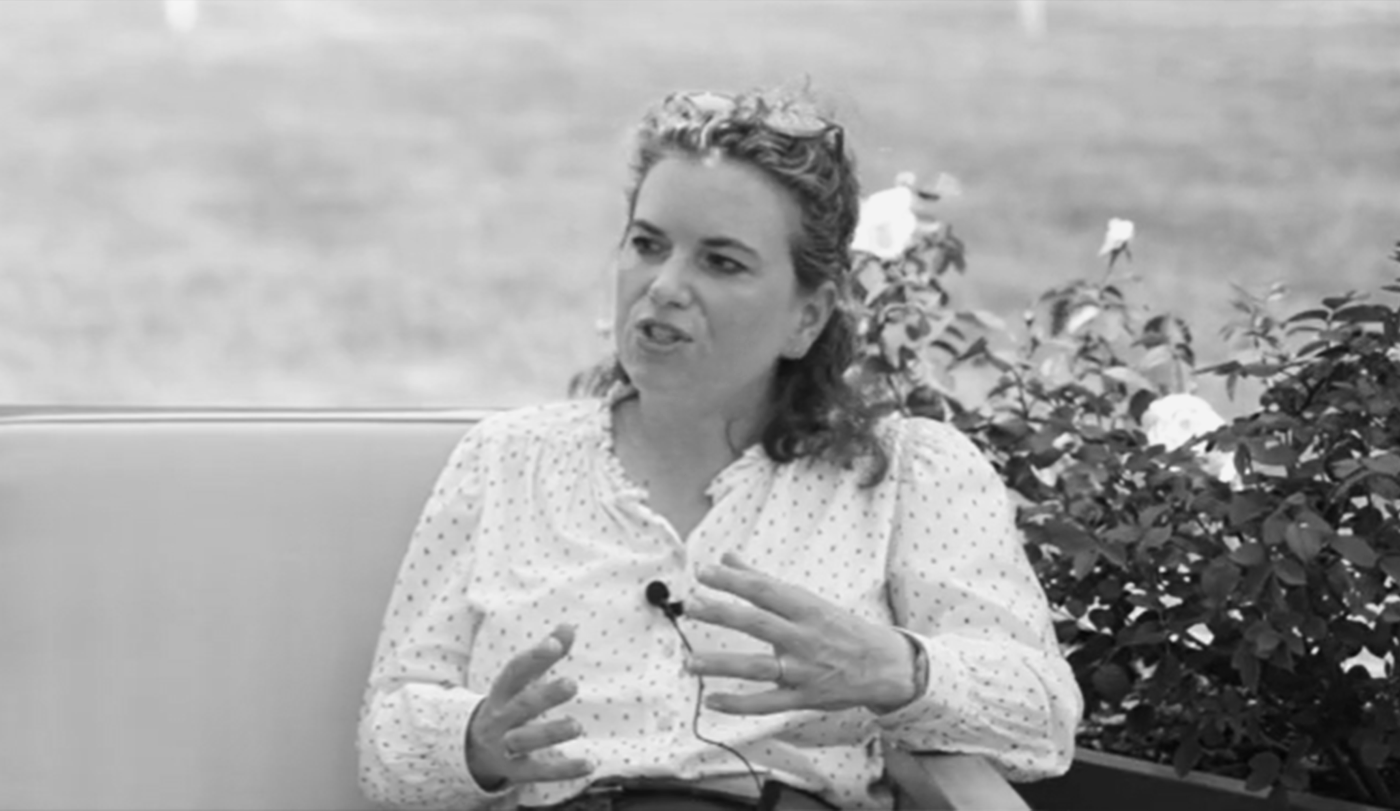

GIB AM head of fixed income Samantha Lamb on the importance of active management in the current environment
Fixed income investors are “walking a tightrope” in increasingly expensive markets, according to Samantha Lamb, head of fixed income at GIB Asset Management and manager on the firm’s Sustainable World Corporate Bond fund.
Economic growth has been surprisingly strong and the market is pricing in a lot of good news yet, even before the crisis in the Middle East, there were some fragilities for bond markets.
“High-end US consumers” have been supported by the wealth effect from a strong stockmarket, says Lamb in the above video – and that has driven growth – but that also “has the risk of reversing.” Commodity prices were already seeing a huge amount of volatility, with the potential to create inflation, she adds, while a lot of high expectations are baked into company earnings.
With markets “priced for perfection”, Lamb says: “We can see a situation where growth really charges ahead, but recession also does not feel off the table either and it depends on how these elements interact.” With credit spreads very low, she warns, it is really not the environment to be chasing risk – indeed, Lamb has been highly selective in its credit exposure over the past 12 months.
As an agile, small, nimble team we are able to move from change in the market to changes in the portfolio very quickly.”
As 2026 develops, she argues, it will be “about income and carry and not about capital appreciation”. As such, the team is sticking to shorter-duration options and being particularly selective in high-yield bonds, with single-B credits looking expensive.
Lamb believes active management is likely to be particularly important in this environment, noting passive funds tend to provide exposure to the most indebted names, while some active funds are hindered by unwieldy processes. “We have an agile, small, nimble team and we are able to drill into pockets and make decisions quickly,” she explains.
“How does that differ to our peers? We don’t have big investment committees or a cycle that we have to wait for. We are not trying to collate orders across a number of different portfolios. We are able to move from change in the market to changes in the portfolio very quickly.”
A full transcript of this interview can be found after this box while you can view the whole video by clicking on the picture above. To jump to a specific question, just click on the relevant timecode:
00.00: How would you describe the current state of fixed income markets?
03.29: With credit spreads at historically tight levels, are investors being adequately compensated for the risk of a potential downturn?
04.48: With yields at these levels, do you think the main source of returns is likely to come from carry? Or do you think it is more capital appreciation?
06.06: Given the big rise in fixed income passive investments recently, why do you think an active, research-led approach is particularly important in this environment?
07.46: Turning to the investment philosophy and process on the Sustainable World Corporate Bond fund, how do you approach things?
10.31: If there was one factor you could isolate that really differentiated you from your peers and from the benchmark, what would that be?
12.19: What was the thinking behind having a custom benchmark for the fund and how does it benefit investors over and above, say, an investment grade-only benchmark?
15.11: What is the most important thing clients should understand about how you manage risk in the fund?
17.06: More philosophically, why should investors have exposure to corporate bonds?
18.44: Finally, in the current environment, where does the value lie in both sector and geographic positioning?
Investment views transcript: Samantha Lamb, head of fixed income at GIB Asset Management and manager on the firm’s Sustainable World Corporate Bond fund
It has been a volatile period for fixed income over the past few years. How would you describe the current state of markets?
SL: I would say the fixed income investors are very much walking a tightrope in what are increasingly expensive markets and, if we see a growth surprise to the upside, we could see more volatility – and similarly to the downside.
Over the past couple of years, US growth has very much surprised expectations to the upside. Particularly when we look at last year, after ‘Liberation Day’, there were predictions of recession – and what we have seen is, even in Q3, US growth surprising at over 4%.
What that, I think, is telling us is that, despite the external shocks we have seen – the knocks to business confidence, where you would expect to see investment in capex be pulled back – that AI investment capex cycle is really storming ahead.
And I think where that leaves us is that the market is pricing in a lot of good news. We are expecting reasonable growth, we are expecting inflation to come down and there are high expectations on company earnings at the same time.
So what are we watching? We are looking at where that growth story is coming from. We know that AI capex is part of that but, in addition, you have the high-end US consumers who have been investing their savings into stocks. And so they have been feeling quite wealthy – because that pot of money has done really very well – and they have then been going out and spending it. So that is driving growth as well – but that has the risk of reversing. If we see equity markets come off, that wealth effect can reverse at the same time as well.
We are also watching what is happening in commodity prices – because that could be a real driver of inflation. We are seeing a huge amount of volatility but we know there is a big infrastructure supercycle going on that will create demand there as well – and that can then feed through to more rates volatility at the same time.
The final thing is the earnings – you know, there is a lot of high expectations that are baked into companies at the moment – and we have seen with some of the recent earnings that there have been very sharp equity-price corrections on the back of them. And so it does feel that things are priced very much to perfection.
So, from our perspective, we had quite a long conversation at the end of last year, thinking ahead on what the potential outcomes could be for 2026 – and what was notable is that the range of potential outcomes was much broader than normal.
So we can see a situation where growth really charges ahead – but recession also does not feel off the table either – and it depends on how these elements sort of interact. We are not in the business of trying to predict growth or where the market is going – we just ask for ourselves, What is priced into the market? Are you getting paid for the risk? And we ensure we position our portfolio accordingly.
With credit spreads at historically tight levels, are investors being adequately compensated for the risk of a potential downturn?
SL: As you say, the risk premiums are very low at the moment. Credit spreads are expensive, and they are historically expensive, so it is really not the environment to be chasing risk – particularly given, as I touched on, that the risk and uncertainty in the market is also very high at the moment.
When you look to last year, investment-grade returns were about 8% whereas high yield was closer to 8.5% – this is in the US. That is not a lot of additional return for the credit risk that that you would have to take. From our perspective, we use a long-term valuation framework to help us understand where valuations are relative to the cycle – and that is telling us that there are many pockets of credit that are looking very, very expensive at the moment.
That said, we ran our portfolio underweight credit risk through the whole of last year, but we were still able to add outperformance – and good outperformance – through using that framework to identify pockets of value and systematically adding risk, when we saw periods and spikes in volatility.
With yields at these levels, do you think the main source of returns is likely to come from carry? Or do you think it is more capital appreciation?
SL: In this environment, we very much see the year ahead as being about income and carry and not about capital appreciation. We still very much like investment-grade – being in the quality end of the spectrum – you have really got solid company fundamentals there. However, we are a little bit wary of going out into the longer end of the curve – and that is just because we are expecting quite high levels of issuance, potentially, coming from some of the hyperscalers. But also if we see M&A pick up as well.
In high yield, we just think you have to be more careful there. We have allocated and we have been adding a little bit to high yield – but very much in the short-duration quality – to put some carry into the portfolio but without necessarily degrading the resilience in the portfolio and its ability to perform, if we see a sell-off in the market.
Within high yield, in particular, single-Bs are looking very expensive, and we certainly did see some individual credit stories and stresses through the course of last year, in names like First Brands. We think you have to be highly selective.
Given the big rise in fixed income passive investments recently, why do you think an active, research-led approach is particularly important in this environment?
SL: When you look at how fixed income indices are constructed, they are very different from equity indices. Equity indices naturally overweight the companies are performing well and that people are backing. In corporate bond indices, it is the companies that have more debt that you end up with more exposure to. And so, from my perspective, if you think about investing passively in fixed income or corporate bond indices, you are really taking a view that you don’t think there is going to be a default cycle ahead.
Now, we have not seen a strong default cycle for a number of years – but that has been a result of easier monetary conditions. If we see that start to reverse, we could see that uptick in defaults – and then you are very exposed as a passive investor. As an active manager, I also have the ability, through the course of the year, to add some additional performance – even when we don’t see credit spreads do much – so I think you are missing out.
Finally, passive investing in fixed income has only become mainstream in the last 15 or so years and so it has not really been tested in a proper default cycle, which I think will really see the differentiation – because that benchmark is leading you to be exposed to the most indebted companies and perhaps those that are most at risk of default.
Turning to the investment philosophy and process on the Sustainable World Corporate Bond fund, how do you approach things?
SL: Absolutely. The Sustainable World Corporate Bond fund is, first and foremost, a global investment-grade fund but we do have a structural asset allocation to both global high yield and emerging market corporates in there as well. So it gives us really good diversification as a universe.
In terms of our philosophy – our beliefs – we have two very clear beliefs. The first is that the world is changing ever more quickly. We thought that four or five years ago when we were launching the fund – and now we are into AI and a number of other things that are making that seem to accelerate!
We also believe that credit is a mean-reverting asset class – that some of the time, everything within credit becomes very cheap for a period of time; and some of the time, everything becomes very expensive – and that you have to be very disciplined about how you allocate credit risks in the cycle to consistently generate good risk-adjusted returns.
Now, in terms of how we go about doing that, we have two key elements of our process that really help to navigate those beliefs. The first is that we have a thematic framework – so we take a longer-term time horizon when we are identifying the companies we invest in, and we are really asking ourselves, Do we think there is a need for their products and services in 10 to 15 years’ time from now? That resilient driver of revenues, we think, helps identify more resilient businesses.
On the long-term valuation framework, we are looking at where credit spreads are relative to a 10-year look-back period – but we are taking a similar approach to look at the sub-asset classes and help us identify opportunities and pockets of value as well. So it is bringing these two elements together really that helps us identify resilient companies – and also ensure we are identifying where there is value at the same time.
In terms of the alpha we generate, we are very much by credit risk allocation. So we are not taking big views on where government bonds or duration are going to go, and we are also not taking views on FX. And when we look back to the history of the fund since inception, which is just over three years, we have generated over 300 basis points of alpha, which is predominantly coming from that credit risk allocation. So we know that how we are applying our risk is also coming through in the alpha we are generating.
If there was one factor you could isolate that really differentiated you from your peers and from the benchmark, what would that be?
SL: I was out for dinner recently with a PM I worked with 10 or 15 years ago. He was originally a credit PM as well, but he has moved across to being a multi-asset portfolio manager and now spends his time investing for a foundation and other bits and pieces. And he was teasing me – like, you credit managers, you’re always long credit risk. No-one in credit ever says, you know, It’s time to underweight risk.
And it is because it is an asymmetric risk – it costs you money to be underweight risk. And what we do differently, as I mentioned, is that we were underweight credit risk through the whole of last year – but we generated almost 60 basis points of outperformance in that environment despite having that defensive characteristic within the portfolio.
So how do we do that? And what is different about what we are able to do? We are able to adjust our portfolio post-volatility very quickly – what we would call a ‘dynamic post-volatility risk-adjustment’. So what does that mean? It means, when the credit spreads widen out, we are very quick to identify where we might want to add risk. As an agile, small, nimble team, we are able to drill into those pockets and make decisions quickly.
How does that differ to our peers? We don’t have big investment committees or a cycle that we have to wait for. We are not trying to collate orders across a number of different portfolios. We are able to move from that change in the market to changes in the portfolio very quickly.
The custom benchmark on the fund incorporates high-yield and investment-grade and emerging market debt – what was the thinking behind that and how does it benefit investors over and above, say, an investment grade-only benchmark?
SL: Absolutely. First and foremost, there is quite a difference in history between equity and fixed income indices. And I think people often equate them in terms of how long they have been around and how sort of familiar they are – or ‘standardised’ is perhaps a better word.
So equity indices – the original Dow Jones has been around for 100-plus years and it was about companies that were listed on a physical exchange. It was easy to identify the members and to have the price discovery. With corporate bonds and fixed income, it is just inherently more complex. It is an OTC market – so some of those elements of membership and price discovery are just much, much harder to come across.
nd so the fixed income benchmarks that we know now – a lot of them have only been around for just over 20 years. It is the early 2000s that we saw the US IG, for example, and the mainstream sort of benchmarks that we think about today. I mean, there have been some that have been around for a much longer period of time – but not many.
But what we do see now is a proliferation of fixed income indices – Bloomberg publishes over 40,000 fixed income indices on a daily basis – and that means there is tremendous opportunity to isolate certain factors, when you want to invest in fixed income, but it also makes it very opaque for people who are not fixed income specialists.
And so we certainly know there are some fixed income managers who might set themselves an easier benchmark to beat, for example – whereas we think what we are really trying to do is build something that is just more challenging to beat. And, if there are better returns on that over the longer term, then we are going to drive better performance for the end-investor.
You know, we stood back and we thought about what makes a good benchmark. And I think it is compelling long-term total returns, diversification – you know, we have over 17,000 lines, or 4,000 companies, huge geographic diversification. So it is very different, for example, compared to the sterling corporate benchmark, which is only 4% of our universe.
So we really saw the benefit in building this customised universe – which we have back-tested against a global IG standard benchmark and, on average, it delivers over 100 basis points per annum outperformance. So if we can beat that, then we are doing a great job for our clients.
What is the most important thing clients should understand about how you manage risk in the fund?
SL: Absolutely – and I think this bears repeating. We have already talked about the long-term valuation framework but it is very important in helping us structure and be disciplined and repeatable in how we allocate risk within the fund.
Using this 10-year look-back period to look at where valuations are in the cycle and ensuring – when they are looking expensive – that were underweight credit risk in the portfolio as a whole is critical to providing that downside protection to have the performance overall. But it also helps us structure and identify those pockets of value to drive out that incremental alpha over the course of a period, even when credit spreads are expensive.
What is worth saying, though, is that while that valuation framework is incredibly important in directing our attention, we still we would only purchase a name that aligns with our thematic framework and that we like from the bottom up at the same time – that individual name piece is still critical in looking at the resilience of a business.
The final thing that is really worth noting – and sometimes isn’t understood as a difference between a corporate bond investor and perhaps an equity investor – is that, through one company, I have multiple ways I can drive performance out.
So once I have identified a resilient business, if I think the markets are expensive, I can just buy the five-year senior bond. If I think there is more of an opportunity, I can go further out along the term structure or I can move down the capital structure. So it gives me a lot of flexibility in how I can manage the risk within the portfolio – ensuring I am driving alpha but also that downside protection remains in periods that are particularly expensive.
More philosophically, why should investors have exposure to corporate bonds?
SL: Corporate bonds are a very good diversifier in a broader portfolio. So, when I look to what we have painted out as potential scenarios in the year ahead, we are very much expecting mid-single-digit returns. The high and low or the range of that, however, is really between zero and 10%. And therefore negative total returns are very unusual in corporate bonds – not impossible, but you are very likely to get this sort of steady return.
You will actually see that higher return – closer to 10% – in a recessionary environment, surprisingly, whereas the concern or the scenario that would create that negative return is not one that many in the market are worried about at the moment. It would be a resurgence in inflation and seeing government bonds move much higher that that would likely bring that – and, even then, it would be a couple of percent negative.
So when you are looking at expensive markets, when you are looking for somewhere else that is going to give you a consistent income, but where you have some downside protection in the portfolio – if we do see an equity market downturn – I think it provides a really good diversifier.
It is also worth considering why they are better than government bonds. They are slightly shorter in terms of duration, so you have less volatility – and the income is better as well. Although you are taking a bit more credit risk, you also have to consider, I think, the shape of sovereign balance sheets, perhaps, at the moment.
Finally, in the current environment, where does the value lie in both sector and geographic positioning?
SL: The credit markets are historically expensive at the moment and so we are overall underweight credit risk – however, within that, we think there are areas that look better value than others. We have had an overweight to euro credit versus dollar credit. This has been a position we have had for a period of time.
Last year it was outright cheap to dollars. Now your credit still looks cheap – but on a duration-adjusted basis. However, we also think some of the risks we see in the euro – particularly from M&A and large corporate issuance – are less of a risk for the euro market than they are for the dollar market. Similarly, we still like banks. We still think, on a rating basis, you are getting paid better there than you are in some of the non-financials – and we do not have the risk of this M&A issuance in these pockets as well.
With long-dated corporates, because of the large capex programmes – particularly of the hyperscalers, but also other businesses – we do have concerns about the volume of issuance and what that may do to credit spreads so we are underweight there. And then, more broadly on sectors, there are just pockets we quite like in terms of materials and copper, where you are essentially exposed to that infrastructure supercycle that we can see coming through, both in the US and in other geographies as well.