

Planes, Trains and Automobiles is a 1987 American road-trip comedy about two travelling executives struggling through a snowstorm to get back home to Chicago in time for Thanksgiving by whatever means of transport they can find. Our own take on this famous movie title features the ever-more creative financing for the AI capex juggernaut that is travelling inexorably towards $3tn (£2.25tn) of spend.
Everyone loves comparing the AI boom with the railroad excess of the early 1900s yet that particular bubble does not reflect today’s risks, which are far more akin to the financing bubble of the 1980s airline industry. Aircraft leasing became synonymous with the inventive use of finance and operating leases to create apparently less risky capital structures.
In 1987, for example, British Airways was privatised in the UK and this author remembers writing research to unmask the financing tricks at play. Operating leases that carried apparent protection covering the asset could be presented without balance-sheet entry and with only an operating cost line in the P&L.
“AI technology may well change the world but that does not mean everyone financing it is destined for success.
The airline lesson was not that leasing was inherently reckless – it was that accounting presentation could make fixed obligations look less threatening than they were.”
This often masked the extent of real risk: when traffic weakened, fuel costs rose and credit tightened – rentals were a fixed cost alongside falling revenues. Leasing amplified the damage rather than single-handedly causing the bankruptcies. Continental, Pan Am and Midway entered bankruptcy, while aircraft lessor GPA narrowly avoided it after its planned floatation failed. The particularly uncomfortable discovery was that repossessing an unsalable aircraft wasn’t a great outcome.
Today’s AI data-centres have potentially familiar baggage: expensive equipment, optimistic forecasts and financing that assumes tomorrow will co-operate. The technology may well change the world but that does not mean everyone financing it is destined for success.
The airline lesson was not that leasing was inherently reckless – it was that accounting presentation could make fixed obligations look less threatening than they were. Under the old US rules, capital leases appeared as assets and liabilities, while operating leases generally stayed off the balance sheet, with future rentals disclosed in footnotes.
Analytical blind spot
Today’s accounting has closed much of that particular loophole and US companies generally recognise both operating and finance leases once they commence. The analytical blind spot, however, has shifted towards leases not yet commenced, construction commitments and contractual purchases of future capacity. These are not automatically current balance-sheet liabilities, yet they can commit tomorrow’s cash before tomorrow’s revenues arrive.
Financing systems today can turn a temporary shortage into a long-term payment schedule. GPUs need not become useless for their economics to disappoint – lower rental prices, expensive power or delayed deployment can do the job. Meanwhile, a ‘take-or-pay’ customer contract protects the supplier only insofar as the customer can pay and the supplier delivers. The equipment, the customer and the refinancing market may all depend on the same exuberant spending cycle.
Financing-structure posterchild
CoreWeave provides a useful example without making any explicit predictions of its own particular outcome. The company is a so-called ‘neocloud’ – contracting to provide compute with very large contracts backed by various forms of debt and security.
As of June 2026, it reported approximately $35.6bn of debt – however, adding the recognised operating and finance leases, the figure becomes roughly $52.1bn. The leases are discounted back using an imputed discount rate so that, on a gross basis, a further $12.8bn needs to be added to the liability calculation to get to gross lease commitments. On top of that, we add a further $35.5bn of disclosed, undiscounted payments on signed leases that have not commenced.
CoreWeave: Debt and lease obligations waterfall
Obligations build from $35.6bn published debt to $100.4bn
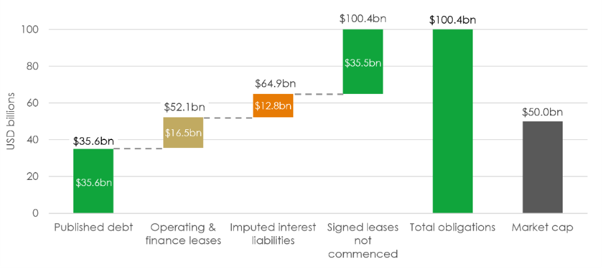
Source: Company filings, 30/09/26. Note: The waterfall adds published debt, recognised leases, imputed interest liabilities and estimated payments on signed leases not yet commenced. Market cap shown separately at $50bn
Next, we turn to the revenue of the company to assess how these expenses and debts will be repaid. The following chart shows the revenue and EBIT forecasts for CoreWeave using consensus analysts’ forecasts from Bloomberg, while the interest charge illustrations are based on the existing disclosed debt number of $35.6bn.
CoreWeave: Revenue, EBIT and illustrative interest charges
Bloomberg consensus revenue and EBIT forecasts, interest scenarios based on $35.6bn disclosed debt
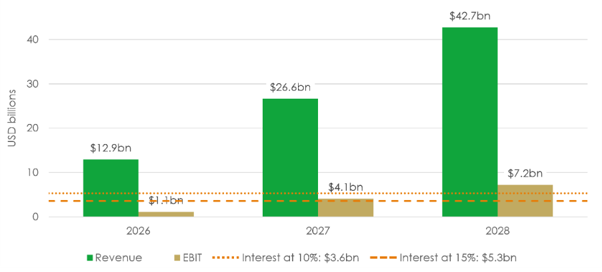
Source: Bloomberg, 30 September 2026. Note: Interest illustrations: 10% x 3.56bn; 15% x 35.6bn = 5.34bn. Forecast figures supplied in the accompanying text
As you can see, at 15%, the EBIT for the 2026/28 period is all but consumed by the servicing charges. It is perhaps of no surprise then that, as interest rates rise in the public markets, the CoreWeave credit default swap (CDS) levels reflect greater risk than the equity market assumes. As of the end of September 2026, the CDS levels on CoreWeave had risen to 850 basis points – under any normal evaluation, this represents a highly distressed debt situation with a significant chance of default.
In other words, while it is not necessarily a bad outcome, the risks are increasingly elevated. Certainly, the company has substantial contracted demand – the question is whether cash arrives, after operating costs and investment, quickly enough to meet those debt and interest obligations without perpetually receptive capital markets. As with the movie we set out with, this is a battle against the clock – the question is, can CoreWeave reach Chicago in time for Thanksgiving …
Mark Hawtin is head of the Liontrust Global Equities team