
China’s tax authorities have had a busy year. In the first half of 2026, more than 100 listed companies received demands for back-taxes and late-payment charges totalling some RMB7.7bn – more than comparable enforcement has collected over the previous 14 years combined.
On the face of it, this looks like another reason for investors to steer clear of China. And yet the sums involved – at around £860m so far – are not yet large enough to matter greatly for the Chinese economy. It is what they say about the state of Beijing’s finances that is more interesting.
None of this has changed our long-held caution over the country – yet, after many years of being underweight, the portfolio’s exposure to China and Hong Kong now roughly matches the two markets’ weight in the regional index.
Why China needs the money
For years, local governments in China funded themselves largely through land sales. The property downturn has severely reduced that income, while weak domestic activity has squeezed conventional tax receipts.
Local authorities are therefore carrying heavier debts and leaning more on transfers from Beijing. Against that backdrop, once tolerated arrangements – for example, preferential tax rates, local concessions and subsidies granted in easier times – have become an obvious place to look for revenue.
More centrally, the growing fiscal burden has made the old policy prescription of credit and infrastructure investment, whenever growth disappoints, progressively more expensive. This means both central and local governments have an incentive to find alternative sources of income – and, increasingly, those efforts are beginning to show up in places equity investors cannot ignore.
Subsidy dependence and clawback risk
Data compiled from Bloomberg shows policy support is concentrated most heavily in technology, semiconductors and other strategically important industries – as illustrated in the chart below– but subsidy dependence does not automatically translate into clawback risk. Given technological self-sufficiency remains a major priority, strategic sectors are probably among the last places Beijing would want to withdraw support.
Government subsidies and effective tax rates across different sectors in China (2025)
“The tax clawbacks are not themselves the central problem – they are a symptom of an economy still working through the debts of its investment-led growth model.
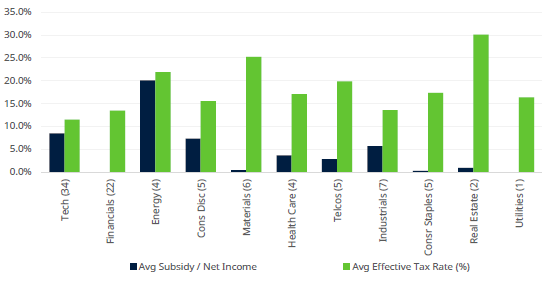
Source: Bloomberg, Schroders. Note: Figures in brackets represent number of companies in the sector included in this study
A more useful distinction is between genuine commercial profitability and earnings supported by tax concessions, grants and other government assistance. With that in mind, we asked our analysts to put our own portfolio through the same scrutiny the tax authorities are applying. Two companies stood out.
Zhejiang Sanhua makes thermal management systems for electric vehicles and air conditioning. In 2025, it received government subsidies worth 6.6% of net income. Even if that support were reduced, the direct impact on earnings looks manageable.
CATL, the world’s largest electric vehicles battery maker, needs more unpacking. Two of its related entities hold high-technology certificates entitling them to a lower corporate tax rate. Both expire at the end of 2026 and, while renewal applications are being prepared, this represents a degree of policy risk. Separately, nearly 15% of CATL’s net profit is classed as ‘other income’ – not all of it subsidy, but worth understanding properly.
We have made no changes to either holding – viewing these as risks to understand, monitor and reflect in position sizing, rather than reasons to sell fundamentally attractive businesses. Nevertheless, they are a reminder that government support is not necessarily permanent – even in industries the state considers vital.
Same instinct – this time applied to individuals
Wealthy individuals are now facing additional scrutiny. New rules effective from July 2026 bring Chinese residents’ offshore investments into the regulatory framework for the first time, and tax authorities are making greater use of international data-sharing to identify offshore income that previously escaped attention.
Policymakers are not trying to stop money leaving China – rather, if Chinese capital is going offshore, Beijing wants to know where it is, how it got there and whether the tax has been paid. Regulated channels are being maintained and, in some cases, expanded, even as informal routes close.
That matters for Hong Kong, where close to $1tn (£750bn) of China’s overseas portfolio assets is invested. Large, regulated banks, with the compliance infrastructure to handle money redirected towards them, may ultimately benefit – HSBC, which we own in the portfolio, among them. Online brokers, however, whose mainland business depended on grey-area access, look structurally more challenged.
None of this makes us more optimistic about China’s economy. Our long-standing caution is unchanged, and we remain wary of assuming the reflation playbook of the past two decades will work as easily in future. Increasingly, though, we find the risks are well understood and already reflected in share prices.
Another holding – pan-Asian life insurance group AIA – illustrates the point. Its growth is expected to slow as its China business faces tougher comparisons and more policy uncertainty but, as the following chart shows, the shares already trade close to historic lows – at around 1.0x price-to-embedded value (a measure of what an insurer’s existing book of policies is worth). A lot of bad news is already in the price, in other words – and anything better than this depressed base case should provide upside.
The market is assigning very little value to AIA’s MCV franchise or future growth
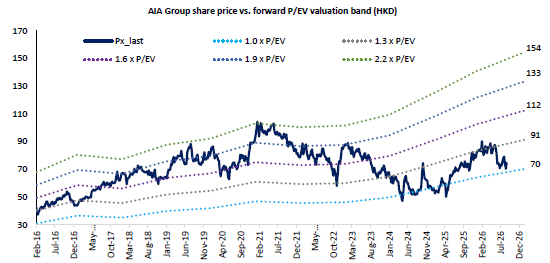
Source: Bloomberg, Schroders
The tax clawbacks are not themselves the central problem – they are a symptom of an economy still working through the debts of its investment-led growth model. That keeps us cautious on China as a whole – but it has not stopped us finding individual companies attractive enough to own. Which is why – as noted earlier – for the first time in years, our China and Hong Kong exposure now matches the index.
Even long-standing China bears like us, it seems, can change our minds when the stock-specific evidence demands it.
Robin Parbrook is portfolio manager of the Schroder Asia Total Return Trust