


Bond markets have endured an uncomfortable few weeks and yet the most important development is not simply that yields have risen – it is that the source of the rise is changing. The US 10-year treasury yield may have briefly reached around 4.82%, its highest level since 2023, while the 30-year approached 5.30% – yet the move has been global.
We have also seen 10-year gilt yields touch around 5.29% and German bund yields approach 3.4% while Japan’s 10-year yield crossed 3% for the first time in three decades. Brent crude has meanwhile moved back towards $95 (£70) a barrel amid renewed concerns over Middle East energy supply.
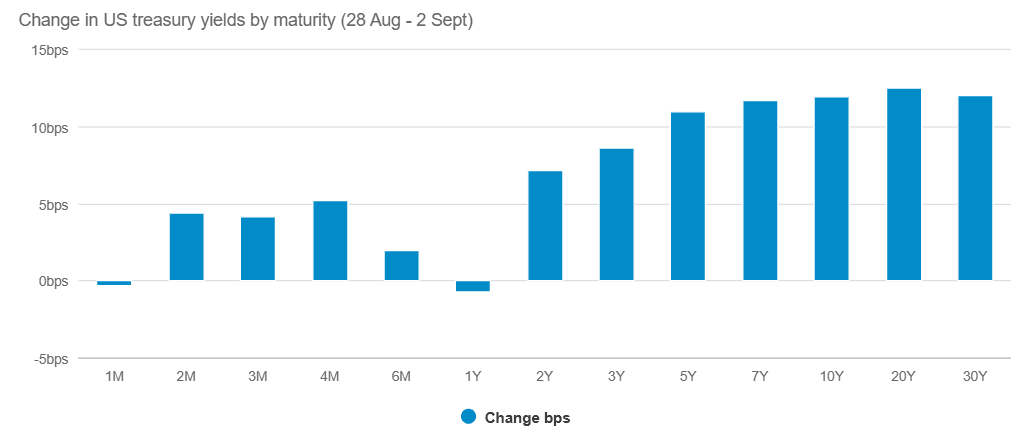
The sell-off has unfolded in two stages. Through much of August, it was predominantly a monetary policy story. The two-year treasury yield rose by around 6 basis points while the 30-year fell slightly, flattening the curve as markets reassessed the Federal Reserve’s reaction function.
Jackson Hole reinforced that move, with chair Kevin Warsh reiterating the US central bank’s commitment to its 2% inflation target and markets increasing the probability of a September hike to around 60%.
More recently, however, longer-dated yields have joined the sell-off, suggesting a broader reassessment of the term premium. Higher oil prices have renewed inflation concerns at a time of large fiscal deficits, heavy sovereign issuance and exceptionally strong private sector borrowing. US investment grade issuance reached around $164bn in August – the largest August total on record – adding to the amount of duration investors are being asked to absorb.
Longer-dated treasury yields have led the latest sell-off
“The question is becoming bigger than whether the Fed hikes once or twice more: at what yield is there sufficient private sector demand to absorb the growing supply of long-duration debt?
Source: Fidelity International, LSEG Workspace, September 2026
The question is therefore becoming bigger than whether the Fed hikes once or twice more: at what yield is there sufficient private sector demand to absorb the growing supply of long-duration debt?
If that required yield is rising, investors are demanding greater compensation not just for expected policy rates, but for inflation uncertainty, fiscal risk and supply. That matters because policy expectations can reverse relatively quickly when growth slows, whereas a structurally higher term premium can prove more persistent.
There is also a longer-term policy question. If rising long-end yields begin to threaten fiscal sustainability or strategic investment, policymakers retain tools – from asset purchases and maturity management to yield curve control (YCC) at the more extreme end – to suppress the term premium. Formal YCC is not our base case, but the broader risk of financial repression should not be dismissed.
Pain today, opportunity tomorrow?
For fixed income investors, the important counterpoint is that the same rise in yields weighing on returns today is improving prospective returns from here. More income is now available across government and corporate bond markets, increasing the amount of volatility that can be absorbed through carry. Investors need to rely less on further spread compression or large capital gains to generate attractive total returns.
That should reinforce the case for fixed maturity and buy-and-maintain strategies. Demand for these approaches is already strong at current all-in yields – but another leg higher could attract investors who have been waiting for more compelling entry points or encourage some of the cash still sitting on the sidelines to move into bonds.
Importantly, the reverse is not necessarily true. A modest decline in yields would be unlikely to undermine demand materially given the income still available. Yields would probably need to fall much further before the fundamental attraction of locking in current income levels diminished significantly.
The further yields rise without a commensurate improvement in the medium-term growth outlook, the more attractive the eventual risk-reward becomes.”
The more complex question is duration. The near-term technical backdrop remains challenging, oil remains volatile, substantial issuance still needs to be absorbed and central banks may yet have more work to do. Yet duration is increasingly becoming one of the more contrarian exposures in markets. The further yields rise without a commensurate improvement in the medium-term growth outlook, the more attractive the eventual risk-reward becomes.
If employment weakens more decisively, energy prices stabilise or central banks conclude that the tightening already delivered is beginning to bite, duration could once again offer meaningful upside as well as portfolio diversification.
That argues for flexibility rather than abandoning duration altogether. A structurally more inflationary environment does not eliminate the economic cycle, and periods of market stress should continue to create tactical opportunities in government bonds.
Opportunity and signal
Credit markets remain remarkably resilient despite the sovereign sell-off. US high yield spreads, for example, tightened during August, while companies were simultaneously able to issue record volumes of investment grade debt. That distinction is important. Government bonds are pricing greater inflation, duration and supply risk, but credit markets are not yet pricing a material deterioration in corporate solvency or default risk.
Credit spreads are undoubtedly tight, leaving relatively little cushion if the macro backdrop deteriorates. For now, though, they suggest the recent move remains primarily a rates event rather than a broader credit event.
Investment grade and the stronger parts of high yield can offer attractive income – but today’s tight spreads argue for selectivity rather than indiscriminate risk-taking.”
Credit is therefore an important signal to watch from here. If government yields continue higher and credit spreads begin to widen materially as well, companies would face both a higher underlying funding rate and the requirement to provide greater compensation for credit risk. That would represent a more powerful tightening in financial conditions and cloud the economic outlook.
From an investment perspective, that reinforces the importance of quality. Investment grade and the stronger parts of high yield can offer attractive income – but today’s tight spreads argue for selectivity rather than indiscriminate risk taking.
High yield also benefits from a generally shorter duration profile, providing some insulation from a sell-off driven primarily by government-bond duration – at least while corporate fundamentals and broader risk markets remain resilient.
Read-through to equities
The bond market adjustment also has important implications beyond fixed income – for corporates, for example, a higher risk-free rate gradually increases refinancing costs as existing debt matures.
For equity valuations, the transmission can be much faster: higher real yields increase the discount rate applied to future earnings, with the greatest impact typically falling on long duration assets whose valuations depend most heavily on profits far into the future.
The distinction between nominal and real yields is therefore important. A rise in nominal yields driven primarily by higher inflation expectations has different implications from a rise in real discount rates. It is the latter that poses the more direct challenge to valuation multiples.
There is also greater competition between asset classes. As bond yields rise, equity dividend yields and future cashflows must be judged against an increasingly attractive fixed income alternative.
None of this necessarily implies an imminent equity correction. Corporate earnings and investment remain robust. Yet the hurdle rate for risk assets is rising, meaning strong earnings may translate less powerfully into higher valuations than they did when discount rates were lower.
The global bond market is moving beyond a relatively narrow debate about the next 25-basis-point central bank decision. Increasingly, the question is how much compensation investors require to own duration in a world characterised by more volatile inflation, large fiscal deficits, substantial sovereign borrowing, heavy corporate investment and a less predictable supply environment.
That is a more demanding environment for bond investors – but it creates opportunity as well as risk. In the near term, we would remain selective in credit, cautious about prematurely declaring the peak in long-term yields and flexible on duration.
That said, every move higher in yields strengthens the underlying income proposition, while tighter financial conditions simultaneously increase the probability that economic momentum eventually slows. For now, the sell-off is making fixed income harder to own tactically, but it is also making the strategic case for the asset class increasingly compelling.
Marion Le Morhedec is global fixed income CIO at Fidelity International