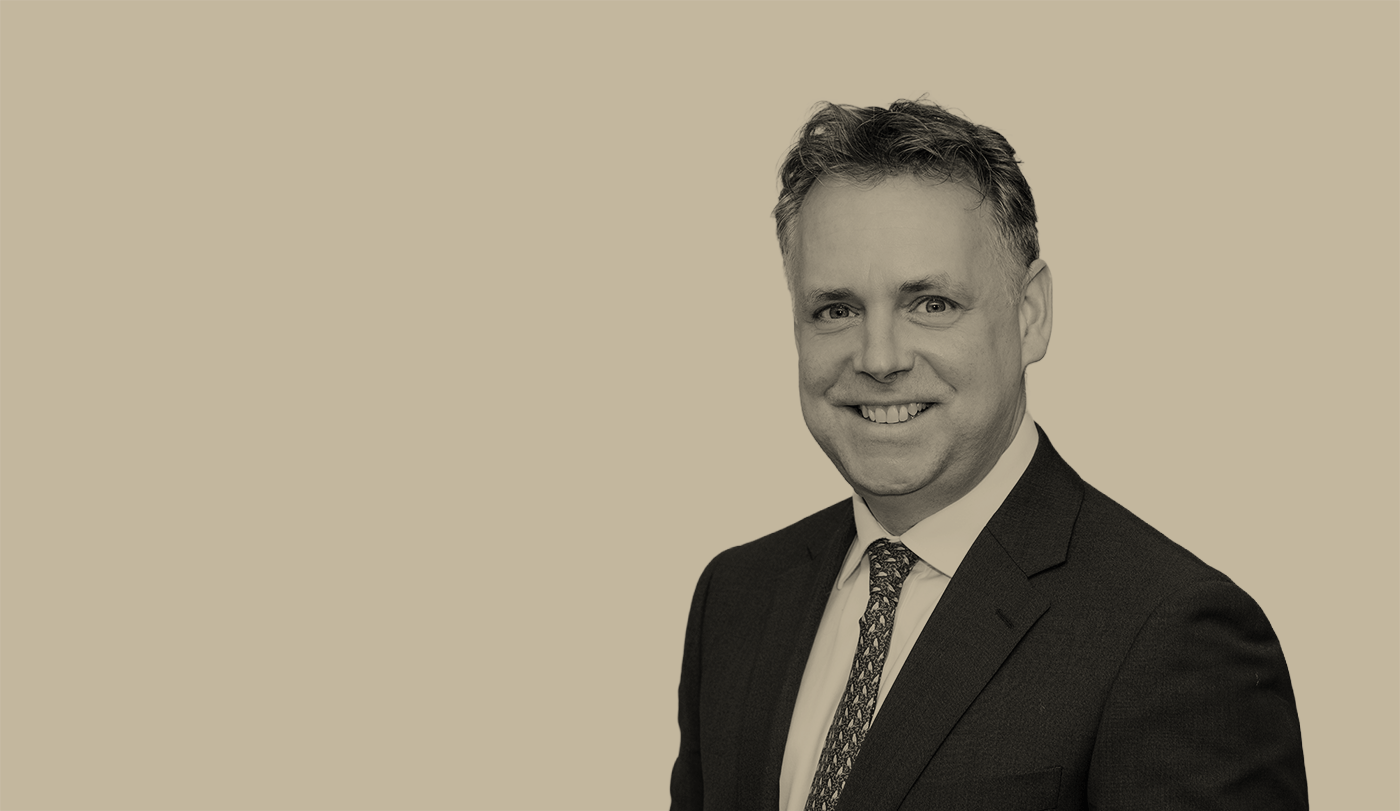


Impax executive director of business development Stuart White on resilience, financial materiality and a family trip to the Sahara
Where – and why – are you anticipating demand or fund-flows from UK-based wealth managers and their clients over the next 12 months?
We expect demand to continue building around several structural themes that are increasingly being framed less in terms of ‘sustainability’ and more in terms of financial materiality. In particular, resilience, energy security, AI efficiency and electrification are all areas where we see strong and growing interest from UK wealth managers and their clients.
Recent years have demonstrated the importance of resilient infrastructure, secure energy systems and efficient resource use, while the rapid adoption of AI is creating significant demand for the technologies and infrastructure that enable productivity gains without unsustainable increases in energy consumption. Electrification remains a long-term structural trend, supported by ongoing investment in power networks, industrial efficiency and transportation.
These themes align closely with Impax’s 25-plus years’ environmental markets heritage. We believe investors are increasingly recognising that many environmental solutions businesses are not only helping address global challenges but are also positioned to benefit from powerful and durable economic trends.
At the same time, wealth managers remain focused on managing tracking error and overall portfolio risk. Clients are increasingly obtaining their core exposure more efficiently with tighter tracking error solutions – be that through indices, ETFs or increasingly popular systematic equities capabilities.
In fixed income, meanwhile, rising government bond yields are forcing clients to consider their current allocations, with credit markets offering historically higher-quality alternatives for allocators to consider.
How are you planning to address and serve that interest?
Our approach is centred on offering investors multiple ways to access these long-term growth opportunities, depending on their portfolio objectives and risk budgets. For investors seeking high-conviction exposure, our environmental equities franchise continues to provide access to the themes where we see the strongest structural growth opportunities. With a track record spanning more than two decades, we believe we are well-positioned to help clients capture client interest in these themes.
At the same time, we recognise that many wealth managers want broader, more diversified solutions with lower tracking error characteristics. For this reason, we are building out our systematic equities capability and plan to launch a new fund in the next few weeks. We believe that this could prove an attractive option for advisers and wealth managers looking to integrate sustainability-related opportunities into mainstream portfolio construction rather than through standalone thematic allocations.
In fixed income, we are having increasing levels of success in high yield, with a more defensive short-duration offering that enables clients to benefit from the carry trade in high yield markets with a strong emphasis on downside protection; similarly, our high-conviction global high yield strategy has achieved its 2%-plus annualised alpha target over more than 11 years. Both strategies are well-positioned in their respective peer groups, while also exhibiting a more attractive sustainability profile.
Alongside our product offering, we continue to support our wealth management client base through thought leadership and education via the Impax Sustainability Centre, which helps our clients understand how these structural trends are evolving and how they can be implemented within portfolios.
Are you seeing a divergence in the demands of UK wealth managers versus, for example, their peers in Europe or on the institutional side in the UK?
Some trends are consistent across the board. Within the UK wealth management market, for example, client partners are increasingly looking to do more business with fewer managers and rightly look to extract more value from their asset manager partners. A similar consolidation trend is happening in the institutional space, for example through the asset pooling of the Local Government Pension Scheme. This means asset-owners are often looking for a ‘one-stop-shop’ or a specialist asset manager.
Specific to sustainable investing, some asset managers have definitely stepped back on their commitments and allocations to the spectrum of solutions within this space – whether that is full-impact through to ESG integration in investment process. This is leading some asset-owners to reconsider how they deploy their assets. In this context, Impax is well-positioned as arguably the leading global shop with such a deep knowledge of the transition to a more sustainable economy.
As a business, how do you define ‘alternative’ and ‘private’ assets and to what extent should asset managers be looking to service investor demand here?
Impax is one of the longest-established private markets managers in the energy transition sector, with more than 20 years’ experience. We manage a series of energy funds that follow an industrially-focused value-add strategy, investing in renewable power generation and related assets in Europe, including onshore wind, solar PV, battery storage and EV charging infrastructure. Currently this is a small proportion (3%) of our AUM, but it is an area we are looking to grow and the team is currently seeking additional capital in this area.
The conflict in the Middle East has only served to highlight the need invest in more resilient energy systems in Europe. Renewable generation is the fastest way to deliver affordable energy that is far less exposed to geopolitical disruption – and private markets is often the best way for investors to capture this theme.
‘ESG is dead – long live ESG 2.0’ – your thoughts as a distributor, please?
‘ESG’ is a term we have long shied away from at Impax, so we would not mourn its passing. And while ‘sustainability’ issues may have fallen down the agenda, for many investors, the framing around these issues has now evolved to ‘resilience’.
This itself is a multi-layered term but, in this context of understanding risks and opportunities, resilience implicitly demands a focus on financial materiality. This aligns well with our own decision in the last couple of years to use the terms ‘corporate-resilience analysis’ and ‘issuer-resilience analysis’ to analyse how robust companies’ strategies and business plans are in the context of evolving challenges.
Outside of work, what is the strangest thing you have ever seen or done?
Possibly the strangest – and certainly one of the most challenging – things I have ever done was take on the Marathon des Sables in 216 with my four brothers. It involved covering around 250km across the Sahara over six days, carrying our own kit and dealing with everything the desert could throw at us.
As if attempting that with four siblings was not unusual enough, we also had a documentary crew following us. The resulting film, Brothers in the Sand, captured an experience that ultimately became about much more than running. Spending six days together in that environment, physically and mentally exhausted, tested our relationships as much as our endurance.
We completed the challenge in support of mental health charities and raised more than £50,000. It remains one of the most extraordinary things I have done – although I am not sure I would recommend the Sahara as the setting for a family reunion.
“Many environmental solutions businesses are not only helping address global challenges but are also positioned to benefit from powerful and durable economic trends.