


For most of the past three years, the AI investment boom has been an equity story – but it is increasingly becoming a bond-market one. The numbers are just becoming too large for bonds investors to ignore.
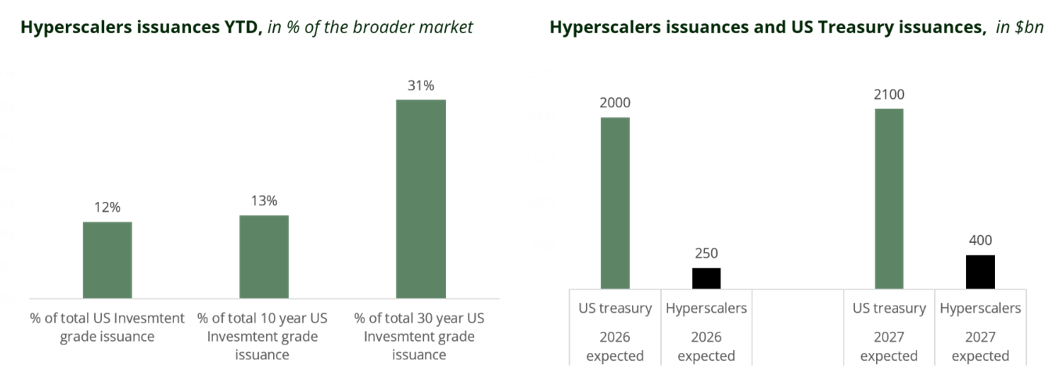
Direct bond issuance from hyperscalers is estimated to have increased from $100bn (£76bn) in 2025 to $250bn for 2026 – and are then expected to hit $400bn in 2027. What is more, direct hyperscalers’ issuance understates the phenomenon as financing is increasingly migrating into project finance, data-centre structures, private credit, leases and other vehicles.
For bond investors, the focus goes beyond how much debt Alphabet, Amazon, Meta or Microsoft can issue under their own names – what ultimately matters is the sheer amount of duration the AI infrastructure is asking markets to absorb.
To the end of October this year, AI-related borrowers have accounted for around 18% of the total US investment-grade issuance – yet they have, in fact, accounted for 40% of issuances beyond 15 years.
Hyperscalers alone represent approximately 12% of overall US investment-grade supply, but more than 30% of the 30-year sector supply. On current estimates, net hyperscalers’ bond supply could reach a scale equivalent to almost one-fifth of annual US treasury net borrowing as soon as 2027.
“How much additional yield will investors eventually demand to finance both the AI capex boom and the US government at the same time?
Source: Carmignac, GS, Bloomberg, October 2026
So the question is no longer whether AI will require a lot of capital – it already does and in huge amounts – it is who will provide that capital and at what price?
As you can see in the above chart, AI-related borrowers have been particularly important at the long end of the credit market. That matters because highly-rated 20 and 30-year technology bonds are paying investors treasury duration plus a credit spread.
So why should insurers, pension funds, foreign investors and other real-money accounts own US treasuries when they can pick up an additional spread from a very highly-rated technology borrower? Even more so as some highly-rated technology issuers offer investors comparable or even sometimes stronger credit ratings than the US government – and, one could, argue less erratic and more visible strategic direction.
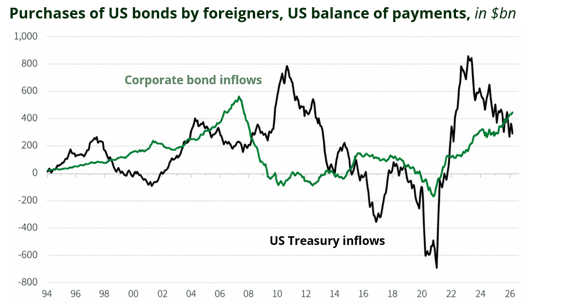
Corporate and sovereign issuances are not perfect substitutes, of course – yet they ultimately compete for the same pool of capital, and this competition is emerging at a time when the demand for US government bonds is already shifting.
In fact there is already some evidence of that competition for capital. As you can see below, according to treasury data, in the 12 months to the end of June 2026, foreign private investors bought a net $390bn of US corporate bonds versus $329bn of treasury notes and bonds. The direction of travel is also telling as foreign appetite for US corporate credit has remained strong while demand for treasury duration has fallen.
Source: Carmignac, GS, Bloomberg, October 2026
Testing the hypothesis
So does this mean the hyperscalers’ issuance caused the treasury sell-off? Probably not. There has been no shortage of explanations for the rise in US long-term yields this year – from resilient growth and changing inflation and central bank policy expectations to humongous fiscal deficits and geopolitical uncertainty.
Hyperscaler issuance also belongs on that list but blaming the treasury sell-off on AI issuance confuses structural pressures with the cyclical drivers of yields. One way of testing the hypothesis is through a term-premium model. Our model estimates the fair value of a given treasury maturity using expectations for short-term interest rates, inflation and economic growth. The remaining component between observed yields and the model-implied fundamental value captures the additional compensation investors demand for holding long-duration bonds – broadly, the term premium.
The results are instructive. Of the approximately 62 basis-point (bp) increase in the US 10-year yield over the period considered, our model attributes around 23bps to a repricing of the term premium. The remaining move is primarily associated with changes in the macroeconomic outlook, including growth, inflation and the expected path of interest rates.
And when using other models – for example, the Christensen-Rudebusch decomposition from the Federal Reserve Bank of San Francisco – only 12bps of the overall rise in the 10-year treasury yield can be attributed to the term-premium component.
Neither model allows us to isolate a precise ‘hyperscaler effect’, it should be noted, as the term premium is also simultaneously absorbing concerns around US fiscal sustainability, debt supply, inflation uncertainty and changes in the composition of global treasury demand.
Still, even if AI debt did not drive most of the sell-off, that does not mean bond investors can ignore it as it most probably contributed to it. This is where the more interesting part of this story begins – and the bond issuance supply shock may only be just beginning.
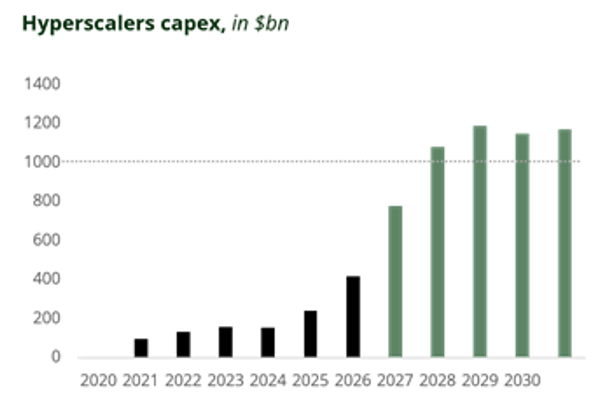
The AI capex cycle has so far proved relatively insensitive to the traditional economic cycle and upward rates environment, and the years ahead should see even more investments with capex projected to run at a $1tn annual clip from 2027 through 2030. And, because of the lag between investment and monetisation, external funding rises before cash-generation catches up.
Some 35% of the estimated capex is expected to be funded through debt – and this is solely at the hyperscaler direct-issuance level. This is massive and would represent one-third of the annual US Treasury funding needs going forward. Further out, even flat spending growth (capex) would leave an exceptionally large recurring funding need.
Hyperscalers will have to find $400bn per annum from next year through to – at least – 2030, according to consensus. This should be financed either by a bigger US deficit, which should impact the treasury curve on the bearish side, or by foreigners, who are likely to ask for a higher premium as the ‘structural’ buyers are fewer – be they Japanese, Chinese or European.
And the same applies for the Federal Reserve, which is not signalling a willingness to increase its balance sheet – indeed, rather the contrary.
Source: Carmignac, Bloomberg, October 2026
The same global pool of long-duration savings is increasingly being asked to finance two enormous investment programmes at once – governments running large fiscal deficits and technology companies building the infrastructure required for AI.
If the supply projections are even approximately right, the adjustment mechanism ultimately has to be priced. That would mean credit spreads widen, treasury term premia rise or foreign capital increases its allocation to US duration – or some combination of the three.
The key question, then, is how much additional yield investors will eventually demand to finance both the AI capex boom and the US government at the same time.
Kevin Thozet is a member of the investment committee at Carmignac