
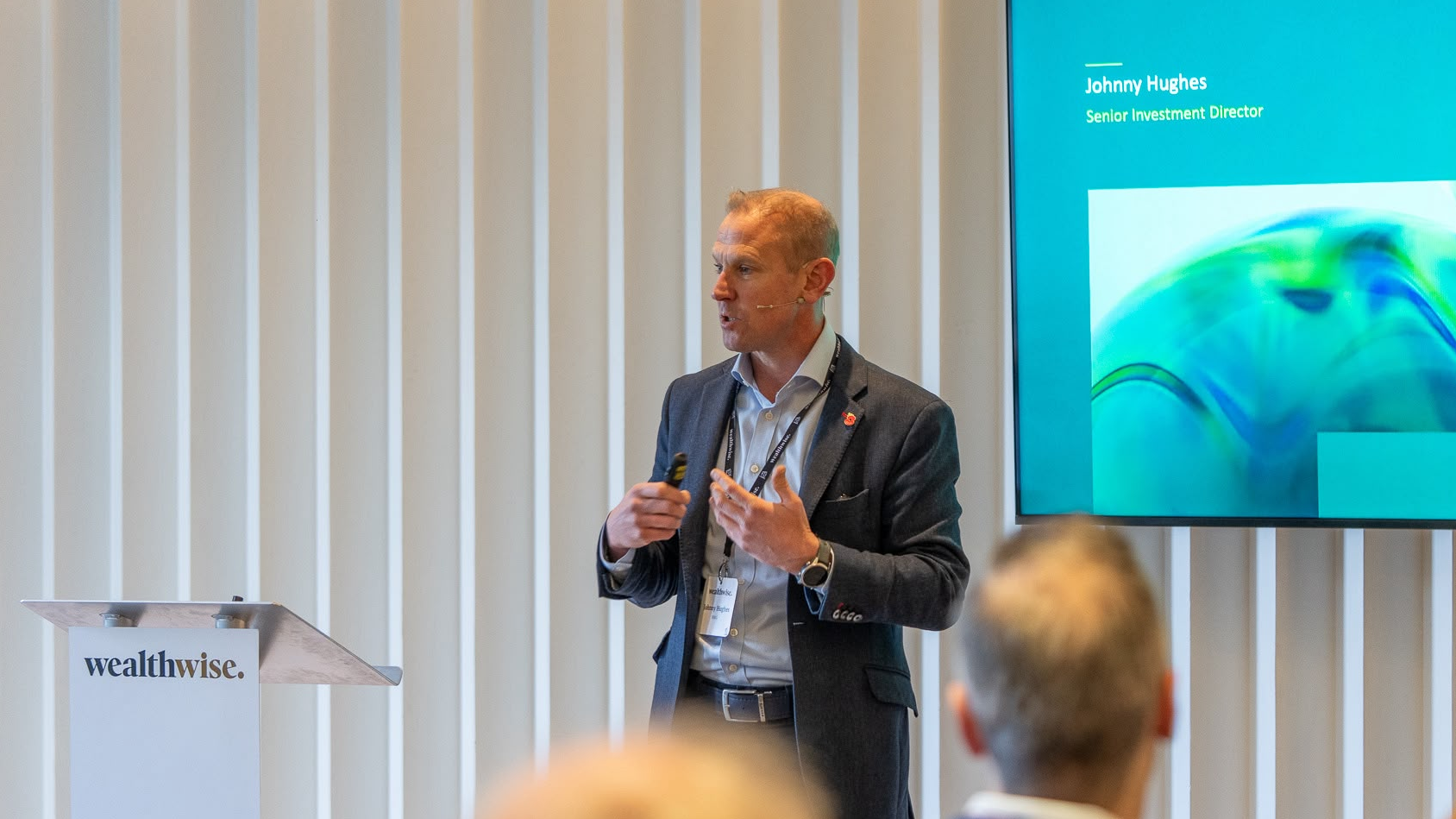
Engaging with risk assets in today’s markets should be more a process of rotation than any kind of retreat, believes M&G senior investment director Johnny Hughes. “The word ‘volatility’ gets chucked around a lot these days,” he tells the audience of Wealthwise’s Autumn Wealth Forum, which took place earlier this month, “but people do not always explain what it means.
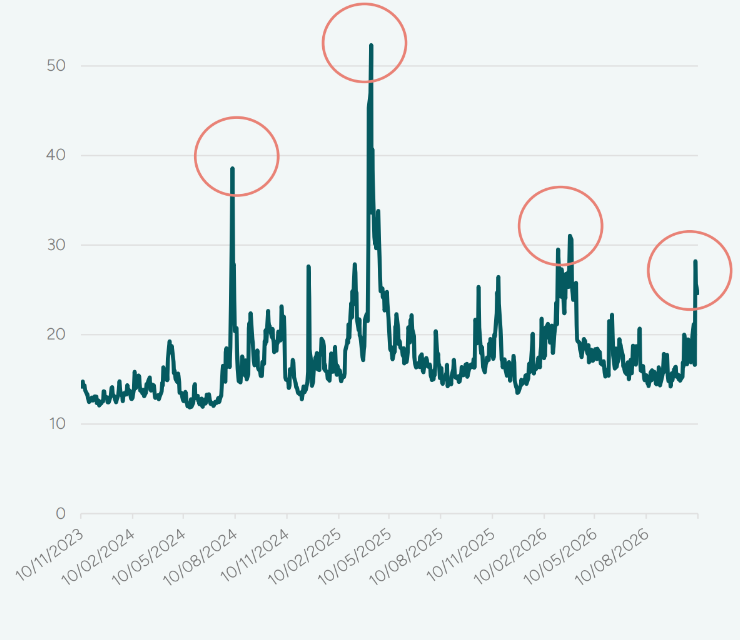
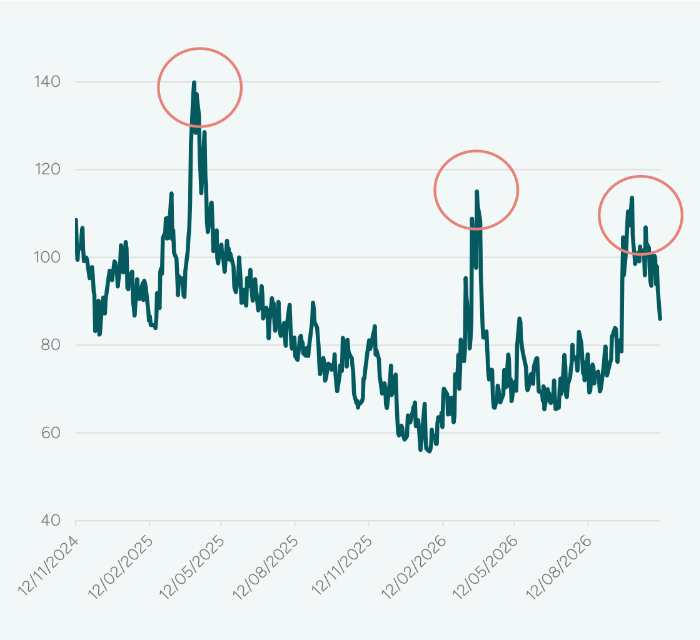
“If you look at the ‘Vix’ – the proverbial ‘fear and greed’ equity volatility index – and its ‘Move’ equivalent in bond markets, it is clear what we have been going through in a relatively short period of time. And, for a lot of folk, these episodic market spikes are the main reason they do not want to be involved in risk assets. They read about the events that lead to these spikes and think, ‘That’s not for me. I don’t understand it. It’s too hard’.”
Fear and greed: ‘Vix’ equity volatility index (left) and ‘Move’ bond volatility index
“In recent decades, all forms of US assets have been very comfortable places for investors – but that is now changing.
Source: Bloomberg, November 2026. Past performance is not a guide to future performance
The counterpoint to that, Hughes goes on to suggest, is to ask – given the all-consuming geopolitical narrative of recent years – how have equity markets still been pushing record highs? And the answer, he believes, is relatively straightforward – elaborating: “Someone repeatedly has had your back – and, for an extended period of time, it was the central banks.
“They were cutting interest rates and flooding markets with liquidity – with periods of quantitative easing and other assistance programmes that went on and continue to support markets – and then, in more recent times, this role has been taken over by governments. In other words, there has been this proverbial ‘put’ option from authorities that has kept the game going.”
Such interventions inevitably raise the spectre of moral hazard, says Hughes, which in turn begs the question: Are markets now too big to fail? “Their repeated support suggests the authorities believe that is definitely the case,” he adds. “So keep that in mind the next time a client says they are worried or scared – that attitude would have meant missing out on some fantastic returns, particularly in equity markets, over the last few years.”
We are on very thin ice from a fiscal perspective as governments have, quite frankly, been spending like drunken sailors.”
To encapsulate how the investment teams at M&G have been thinking about the world for the last 24 months, Hughes picks out a trio of “seismic shifts or major regime changes bubbling away under the surface” adding: “On any given day, one may be more apparent than the others but we believe all three remain there in the background and working their magic.”
These are a ‘great rebalancing’ of capital across assets, regions and investment style; ‘fiscal fragility’ in many world governments; and the disruption and dislocation being caused by the ‘AI capex supercycle’. On the first of these, Hughes says: “Capital is progressively reallocating away from the destination of choice of recent decades. All forms of US assets have been very comfortable places to be involved but that is now changing.
“Then, of course, we are on very thin ice from a fiscal perspective as governments have, quite frankly, been spending like drunken sailors. Bond markets occasionally try and rein them in – the proverbial ‘vigilantes’ do get involved from time to time – but ultimately what this is doing, along with inflation, is distorting the risk-free rate, the 10-year treasury yield, which sets the price for every risk asset in markets.
“That means investors are facing a challenge as they try and price individual stocks or credits. After all, if the risk-free asset itself becomes a bit of a moving target – and frankly, at times, it has been trading more like a meme stock – then, as investors, we are in a completely different place in terms of portfolio protection and hedging.”
‘Exhilarating and terrifying’
As for the seismic nature of the current capital expenditure by AI businesses, it is worth noting Hughes is speaking a week after the Nasdaq index dropped 6% in a day in response to the results of the US midterm elections – and, as it turns out, a few hours before the resignation of Nvidia CEO Jensen Huang. “We are in the middle of an extraordinary capex boom that is both exhilarating and terrifying,” he goes on to observe.
“Clearly a fair degree of dislocation and disruption is being produced as we work through this technology supercycle – although, of course, that is potentially an absolute goldmine. If you are an active equity manager at the moment, you are having a fantastic time because, along with such degrees of variance, there are wonderful stockpicking opportunities emerging on a daily basis.”
And while Hughes concedes it may be almost redundant to add that, when the world is changing, portfolios should change too – especially when “diversification can be obtained at a discount” – he also warns: “We do not necessarily feel this change is happening at the speed or to the degree that probably needs to be the case to make sure you are on the right side of these trends.”
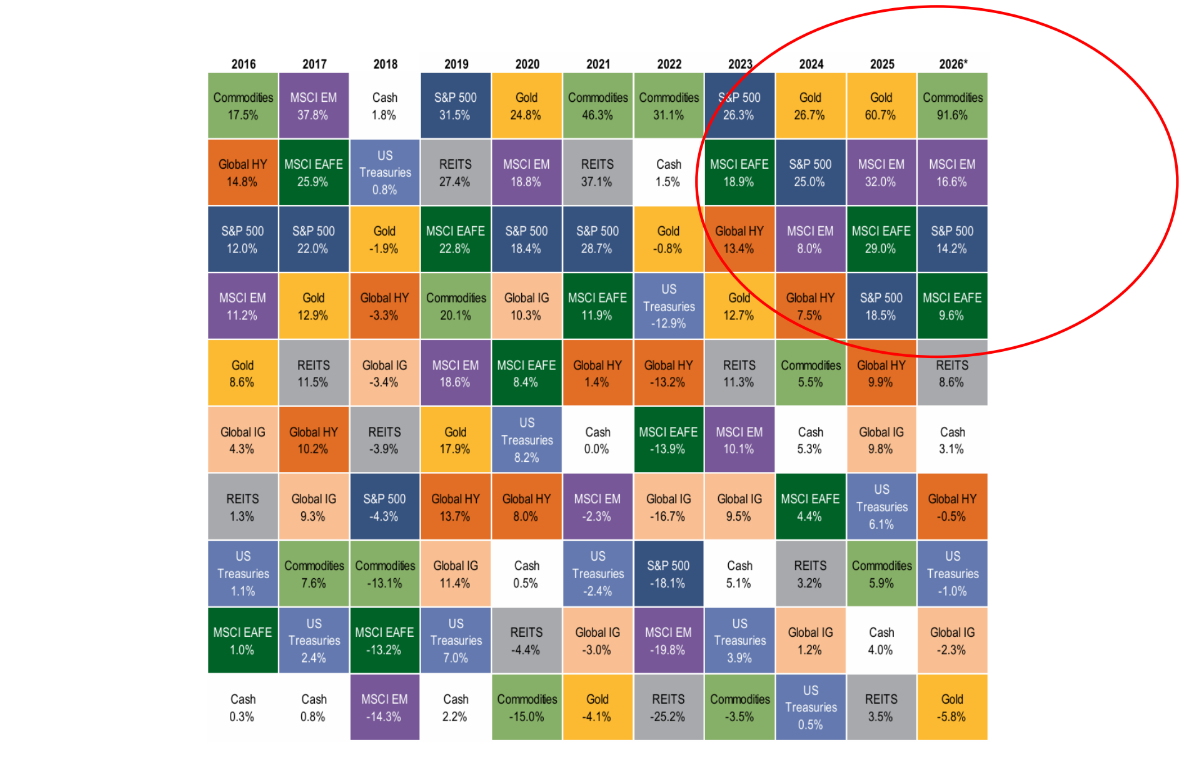
To offer some perspective here, Hughes highlights the following chart, which ranks the main asset classes by discrete annual performance since 2016 – with this year’s performance taken to the end of October – and notes: “What has been working – and has continued to work this year – is not what most investors tend to have a lot of in their portfolios.
Rotation by assets: Discrete annual performance of main asset classes since 2016
Source: Bloomberg / BAML, October 2026. Past performance is not a guide to future performance
“They are unlikely to own a huge amount of commodities and may only have a bit of emerging markets. OK, for the S&P500, they are probably covered – but the investment world is rotating. It is starting to own and to elevate different forms from, let’s say, the traditional, more comfortable asset classes we have owned at other periods of time.
“As you can see in the top-right corner, there has been a rotation towards real assets with a nominal growth boom – and you want to own real assets because inflation is back. We will discuss that more as we go along but you can see the effect of inflation in this chart – it is not too good on fixed income. If you believe inflation is sticky and here to stay, this real asset rotation has to be a key point of consideration.
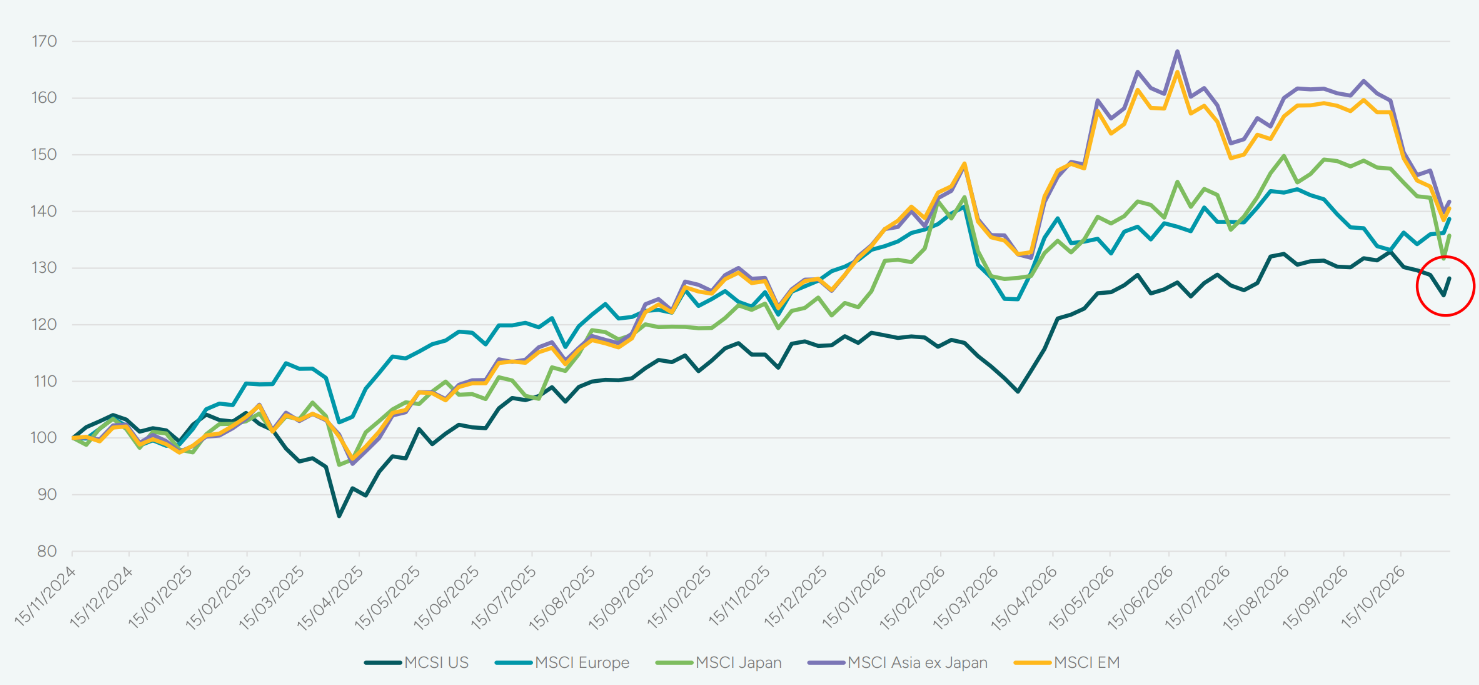
Turning to the following slide, Hughes says: “We have already started to see regional rotation in equities because US equities have not been pulling their weight. In reality, there is not a huge gap in performance here but, if you take into consideration the fact all these other markets are materially cheaper on a risk-reward basis, things have heavily shifted away from US equities.
Rotation by region: Performance of major regional equity markets over the last two years
Source: Bloomberg, November 2026. Past performance is not a guide to future performance
“Now, that is not to say I am a US equities bear – investors have to be allocated there because the US is the best home for companies, the best home for capital and, traditionally, the best home for entrepreneurism. The key point here, however, is the marginal allocation could increasingly look elsewhere. The story around non-US equities is fundamentally based – it is because their earnings are now starting to grow again.
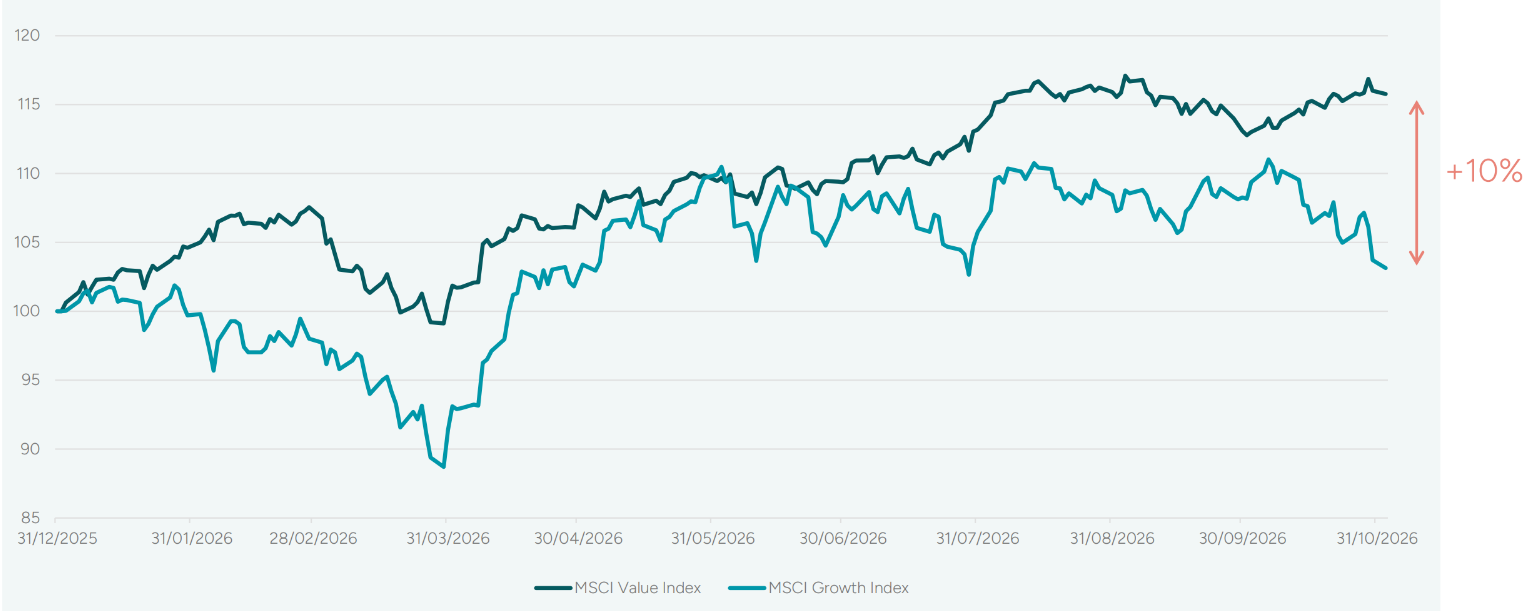
“Most of the world has not enjoyed the buoyant earnings upgrade cycle – mainly driven by AI – that the US has enjoyed for quite some time but it is catching up now. And markets always look for that second derivative – the rate of change – and rest-of-the-world equities now have an earnings-growth story.” And, in addition to rotation be asset class and rotation by region, Hughes highlights rotation by investment style with this next slide:
Rotation by style: MSCI Growth Index vs MSCI Value Index (USD)
Source: Bloomberg, November 2026. Past performance is not a guide to future performance
“Investors may have been extremely enamoured with US tech and growth stocks,” he says, “but under the surface – outside of the US – value as a style has continued to perform very well. And what is interesting now is that value strategies are having a much better time in the US as well. So, on a global basis, value is back doing what it should do and has done longer-term, which is to be the main outperformer in equity markets.”
Moving on to the fallout from the US midterm elections at the start of this month, Hughes argues there are some significant lessons for investors to draw. “While the result was relatively well-flagged – looking at all the prediction markets, the so-called ‘blue wave’ was pretty much nailed on – the subsequent reaction in markets shows elements of it were not,” he says. “And that is what we are chewing through now.
“There are a couple of critical points here that feed back into those ‘seismic shifts’. First and foremost, it is very clear that US voters hate inflation and are extremely wary about AI. Breaking that down, they basically hate the causes of inflation, which of course are elements of the war and tariffs and geopolitical decisions that have been made that are somewhat self-inflicted. And the message has now gone out that those things need to change.
“And while we will look at the question of AI and where it is going in more detail later on, a fascinating aspect here is these elections were probably the first time any major country has had issues such as AI tech bros, datacentres, cronyism, the super-rich and so forth on the ballot – and the result was effectively a resounding rejection of ‘all of the above’.
We are now hostage to the work of indexation, the degree of passive involvement in markets and the ensuing herd mentality, which produces these massive swings.”
“The newly-elected politicians are not anti-datacentres per se and they are not anti the economic benefits of these facilities. It is more the symbolism – the fact AI businesses often overrode planning permits, developed these huge facilities, drove up prices and changed the cost of living for people in those locations. Hopefully, though, what it now means is more of a collaborative experience for the next wave of AI development.”
A further lesson Hughes picks out concerns the current fragility of markets. “As the results of the midterms came in on the Wednesday, markets appeared comfortable,” he points out. “Risk assets were reasonably buoyant, fixed income did not really move and gold moved only a little – but none of the major contagion signals were ringing at that time.
“Then, the next day, everything collapsed – begging the question: What is at work here? The whole ‘plumbing’ of markets – particularly in equities and fixed income – has become extremely volatile. That much is obvious – but I would argue we are now hostage to the work of indexation, the degree of passive involvement in markets and the ensuing herd mentality, which produces these massive swings.
“As someone who has spent 20-odd years of their life on the trading floor, I find this fascinating. At the start of my career, we would pick up the phone and speak to fund managers and they would ask to buy 300,000 Nestlé or whatever. By the time I left a couple of years ago, though, the trading floor was silent as some 90% of trades going through on any given day were done systematically – by a quant fund, a CTA or whatever.
Inherent fragility
“In other words, the marginal mover and price-setter in markets is now a machine that is probably coded off a model from some smart guy who went to MIT. So the involvement in markets on a daily basis at a participant level is very different and this is causing a lot of inherent fragility. As with volatility earlier, it is something we just need to be aware of. It is hard to react against it on a day-to-day basis so we need to look beyond it.”
A fourth lesson, suggests Hughes, is from the latest payrolls data as much as the midterms. “The US economy is still fine, which is fascinating,” he says. “Voters have effectively said, ‘The economy may be optically strong but we are still pushing back and want change’. That must be a reflection of the so-called ‘K-shaped economy’ – the idea that the rich have grown richer while, sadly, for everyone else the cost of living is really biting.
“And then finally, what we had already noticed but was underlined last week is that, with the rejection of AI, there are plenty of other places to invest – lots of other companies and markets that have been shunned. This ‘underclass’ of assets – which has just not been represented sufficiently in portfolios and has lagged in terms of equity performance – has been given another chance and capital has started to flow.”
With these lessons duly noted, Hughes shifts his focus to the future. “At M&G, we do not do forecasts,” he makes clear, “but it is fair to say we may well have reached a number of ‘peaks’. These inflection points normally elicit a response in markets – and particularly equity markets, which always want to think about what is next and the rate of change in either direction, as opposed to the absolute level.” You can read more on that shortly in ‘A peek at the peaks’
Johnny Hughes is senior investment director at M&G Investments