


Earlier this summer, investors began to ask who would earn a return on all the money being spent on artificial intelligence. Recent weeks have begged the natural follow-up question of who pays for it as the cost, funding and cash generation of the build-out attract more scrutiny. Developments in early November, including the results of the US midterms and sharp moves in equities and the price of oil, have added further dimensions to that debate.
Against this backdrop, investors have become more selective between businesses benefiting from AI demand and those financing the infrastructure needed to meet it. Several areas that had delivered the strongest gains over recent years were among October’s weakest, while some recent laggards made respectable progress.
That divergence has continued into early November – and, while a period of a few weeks does not make for much of a trend, and leadership has changed direction several times this year, the latest moves are a useful reminder of why investors should seek to diversify portfolios across multiple sources of growth.
A bill for the build-out
October began with the S&P500 and Nasdaq Composite indices at record closing highs, while substantial increases in quarterly operating profits at Samsung and SK Hynix demonstrated the strength of semiconductor demand. Attention, however, quickly moved from the size of the opportunity to the financial commitments it entails.
AI cloud provider CoreWeave’s credit default swap spreads widened above 1,000 basis points, indicating greater concern about its credit risk. SpaceX secured around $40bn (£30bn) of financing for AI chips, while Meta announced plans to raise up to $95bn of equity. Together, these developments underline the scale of the industry’s capital requirements and its reliance on external funding alongside internally generated cashflow.
Company results followed a similar path, shifting the test from growing revenues to cash generation, with Meta’s negative free cashflow and heavy capital expenditure plans unsettling investors, Alphabet falling sharply towards the end of the month after missing revenue expectations, and Intel falling on the final trading day after a disappointing outlook compounded by disruption at its Israeli factory.
“The US midterm results brought opposition to data-centre development into greater focus – including in states where incoming Democratic governors have advocated pauses or tighter requirements.
Campaign commitments are not yet implemented policy yet more demanding approval processes could lengthen project lead times and increase costs.”
Anthropic, one of the leading AI developers, added further fuel to the debate with its filing ahead of its proposed listing. First-half revenues of $16.3bn, alongside sizeable commitments for computing power, show demand for AI is growing – and is the capital needed to deliver it.
Financing may not be the only constraint. November’s US state and local election results brought opposition to data-centre development into greater focus – including in states where incoming Democratic governors have advocated pauses or tighter requirements.
Campaign commitments are not yet implemented policy yet more demanding approval processes could lengthen project lead times and increase costs. That would add permitting risk to the financing concerns, potentially favouring better-capitalised developers and delaying orders and revenues for suppliers of chips, equipment and construction services.
World sector performance: October 2026 against three-year performance
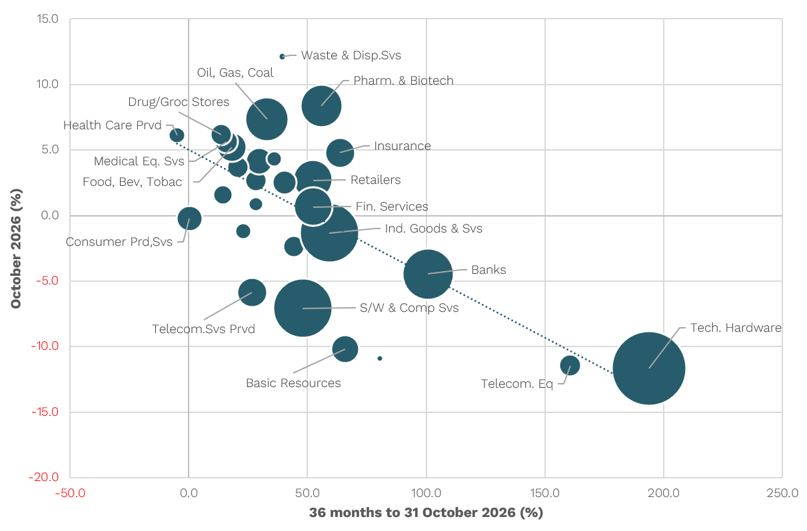
Source: T. Bailey, LSEG Workspace. Notes: Bubble sizes are proportional to each sector’s market capitalisation; chart shows total return in GBP terms
Last month ended with a pronounced sell-off – the S&P500 closing at 7,580 and the Nasdaq Composite at 25,437 on 30 October – with healthcare and selected consumer shares attracting buyers as leadership rotated. Yet, beneath the headline, the equal-weighted S&P500 rose by roughly 3.5% over October while the standard, market cap-weighted, index fell by around 1.7% in sterling terms.
The divergence continued into early November, against the backdrop of the Democrats’ victories in both chambers of Congress. AI-related and Asian equity exposures remained under pressure, while more defensive sectors and gold performed better.
Same companies, different weights
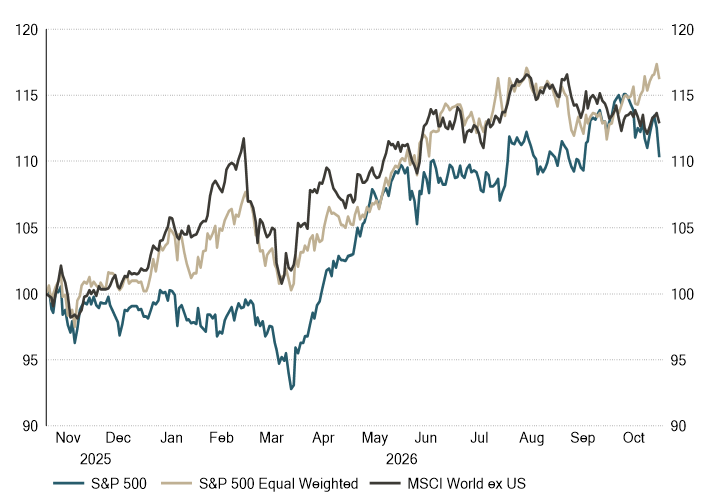
Source: LSEG Workspace. Notes: Total return, GBP terms to 31/10/26
October also saw Asia Pacific and emerging market equities fall sharply. Despite strong results from Samsung and SK Hynix, relatively modest valuations and healthy near-term profit expectations, Korean technology shares reversed some of their earlier gains. The question remains, however, how long those profits can last if AI developers struggle to raise capital and infrastructure spending slows.
Early November brought still further weakness in Asian equity strategies. Lower valuations remain relevant to the long-term investment case but they do not remove exposure to the same spending cycle affecting more highly rated US businesses. This makes position sizing and diversification within AI exposure particularly important.
Rates and bonds under pressure
Back in the US, the Federal Reserve held its policy rate at 3.75%-4.00% a month after its first increase since 2023, with two committee members voting for a further rise and chair Kevin Warsh offering little reassurance the cycle had ended.
Economic data offers conflicting signals. Payroll growth slowed to 29,000 in September and unemployment rose to 4.2% yet third-quarter GDP expanded at an annualised 3.4%. Consumer prices increased by 0.6% in September, lifting annual inflation to 3.7%, with petrol accounting for more than half of the monthly increase. Weaker employment growth therefore sits alongside resilient activity and renewed inflationary pressure.
A fall in unemployment in October, reported in early November, added to that mixed picture. Meanwhile, the Democrats’ mid-term election victory sets the stage for a divided government when the new Congress takes office in January. That may constrain major new tax and spending measures.
Other central banks face similar difficulties. India and Canada raised rates, the European Central Bank held its deposit rate at 2.5%, with a December increase still expected, and the Bank of Japan held at 1.25% while signalling it could tighten as soon as December.
US and UK 10-year and 30-year benchmark government bond yields
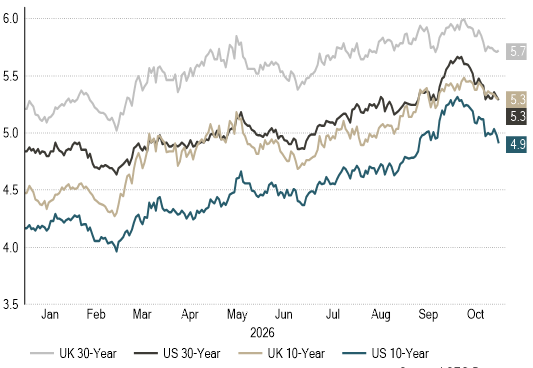
Source: LSEG Workspace. Year to 31/10/26
Government bonds were volatile meanwhile. Long-dated yields approached multi-decade highs early in October before a flight to safety helped US treasuries recover. The US 10-year yield fell below 5% on 22 October and recorded its largest monthly decline since 2023. Higher yields have restored income opportunities, but they have not made every maturity equally attractive. As such, we continue to prefer short and intermediate maturities rather than making a wholesale move into long duration.
As for the UK, fiscal credibility remained a concern. The 30-year gilt yield briefly exceeded 6%, while the 10-year reached around 5.53% early in October, against a backdrop of 3.5% inflation and public debt above £3tn. John Healey’s first Budget on 28 October proved relatively cautious – meeting the government’s fiscal rules but leaving little headroom against the day-to-day spending rule.
The immediate market reaction was muted, with the 10-year gilt yield easing to around 5.3%. France meanwhile presented a further source of concern, as its 10-year yield rose above 5%, the spread over German Bunds widened, and both Moody’s and Fitch assigned negative outlooks.
Oil prices (lefthand chart) and gold and copper prices (righthand chart)
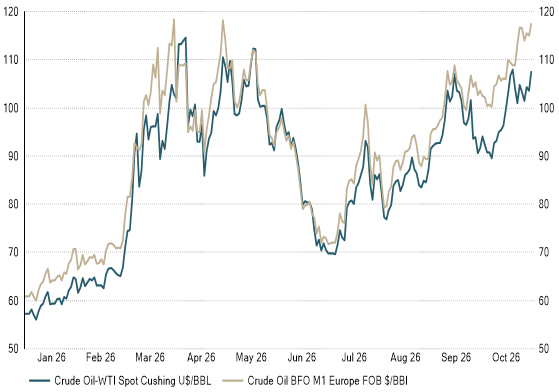
Source: LSEG Workspace. USD terms to 31/10/2026
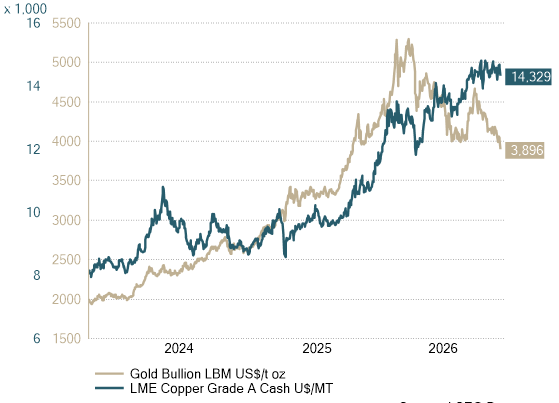
Source: LSEG Workspace. USD terms to 31/10/26
Oil and gold
Energy remained the link between geopolitics and the economic outlook. Repeated attacks on Saudi facilities and Gulf shipping pushed Brent above $117 a barrel by the end of October. Emergency stock releases did provide some relief but, with the US’s Strategic Petroleum Reserve close to a 40-year low, the scope for drawing further on that buffer was limited.
The direction changed sharply in early November, however, as hopes of a diplomatic resolution to the Iran war pushed oil lower and weighed on energy shares. The retreat offers some relief from October’s pressure on households and inflation, although the outlook remains sensitive to events in the Gulf.
Gold fell for a second consecutive month in October, ending just below $3,900 an ounce despite an escalation in the Gulf conflict and higher oil prices – behaviour that showed the limitations of treating it as an automatic geopolitical hedge. Higher energy prices reinforced expectations US interest rates would remain elevated and investors seeking safety from a growth shock bought US treasuries instead.
That pattern reversed in early November, when gold rebounded. We allocate to it as a diversifier against fiscal stress and geopolitical shocks, with central bank buying providing an additional source of demand. October’s decline and November’s recovery nevertheless illustrate its short-term performance depends on the interaction between interest rates, inflation expectations and investor positioning – not simply the level of geopolitical risk alone.
Two connected questions – and some portfolio conclusions
Markets now face two connected questions: whether energy costs will sustain inflation and require further monetary tightening; and whether AI-related earnings can justify the investment commitments being made. And while November’s fall in oil has eased one immediate source of pressure, neither question is settled.
We remain invested in AI’s development without relying on it as the only source of growth. Our exposure is shifting towards businesses using AI to improve their own operations, alongside selected Asian chip and memory suppliers whose valuations are less demanding.
Those valuations do not insulate suppliers from financing pressures elsewhere in the industry, however, which is why position sizing matters alongside stock and fund selection. Potential changes to data-centre approvals add another consideration, but their effects will depend on the policies ultimately adopted.
Recent weeks have also demonstrated opportunities extend beyond the market leaders of the last few years. Healthcare, water and waste, insurance and global quality strategies contributed through different return drivers. That breadth remained valuable in early November, when AI, cybersecurity and Asian equity strategies were among our weakest holdings, while gold, insurance, utilities and value strategies were among the strongest.
In bonds, we remain selective while inflation is above target, several central banks are still tightening and governments continue to borrow heavily. Short and intermediate maturities offer income without the same sensitivity to changes in long-term yields.
Gold remains a portfolio diversifier, while copper exposure reflects our long-term investment case for the metal. Across the portfolios, the aim is to retain access to structural growth without allowing one theme, policy outcome or source of risk to determine the overall result.
Elliot Farley is CEO and fund manager at T. Bailey Asset Management