

Portfolio construction has become more complex in recent years because investments that appear different can still struggle when the same risk-drivers dominate. A balanced portfolio might hold equities for growth, bonds for income and protection and alternatives for diversification, yet rising yields can put pressure on all three.
For decades, declining long-term government bond yields provided a favourable backdrop for traditional balanced portfolios – that is to say, the 60/40 portfolio of equities and bonds. Falling yields supported bond prices, while lower discount rates increased the present value of future cashflows from equities.
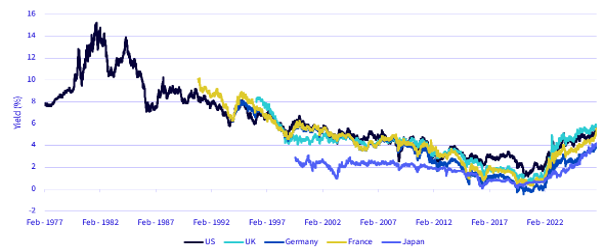
That backdrop has changed substantially since the Covid-19 pandemic, with the supply side shocks and increased geopolitical uncertainty that has followed. The chart below shows a meaningful inflection point after 2020, following the exceptionally low– and even negative – yields of the previous decade.
30-year developed market government bond yields
“Today’s economy and monetary policy frameworks differ from those of the 1970s but another ‘cost-push inflation’ episode remains a scenario worth considering.
Source: WisdomTree, Bloomberg
For investor portfolios, the source of the yield move is as important as the direction. Demand-pull inflation can support corporate revenues and earnings, even as inflation and interest rates rise. Cost-push inflation, however, can be much more detrimental, with supply constraints lead to rising prices alongside weaker growth and squeezed margins.
In such environments, bonds’ sensitivity to rising yields can reinforce equity losses rather than offset them. The experience of 2022 demonstrated this vulnerability, challenging the assumption that bonds would reliably cushion a balanced portfolio.
History often rhymes
In the 1970s, inflation retreated after its first major peak, only to accelerate again later in the decade. The following chart illustrates these peaks and the relationship between oil-price shocks and successive inflation waves. It also shows that the inflation response was not proportional to the size of the oil-price increase.
Beware a second wave of inflation
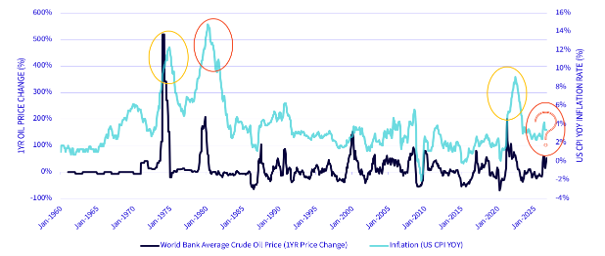
The second wave in the 1970s was characterised by a smaller year-on-year oil-price increase, but a higher peak in CPI inflation. Over this period, 30-year US government bond yields almost doubled, from 7.7% in February 1977 to 15.2% in October 1981 – as shown in the earlier chart.
Today’s economy and monetary policy frameworks differ from those of the 1970s but another ‘cost-push inflation’ episode remains a scenario worth considering. Higher input and financing costs could challenge the earnings growth embedded in equity valuations, while rising yields could weaken bond returns at the same time. Investors should therefore consider how much of their portfolio depends on discount rates remaining stable or falling.
Investors have responded to the changing inflation and yield backdrop in various ways – by reducing bond duration, broadening commodity exposure or introducing alternatives – yet moving into another asset class does not necessarily remove the exposure to higher yields. An infrastructure or property allocation, for example, may diversify revenues while retaining substantial exposure to discount rates and refinancing costs.
To combat this, investors have also incorporated more targeted strategies alongside traditional allocations, seeking diversification through the outcomes those investments can generate. As an illustration, more than half (55%) of the European sample canvassed by the2026 WisdomTree professional investor survey were already investing in options-based ETFs or mutual funds.
Changing an index’s return profile
Options-based defined return strategies can use autocallable structures to change the return profile of an equity index. Investors accept capped upside in exchange for a payoff that aims to generate a specified return across a wider range of market scenarios, subject to predefined conditions. This can include sideways markets and, in defensive implementations, moderate declines in the underlying index. In severe market declines, however, autocallables will not necessarily protect an investor.
As an example, an autocallable with a six-year maturity and a capital-protection barrier 30% below the initial index level would, if not called earlier, incur losses on a one-for-one basis if the index finished more than 30% below its initial level at maturity. A defined return investor would also generally forgo the dividends an equity investor would likely collect. That said, point-to-point declines of more than 30% over six years have been relatively rare for major equity markets.
Portfolios of autocallables can spread exposure across entry dates, observation schedules and maturities, reducing dependence on the timing of any individual investment. Open-ended ETF and mutual fund solutions provide access to this portfolio approach.
Since the potential returns from these strategies do not necessarily require equity-market appreciation, they can contribute to diversification within an equity or alternative allocation. Their exposure to equity downside risk, however, means defined return strategies can experience substantial losses during periods of market stress.
Investments with similar risk drivers can leave a portfolio more concentrated than its asset allocation suggests. This has encouraged investors to look beyond asset classes and consider how strategies such as defined return can diversify the outcomes their portfolios generate. As conditions change, investors’ willingness to reassess familiar allocations and consider different approaches has become increasingly important for portfolio construction.
Jack Roberts is a fund manager at WisdomTree