


In the latest in our series taking a closer look at boutique investment houses and the strategies they run, Alex Paget explains what draws the Downing Fox multi-asset fund range he runs with Simon Evan-Cook to this particular type of corporate structure and, in this instance, to the Iridian US Corporate Change Fund
Everybody loves a redemption arc. Think Robert Downey Jr, an early 2000s David Beckham or even The Mighty Ducks. There is the fall from grace, the long road back … and then the third-act win that makes you glad you stuck around. Fund management rarely delivers one – but this month’s Boutique Critique selection has earned its place in the genre.
The firm is Iridian, a US boutique founded in the 1990s by Harold Levy and David Cohen, both of whom boast restructuring and private equity backgrounds. Its US Corporate Change strategy, a Dublin-based UCITS fund, is one we hold in the portfolios – and it has one of the more chequered histories you will find. To appreciate fully the extent of the comeback, you need to know just how low the low point was.
At its peak, Iridian managed $16bn (£12bn) – but the foundations were shaky. The founders had retired yet still owned the business, so the people running the money had no equity in it. At the same time, the flagship was run by two co-managers who could, remarkably, buy stocks without the other knowing.
As assets swelled and the portfolio sprawled, performance suffered. Throw in the fact the investment style was massively out of favour as well, and you can see it was a very painful period. A long, drawn-out ownership dispute followed and, by the time it concluded in September 2021, assets had shrunk to $350m.
Pivotal date
That date is the pivot. The management buyout completed, one of the co-managers left and Eric Stone joined the other, Todd Raker, who had come to Iridian in 2011 from investment banking and sell-side research and is now also its CEO.
Crucially, both must now agree on every stock going in or out of the portfolio. In addition, the firm is 100% employee-owned, so everyone has skin in the game, and much of the back office has been outsourced. The result is a business that is leaner and profitable despite far lower assets. It has not so much been rescued as rebuilt.
The philosophy remains unchanged, though. Iridian looks for companies undergoing – or capable of undergoing – corporate change: new management, a shift in capital allocation, M&A, a spin-off or an industry being reshaped. It is ‘value’ – but a differentiated type.
The team does not screen for cheap stocks – instead, they behave like a potential acquirer, picking over the balance sheet and cashflows as if they were buying the whole company. That approach naturally leads them to mid and smaller companies, where they can genuinely engage with management, and the portfolio holds around 30 to 40 of them.
It is also a process with a healthy dose of tactical portfolio management – or what, as we discussed last time, we call the ‘Dark Arts’. New positions start small, at around 1%, and are built as conviction grows, with a full position capped at 5% to 6% for the best ideas. Acutely aware, also, how the tactical side of investing matters more in a passive world, the team studies who owns a stock, what might drive demand and whether the company itself can act as a natural buyer through buybacks.
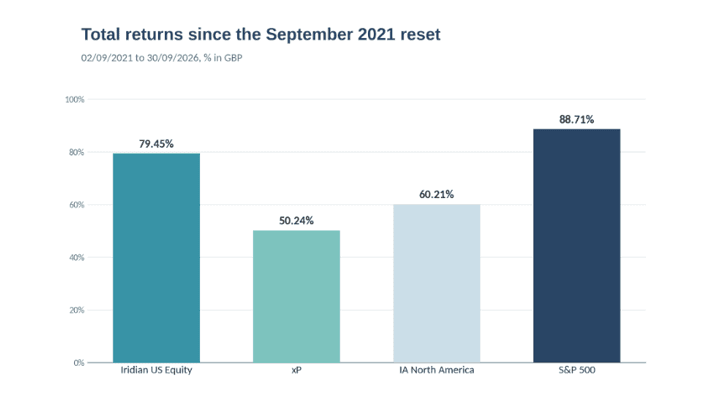
Since the 2021 reset, the results have been impressive. As you can see below, despite being a smallcap value fund in the era of the megacap, the fund has kept pace with the S&P 500 and is comfortably ahead of its peer group.
“The team does not screen for cheap stocks – instead, they behave like a potential acquirer, picking over the balance sheet and cashflows as if they were buying the whole company.
Source: Downing
That said – since this column is ‘Boutique Critique’ and not ‘Boutique Cheerleader’ – it is worth noting a 2023 ‘rebate’ from the former Valeant business does flatters the numbers. This was a stock the previous manager bought that was found guilty of accounting fraud – with Iridian and other shareholders later receiving compensation via litigation.
And because it was calculated on the much larger fund of 2017, the ‘rebate’ landed with outsized impact on a far smaller one. Strip it out and the fund still comes out ahead of peers – with 2024 the one year it did not – but the picture does become less spectacular than the headline.
There are other things to bear in mind – not the least being that, if the market is led by megacaps, a fund like this will lag. And, in a genuine bear market driven by a weakening economy, we would expect it to struggle. It is still a small fund – we are one of the other only backers of the Ucits currently – and a messy history leaves us keeping an eye on it.
Still, we like what we see. This is a proper boutique: focused, employee-owned and run by a manager with the entirety of his liquid net worth in the strategy.
It also offers something genuinely hard to find – a US small and midcap value approach that is not run by a giant US firm or a UK-based team looking across the Atlantic – and is the type of strategy (due to the highly idiosyncratic, bottom-up nature of the approach) that can genuinely tread its own path rather than relying on market beta.
Redemption arcs are rare in fund management, but this one has a process behind it – and that is what gives us encouragement the future looks a lot brighter than its past.
Alex Paget is a fund manager at Downing Fund Managers
Wanted: ‘Bellitious’ fund managers
Our work sees us constantly on the hunt for what we call ‘bellitious’ fund managers – and if you have not come across the word before, that is because we made it up. Our reason for doing so? There is not a current word or phrase out there that adequately defines the types of investors we want to own in our portfolio.
Bellitious (adj.)
[bell-ish-uhs]
Driven to fight or endure great discomfort to follow one’s conscience; willing to break laws, rules or social norms in order to uphold one’s inner sense of what is right.
From belligerent/bellicose: being inclined to fight; and conscientious: being governed by conscience