

Mirroring evolution in nature, changing environments and competition are powerful drivers of innovation in the world of exchange-traded funds.
Market crashes, changing interest rate and inflation regimes or simply tough competition can all push issuers to develop new investment strategies. That may mean opening access to a new asset class, making a sector or theme investable or adding another twist to an existing approach.
The result is a constantly expanding range of ETFs and every new pound, dollar or euro to be allocated faces an ever-growing choice of strategies. For investors, the question is therefore no longer simply which market to access but which strategy best matches the objective at hand. Is it a concentrated AI strategy offering greater upside potential or a tail-risk-hedged ETF that gives up some upside in exchange for downside protection?
Every week, new ETFs are launched. Most are variations of existing concepts – a slightly different regional exposure, another index methodology or a new tweak to a familiar strategy. Every once in a while, however, a cluster of ETFs emerges that is sufficiently different to develop into a new category of its own.
In the rearview mirror, the evolution of ETFs appears like a steady staircase up; in real time, however, it is more akin to an artist’s chaotic mind – ideas overlap and some may never come to fruition. ESG screening, for example, has penetrated almost every part of the market, creating screened variants of existing strategies, while active and thematic approaches increasingly overlap as well.
“As the ETF universe expands, the question facing investors is no longer simply which market to access but which strategy best matches the objective at hand.
Newer does not necessarily mean better – each wave simply broadens the range of risk and return profiles available to investors.”
Importantly, none of these developments should be read as replacing what came before. Smart beta did not make market-cap-weighted beta obsolete, just as thematic, active or derivative-based ETFs are unlikely to make earlier approaches disappear. Newer does not necessarily mean better – each wave simply broadens the range of risk and return profiles available to investors.
One of these new clusters is currently forming around so-called ‘defined outcome’ ETFs. Here ‘defined outcome’ can be loosely translated to ‘knowing your return in predefined market scenarios’. For now, that is as much definition as there is – and the actual implementation can vary considerably.
From providing a buffer to losses at the fund level over a specific time horizon – known as ‘buffer ETFs, as Tom May has discussed previously here – to assembling a portfolio of defined-outcome instruments such as autocallables, the actual implementation is not predefined by its label.
New kid on the block
Defined outcome ETFs are gaining traction in Europe, following strong growth in the US. Rather than simply changing the underlying equity exposure, these strategies use derivatives to reshape the return profile over a defined period.
A simple, illustrative example is a strategy that buffers the first 10% of losses in the reference index, while capping participation in gains at 15%. In other words, as illustrated in the following table, the investor gives up part of the potential upside in exchange for protection against a defined range of losses.
Illustrative buffer strategy over one year

Source: WisdomTree – illustrative example of a buffer ETF
One drawback of buffer ETFs is that the level of protection depends on when an investor buys and sells. To receive the full stated buffer, investors generally need to remain invested for the entire period. These funds also typically reset each year, which can limit the time available for markets to recover after a fall.
An alternative is to spread investments across a range of longer-dated defined outcome strategies. This reduces reliance on a single entry or exit point and gives markets more time to recover from a downturn. As the following chart illustrates, this diversified, longer-term approach can offer better risk-adjusted returns – although it is less simple than the annual pay-off structure of a buffer ETF.
Illustrative portfolio of partially capital-protected defined-outcome instruments (autocalls)
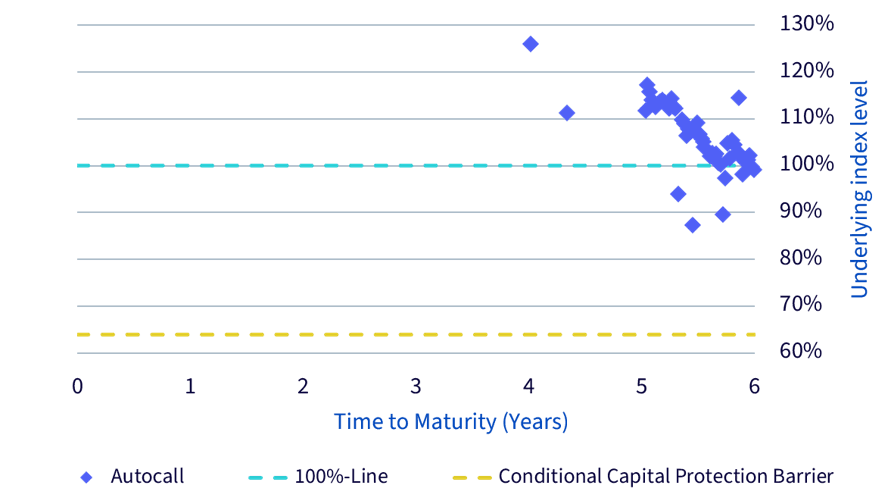
Source: WisdomTree. Each blue diamond represents a defined outcome instrument, plotted by its time to maturity and the underlying index level, rebased to 100% at inception. ‘Conditional Capital Protection Barrier’ indicates the level below which losses are no longer protected. Data points are illustrative only and do not represent an actual autocallable portfolio
Taking a step back, we should ask why these new ETFs are emerging in the first place. One reason is they allow investors to express risk and return preferences more explicitly. Full participation in strong equity markets is attractive, but it comes with full exposure to market drawdowns too. Defined outcome ETFs offer an alternative trade-off: investors can give up part of the upside in exchange for protection against a defined range of losses.
For investors whose objective is less about maximising equity-market participation and more about achieving a smoother or more predictable return profile, that can be a useful portfolio-building block. The important point is not that such an outcome is inherently better, but that the ETF wrapper can now accommodate a much wider range of investor preferences.
Defined outcome ETFs still represent only a small fraction of the overall UCITS ETF market. As the next chart shows, however, the number of products has increased quickly: within three years, more than 20 such ETFs have been launched in Europe, with different combinations of buffers, caps and reference markets.
AUM growth of defined outcome UCITS ETFs
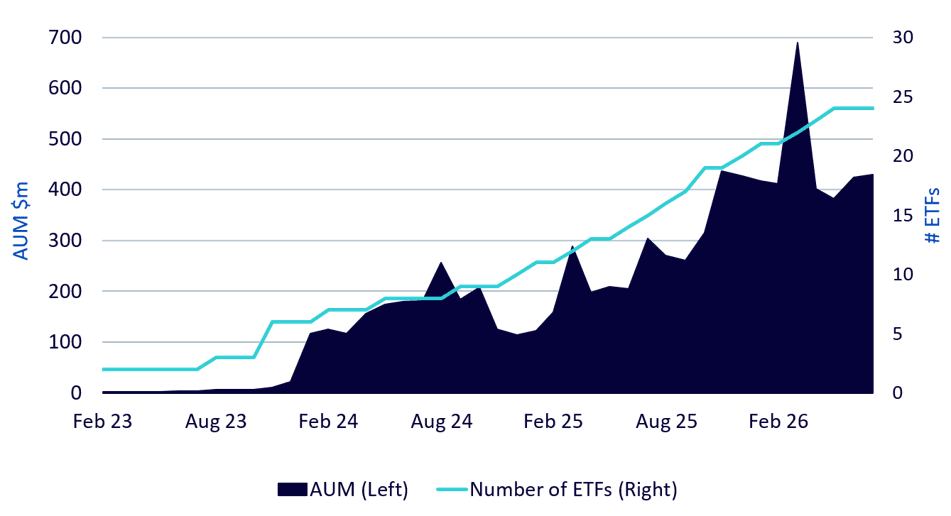
Source: WisdomTree, Bloomberg Finance L.P., from February 2023 to July 2026
That number may reasonably be expected to continue to grow as more issuers enter the market and existing providers broaden their ranges. The category is still small today but, if investor demand continues to build, defined outcome ETFs have the potential to move from a niche allocation into a more mainstream part of the European ETF toolkit.
ETF innovation tends to emerge where investor demand materialises. Many new concepts are launched yet only some attract enough assets to develop into an established category. Defined outcome ETFs are still at an early stage in Europe, but the growth in both assets and product launches suggests investor demand is gaining momentum
Whether they become a mainstream part of European portfolios will ultimately depend on that demand persisting. If it does, though, rather than replacing any existing exchange-traded options, defined outcome ETFs could join beta, smart beta, thematic and active strategies as their own established branch of this ever-expanding ecosystem.
Tobias Lazar is associate director, quantitative research at WisdomTree