
On pragmatism in multi-asset, ‘red-flag moments’ and an evolving economic background
In our regular video series, we interview the wealth sector’s key decision-makers to discover how they think about life, both within the world of investment and beyond it; what brought them into the business and what keeps them here; and what makes them and their companies tick
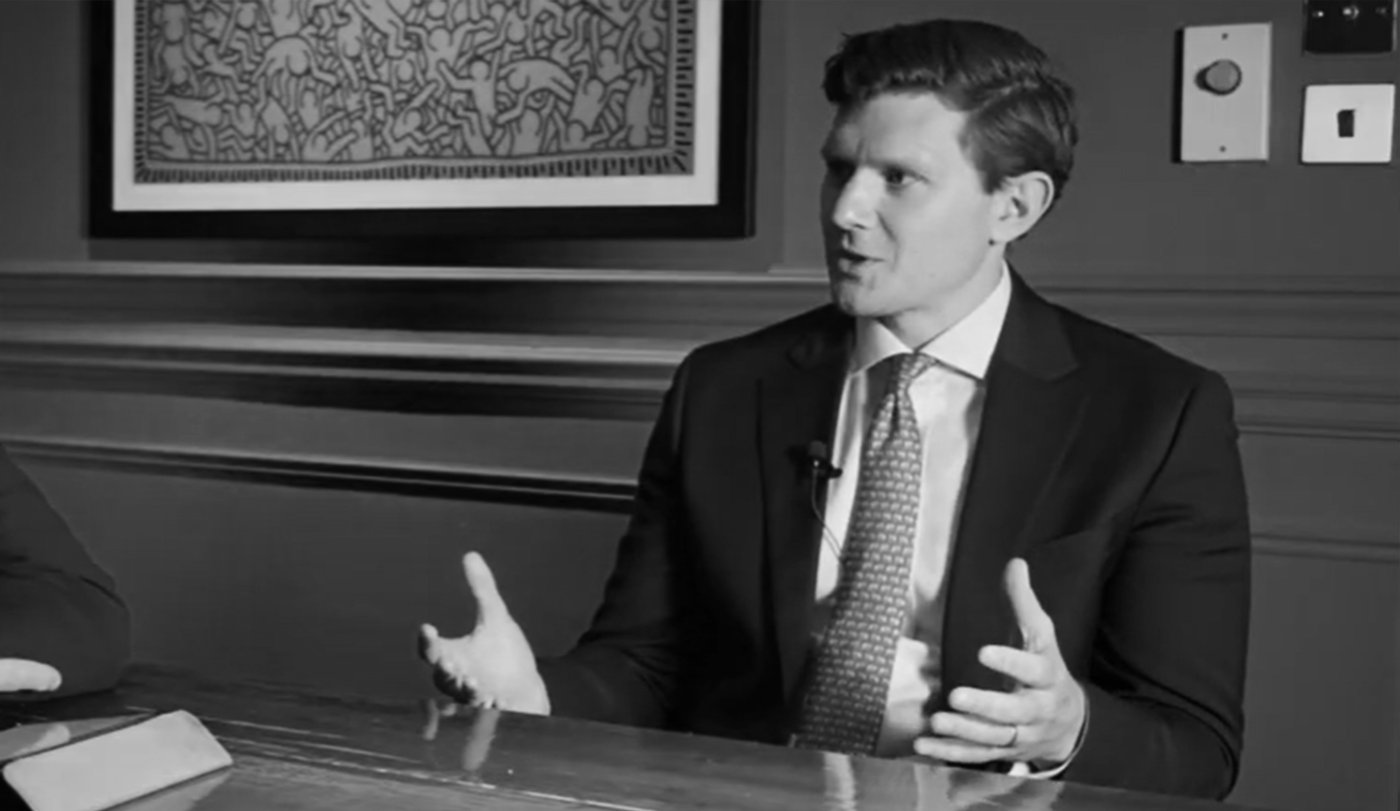
When you live in the multi-asset world, asserts Jordan Sriharan, senior fund manager at Keyridge Asset Management, each and every investment you think may warrant inclusion in a portfolio has to play a role. “I came to this from a fixed income funds background where thinking about your defensive mix was as important as thinking about your risky asset mix,” he tells Wealthwise editorial director Julian Marr in the above video.
“And people often go, What is the upside to that? Rather than, How is it going to diversify a portfolio while providing me with a return stream I wouldn’t see in other parts of that portfolio? So, as a multi-asset investor through and through, I am principally concerned about how an asset is going to fit in my portfolio and improve my upside – or, in the case of a defensive asset, my downside.”
Asked what he views as potential ‘red flags’ when investing, Sriharan is careful to distinguish these from what he describes as ‘hygiene factors’. “Lots of ‘hygiene factors’ are going to be natural, such as the management of an underlying business or a particular fund,” he explains. “And then, aligned to that, is the size of that investment and its liquidity.
What I am always trying to think about is, How do I avoid being behaviourally biased in my views on markets?”
“Whereas, to find the red flags, you have to get underneath the quantitative data and really understand, What is the drawdown risk you are expecting to generate in that particular asset? And, connected to that, Do you understand the correlation of that particular investment to the rest of your portfolio?
“Now, that can shift over time – I am not suggesting correlation remains the same over one, two, three years – but if you can be comfortable with the maximum drawdown, given its place in the portfolio, then that, for me, is the ‘red flag moment’. And if it is a number we think is too high for an asset, in either the growth or the defensive bucket, then that is a signal it perhaps doesn’t sit neatly where we want it to from a portfolio construction perspective.”
Economic resilience
On the question of what excites him about the outlook for markets, Sriharan makes an interesting case for his answer – the resilience of the global economy. “If I think back to my economics degree, 20 years ago, and what it taught me about the interaction between interest rates, the global economy and inflation – I am not cynical about it but I do wonder how much of it holds true today,” he says.
“What we are seeing today is a world that has slightly decoupled from that. Yes, you can look at the short-term noise around, say, credit-card spending – or particularly after the events we have had with the Iran conflict in early March – and you can get behaviourally biased into shorter-term thinking. I get the sense, however, that economists are perennially pessimistic about economic growth rates – with respect to GDP and, particularly, developed markets.
“I don’t think we have an accurate way of measuring productivity in the global economy, though, and so when we look at the pessimism of economists and we look at the economic reality – at least for corporates and their earnings profile – it strikes me the global economy is much more resilient than we typically have understood it to be in the past.”
As for what worries him about markets, Sriharan highlights short-term pricing movements in different asset classes and subsectors. “Today, for example, I would not say software is dead in a ditch but, at the same time, I don’t think semiconductors is the only sector in town we can play,” he continues. “So this is more of a structural idea rather than being worried about one individual issue at any point in time.
“Of course, pricing movements are a reflection of markets’ best thinking – I am not arguing against that. I just think you can be very quickly buffeted by short-term movements and asset prices – both up and down. So I worry about how engaged I can become as a result of those price movements – and what I am always trying to think about is, How do I avoid being behaviourally biased in my views on markets?”
A full transcript of this episode can be found after this box while you can view the whole video by clicking on the picture above. To jump to a specific question, just click on the relevant timecode:
00.00: What excites you about the current investment outlook? What worries you?
03.24: What do you most look for in an individual investment? What constitute ‘red flags’?
05.42: What are your thoughts on style-drift? How do you cope with points in time when it might be uncomfortable to maintain investment discipline?
08.34: To what degree should professional investors be thinking beyond so-called ‘traditional’ investments? Towards what?
11.35: What was your path into investment – and, if you hadn’t taken it, what do you think you would be doing now?
13.32: What was the biggest investment mistake you are prepared to admit to – and what did you learn from it?
16.40: What kind of investor do you think of yourself as?
19.04: Outside of work, what is the strangest thing you have ever seen or done?
21.08: What advice would you have given your younger self on your first day in this business?
22.47: Two Choice Words recommendations, please – one a book; one a free choice?
Transcript of Choice Words Episode 34:
Jordan Sriharan, with Julian Marr
JM: Well, hello and a very warm welcome to another in our series of ‘Choice Words’ videos, where we get to speak to the great and the good of UK fund selection and UK fund research and find out what makes them tick. I am Julian Marr, editorial director of Wealthwise Media, and today I am delighted to be talking to Jordan Sriharan, who is a senior fund manager at Keyridge Asset Management. Hello, Jordan.
JS: Hi Julian. Thank you very much for having me today.
JM: My absolute pleasure. Let’s jump straight into my first question – and it could be a long answer! What excites you about the current investment outlook? And what gives you pause for thought?
JS: What excites me? I mean, it is an exciting industry – so tough to know where to start! What I would say is, when I think about today’s global environment, we are much more comfortable with the resilience of the global economy. If I think back to my economics degree, 20 years ago, and what it taught me about the interaction between interest rates, the global economy and inflation – I am not cynical about it but I wonder how much of it holds true today.
And what we are seeing today is a world that has slightly decoupled from that – and I think that demonstrates there is resilience. You can look at the short-term noise around, say, credit-card spending – or particularly after the events we have had with the Iran conflict in early March – and you can get behaviourally biased into shorter-term thinking. But when we look at the results and we look at the economic output, actually the global economy is much more resilient than we give it credit for.
So when I think about things we learn from history, I get the sense economists are perennially pessimistic about economic growth rates – with respect to GDP and, particularly, developed markets – but I don’t think we have an accurate way of measuring productivity in the global economy. And, when we look at the pessimism of economists and we look at the economic reality – at least for corporates and their earnings profile – it strikes me the global economy is much more resilient than we typically have understood it to be in the past.
And then you asked me about what worries me – and I am always worried about short-term pricing movements in different asset classes and different subsectors of asset classes. Today, for example, I don’t think software is dead in a ditch but, at the same time, I don’t think semiconductors is the only sector in town we can play. And what I am always trying to think about is, How do I avoid being behaviourally biased in my views on markets?
That is a constant ‘push and pull’ I think about when it comes to worries. It is more of a structural idea rather than being worried about one individual issue at any point in time. And pricing movements are a reflection of markets’ best thinking – I am not arguing against that. I just think you can be very quickly buffeted by short-term movements and asset prices – both up and down – and I worry about how engaged I am, or how behaviourally biased I can become as a result of those price movements.
JM: That is a good start – both keeping a check on your behaviour biases and also being generally upbeat and ‘Don’t worry – it is going to be slightly better than you think it is’! That is a nice approach to life.
On a role
JM: From that wider view, let’s focus in on individual assets – what do you most look for when you are buying into an individual investment? And what would you consider to be red flags?
JS: When you live in the multi-asset world, everything that comes your way that you think warrants inclusion has to have a role in portfolio construction. I came to this from a fixed income funds background where thinking about your defensive mix was as important as thinking about your risky asset mix.
And people often go, What is the upside to that? Rather than, How is it going to diversify my portfolio while providing me with a return stream I wouldn’t see in other parts of my portfolio? So, as a multi-asset investor, through and through, I am principally concerned about how an asset is going to fit in my portfolio and improve my upside – or, in the case of a defensive asset, my downside.
When I think about red flags, lots of ‘hygiene factors’ are going to be natural – and that I am sure others will have spoken about – when it comes to an investment, whether it be the management of an underlying business or of a particular fund. Aligned to that, is the size of that investment and its liquidity. Is it a big corporate or a big fund? Or is it a small fund or a small corporate with a low market cap and therefore less liquidity?
So those are hygiene factors, I think – whereas, to find the red flags, you really have to get underneath the quantitative data and really understand, What is the drawdown risk you are expecting to generate in that particular asset? And, connected to that is, Do you understand what the correlation is of that particular investment to the rest of your portfolio?
Now, that can shift over time – I am not suggesting correlation remains the same over one, two, three years – but if you can be comfortable with the maximum drawdown, given its place in the portfolio, then that, for me, is the ‘red flag moment’. And if it is a number that we think is too high for an asset, in either the growth or the defensive bucket, then that to us is a signal it is not something we are comfortable with and perhaps doesn’t sit neatly into where we want it from a portfolio construction perspective.
Catching the drift
JM: I am going to ask a separate question – or a separate related question – on style drift, then. How do you guard against it, whether that be personally or in the assets you buy?
JS: Style drift is a fascinating question because, if I think about the Fundsmiths and Lindell Trains of this world – and the amount of noise they have created in financial news over the past six, 12, 18 months – they wonderfully represent funds that have stuck to their knitting and not ventured outside it. And yet they have been critiqued for their total-return qualities over, you know, four or five years and indeed over longer periods.
And I guess I have become a bit – what’s the right word? – disengaged, perhaps, with that reporting because it doesn’t reflect on what those managers’ underlying styles are. It kind of copies-and-pastes them into a total return approach – that, if they haven’t outperformed XYZ over five years, then they don’t warrant inclusion. Yet, if you talk to heads of fund research, they will tell you they are doing a certain job in the portfolio.
And that comes back to the point about the type of product you are buying. In the global equity space, style bias is a real thing – and people have bought or purchased because they have a growth bias or a value bias and they sit within those neat ‘buckets’ within their asset allocation process. And those individuals, those funds, cannot afford style drift – it is the nature of what they are trying to do and they typically have processes that lend themselves well to that type of stylistic investing.
Where there is flexibility, I think – at least in the equity space – is with small and midcap active managers,. Typically, they are a smaller allocation of your portfolio and I think people are willing to allow some pragmatism to creep into that mindset.
So you could be, say, a UK midcap growth manager but if, in reality, it is the cyclicals and value names that have been on a run for one, two, going on to three years, I think pragmatism allows you to lean in a bit to that cyclicality in your portfolio – because you are a small position, you are a small part of the portfolio and you are always judged against the benchmark.
And so, if you have moved into that space a bit in order to ensure your tracking error, shall we call it, has not moved too much, I have some sympathy with that. So I am comfortable with style drift when it comes to those types of ideas or ideologies – but when it comes to your big positions in global equity and you are buying a fund because it has a particular style bias, you cannot really tolerate any style drift ultimately.
Downside protection
JM: Absolutely. Very interesting. Thank you for that. Let’s move on to alternatives. To what degree do you think private investors and, by association, their advisers need to be moving away from traditional assets – cash, equities, bonds – and towards alternatives, however you are willing to define those?
JS: It is a fascinating question. We live in a global economy that is much more pumped by liquidity, perhaps, than it was previously. And I think that leads to different correlations – and very swiftly changing correlations – between bonds and equities and we have all heard about the death of the 60/40 portfolio.
I think the problem alternatives have had historically is they have blown hot or cold in their investment outcome, ultimately. So I think that is why we kind of had a period of buying alternatives, which perhaps are more expensive than a typical equity or bond fund, and we have come full-circle again to the 60/40 idea.
Commodities have obviously come into vogue quite recently – I think that is a cyclical story. So, for us, that feels like a growth asset rather than an alternative – a lower-correlated opportunity. When we look at Keyridge and think about some of the resources we have there, we have a very successful set of derivative strategies we employ – really for income enhancement and drawdown protection purposes.
What we are looking at is how we can incorporate them in a very intelligent way that manages risk on the downside, rather than looking to generate lots of upside potential from it. I think the portfolios of the future will look at having an allocation to a derivative strategy – non-complex, thinking about the downside protection – that I think complements your risky and defensive assets.
Just within that point, I think an alternatives strategy is quite important if you believe the world is more highly correlated than it was previously. So we think it is an important place to focus on. Without an alternatives line, we think, you do struggle to get the deep diversification you need in these risk-off moments – and the Iran conflict of March is a great example of that.
I know it was an inflation kind of story – that the bubble was pushed up by higher oil prices – but these geopolitical situations are constant in nature and the highly-correlated nature of equities and bonds means thinking about your alternatives bit is important. You know, we today have gold in there. Gold is less commodity-like perhaps in the industrial metal space, which is doing quite well for different reasons.
And I think there is a space where you can achieve this in slightly more liquid private credit options or private asset options now. The way you find the right vehicle for that is different for different investors – but getting that right across your portfolio, within your non-equity and alternative bucket, is important for longer-term performance.
‘Real world’ thinking
JM: Thank you for that. A more personal question now – what was your path into investment and, in an alternative universe, what do you think you would be doing now, if you had not taken it?
JS: I probably had quite a traditional route into investment – which is a really boring thing to say – as somebody who did economics at both an undergraduate and postgraduate level! That was all born out of my A-levels, really, as economics was one subject that piqued my interest. That is not to say maths and English are not interesting but there is something more ‘real world’ about economics than those two particular A-levels.
So I took that on with me and it just made sense to follow that in tertiary education and then naturally into investment. Although, as I said earlier, I am not entirely sure what I learned 20 years ago marries up with what we are seeing today, given how much change there has been in the natural infrastructure of global economies.
As for what I would be doing if I were doing something different, my parents were very much from the school of, In the summer holidays you get a job – and so I think, in my late teenage years, I would have worked as an accounts assistant or a junior accountant or in an administrator-type role in the summer holidays, and I would probably have piggybacked off that post-degree.
And, I mean, that is incredibly boring – and that is no offence to accountants as there are obviously lots of interesting things within that sphere – but I fear I might have ended up in that kind of a world. Had you asked me this when I was a young teenager, though, I would have probably told you I was destined for sporting fame – with misplaced faith, I would add! So depending on what age you asked me that question, I would have given you a different answer.
JM: No, no – it’s important to dream. It is just important not to dream of becoming an accountant – I suspect that is a red flag!

Three lenses of investing
JM: What is the biggest investment mistake you are prepared to admit to – and what did you learn from it?
JS: I think you have to have humility as an investor. We were talking about red flags – and those who don’t and think they have never made a mistake in their life are probably the ones you want beware! I mean, you can measure ‘biggest’ by lots of different metrics and, while this might not be my biggest by alpha, it might be my biggest in terms of credibility within my team.
It was back in 2015 and I was personally concerned by what I thought were high valuations in tech – I think I was getting that misconstrued, but I will talk about that in a second. The analysts on my team were super-bullish and I guess I probably made the mistake of thinking, Yes, they are bullish for reasons I cannot get comfortable with and these valuations look eye-watering to me – I don’t think we’re going to do this.
I was head of MPS at the time and I probably pushed back for two or three quarterly meetings on this as an opportunity to add in portfolios – until they brought a more fundamental look at the tech sector and talked through the minutiae around the earnings story and how margins were growing.
And when I married that fundamental story with the valuation story, I realised I was getting it wrong. I was looking at it as a technicals and momentum picture – which was showing these things just going up and up and up – rather than understanding why, from the bottom-up, it was attractive. So, credit to the analyst and the team, who kept coming back quarter after quarter, saying, We think this is worth investing in as part of our global equity allocation.
And what I learned from that is you need to look at it through the three lenses of fundamental, valuation and technical and not get stuck on one of those as the only reason not to invest in a particular idea. I also learned a lot about my own valuation lenses or my own lens with which I invest. And I learned a bit about … I don’t know if ‘trust’ is the right word – but actually having faith in individuals around you, who have done a lot of heavy lifting to understand the thesis behind something, and I guess giving that more credibility than I did, perhaps previously. So there is a lot to be learned from that whole episode.
JM: For sure. Plus I like the idea there is an alternative podcast somewhere with an analyst going, My biggest mistake was not explaining properly to this head of MPS the opportunity in technology – so I went away and then came back and repitched it! Because arguably it was their mistake for not painting you the right picture in the first place. That is the mirror of your position, isn’t it?
JS: Yes – internal communication is a really important skill set that maybe we don’t provide enough of an element around.
Pragmatism in multi-asset
JM: Yes. I also like somebody who is prepared to say, I don’t just have one ‘biggest mistake’ – I have different categories of them! That is a humble way of looking at life! Let’s stick with personal questions then – what kind of investor would you say you were?
JS: I would say I was pragmatic, ultimately – I think dogmatism does not work, particularly in multi-asset. When you are a US growth equity fund manager, dogmatism makes perfect sense – you live and die by that – but when you are in multi-asset … multi-asset today is multi-faceted. You have no excuse not to generate returns as there is a myriad of aspects. It is not just equities and bonds or alternatives – as we have already spoken about – it is also, you know, what of your FX have you hedged? What is your duration position?
So for a multi-asset investor, there are lots of tools in the box we can use. And so being pragmatic is an important part of flexing that opportunity set – because the cycle can go through periods of being very short and you can go through periods where some asset classes just grind on higher. And so pragmatism, to me, is a strength rather than a weakness.
I think that is where good multi-asset managers do well – and, you know, I would reference my previous story on not changing my mind on tech for three quarters. But, actually, that was a decade ago and I think you have to be aware of how events change, and as a result, end-outcomes change. Not to quote Winston Churchill but, as the facts change, I change my mind – and I think that is quite pertinent in multi-asset investing.
So being pragmatic and, then, being thoughtful. That might seem an obvious thing to say, but the thoughtfulness has to come from your portfolio construction over time. Just layering on risk, without thinking about how everything is correlated, ultimately ends up with periods of strong performance followed by a risk-off moment – and you give all your alpha back.
Clients want a certain investment journey, I believe. Some want to shoot the lights out – and that is fine; and some want to be ‘steady Eddies’. But I think the majority of us sit in the middle lane of providing a smooth investment return profile for clients and, in order to do that, being pragmatic and being nimble and being thoughtful about your portfolio construction are three qualities I like to think I have.
JM: Good answer. I have not done that question before but I think we might have to go with it again. You have set the standard for that – so thank you.
Northern soul
JM: Everybody’s favourite Choice Words question now – outside of work, what is the strangest thing you have ever seen or done?
JS: Yes – I have seen you ask this question and I have heard various people answer it in a myriad of ways! And I thought about this perhaps longer than I should have done but I thought about the monotony of the Tube journey. And you are going to think, What is strange about a Tube journey? And, you know, on the Northern Line, it is fairly monotonous – you get on and you get off and people come and go.
But then I think about moments that took my breath away slightly came during the 2012 Olympics when – and I am sure you were around for that too – the whole of London was a completely different place, for reasons that are hard to put a finger on. Though, obviously, the Olympics were in town. Still, I remember sitting on the Tube in those two weeks with friends and family and, whenever a person in a purple Olympic uniform came on, everyone clapped and cheered like they were heroes.
And at the time, I guess, as a Londoner I was thinking, Why are we clapping? These guys going to work? It felt like it was everyone – certainly tourists were kind of clapping – and I thought, This is great because it is a real change to my commute, but also a real sign that we are actually appreciating people.
And then, one evening, I was getting the Tube back home after work and there was a group of purple-uniformed Olympic volunteers and that part of the carriage broke out in song! This is half-past-six on a Wednesday on the Northern Line – it doesn’t happen! And that just really surprised me. Something I quite enjoyed about life in the capital at that time was everyone had left town because it was supposed to be too busy – but, actually, it was great to be there because you had these fleeting moments when everyone felt human again.
The fork in the road
JM: That is a nice answer – well played. We are racing through here – only a couple more questions to go. First, what advice would you have given yourself on your first day at work?
JS: What advice would I have given myself? I would have told myself to keep my head down – not that I didn’t. But there are a certain amount of questions you should be asking and too many questions on your first day – outside of, Where’s the cafeteria? – can probably do you more damage than good.
What I would also have told myself on day one is just be prepared to work as hard as you need to for those first … I don’t know what the time period is – certainly the first five years and, I guess, longer in reality. And what happened is, I did the CFA very early on, as you could – and maybe if I had not left early to revise and stayed later to get critical work done, then maybe I would have seen a difference in the ‘fork in the road’, once I qualified with my CFA.
That is not a negative – I guess I got my qualification and I got out, as they say – but I would have told myself, you know, applying yourself time-wise and mentally is a much better decision than choosing to kind of divide your time up between personal conquests, such as CFA exams, and being in the office.
JM: Interesting. I am completely with you on questions. That idea there is no such thing as a stupid question? Well, I am not willing to take the chance sometimes – except maybe half the ones I ask here, of course!
Life lessons
JM: Last question – we call this ‘Choice Words’ because you make choices as part of your day job. We are looking for two personal choices now. One is a book tip for our audience – it does not have to be on investment, but it can be – and the other one is a completely free hit.
JS: OK. I read a book at the start of this year by Morgan Hounsell called The Psychology of Money. I think he has written quite a few books – this is from 2020, I ended up realising – but I just thought it was absolutely fascinating. And for anybody to read too – it does not matter what your background is. Now, The Psychology of Money implies it is some sort of turgid, deep-rooted study into the brain – but, actually, I end up quoting it in investment committee meetings, because the simplicity of the thought in it is quite powerful.
And it is really talking about how our spending decisions are based on our own personal experiences – rather than any preconceived idea that my economics textbooks taught me 20 years ago. And I just think it is a really sensible way to think about how to manage your home finances and how you think about spending in later life.
It is just really well-written and applies to everybody, regardless of industry background, regardless of what age you’re at, and I would highly recommend it. And as I said, I have quoted it in investment committee meetings as kind of investment parlance for wanting to do something in particular. There are a lot of lessons to be had from it – both financially and for life.
What would be my free hit? I alluded to the fact I played a lot of sport when I was younger – and that is not to say I was any good! But I think, as you get older and you have children and the time for your own personal sporting triumphs falls by the wayside, I realise that actually keeping fit is an important part of life – and ‘keeping fit’ is very 80s language for me to use.
Just staying mobile is really important – and that might be going for walks, going to gym – whatever you want to do. But we live in a world where everyone is living a little bit longer – you know, my grandparents lived longer than their parents – and if I am going to be around for a long time and I want to be able to pick up my grandchildren and all those things, I just think I owe it to my future self to be vaguely capable of doing that.
And ultimately, if we are going to be retiring later in life – for lots of different reasons; we don’t have to go into the politics of that today – then I want to be in a position where I can swing a golf club or go for a walk or go swimming when I am retired and not feel like I am just sat in a chair drinking cups of tea in front of Countdown or whatever the equivalent will be in 30 years’ time!
JM: It is a high aspiration. The keep-fit bit I am not sure about. The Psychology of Money I can endorse 100% and have often recommended it as my own book tip. And even just that last chapter on the postwar US economy is just a brilliant 30 pages. Morgan Hounsell is kind of like the Malcolm Gladwell of finance! So great Choice Word choices – and great to talk to you, Jordan. Thank you so much for coming in today.
JS: Thanks Julian. Appreciate your time.
JM: It was a pleasure. And thank you very much for watching. Do look out for further Choice Words videos as they are published.