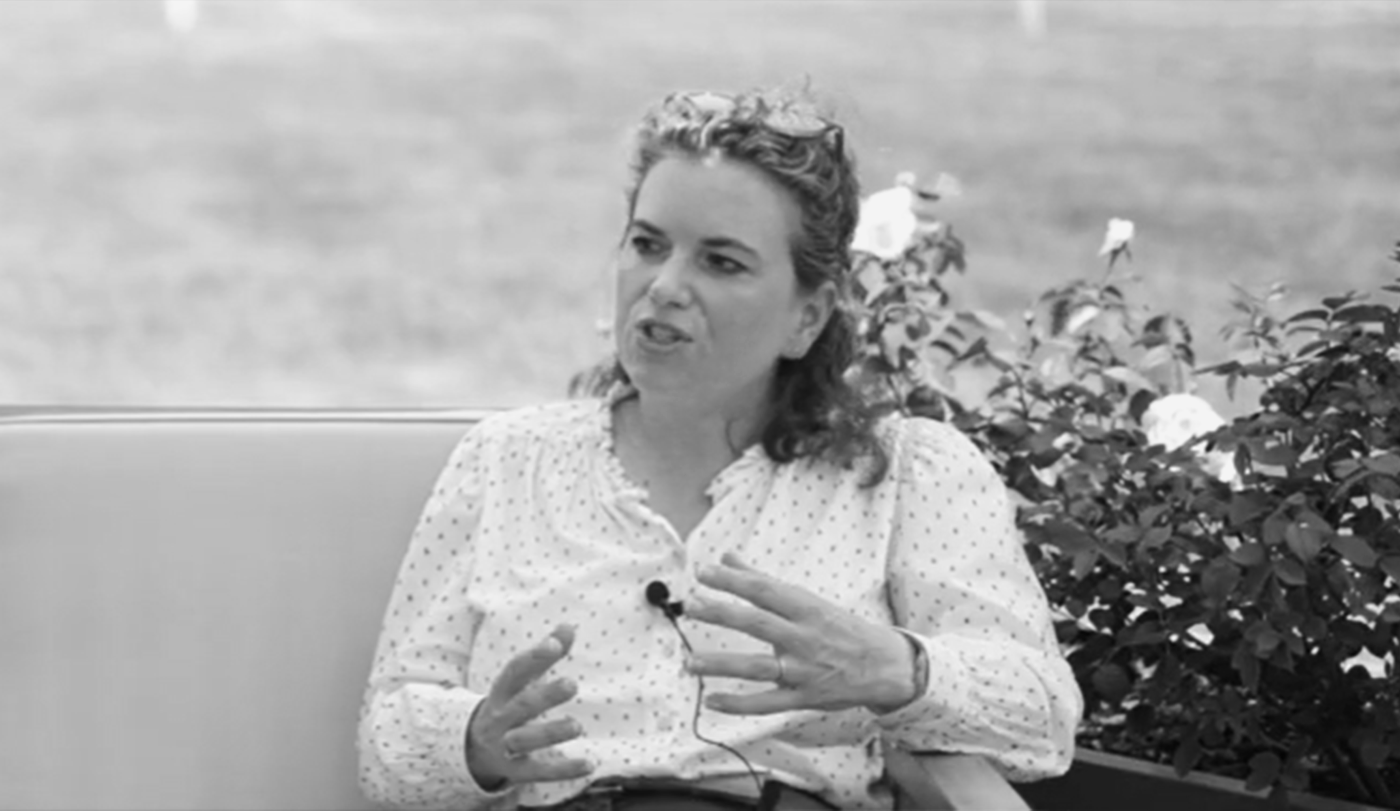

On simplicity in client comms, investment red (and green) flags – and TV perfection
In our regular video series, we interview the wealth sector’s key decision-makers to discover how they think about life, both within the world of investment and beyond it; what brought them into the business and what keeps them here; and what makes them and their companies tick
“Client communication has to be interesting.” It is a radical suggestion from Ben Yearsley, co-founder of Fairview Investing, but – who knows? – maybe there are some brave souls out there willing to try it. “Make it interesting, make it snappy,” he tells Wealthwise editorial director Julian Marr in the above video.
“I do a lot of stuff with the press, and have done over many years, and you strive to make something interesting and easy to understand. Too often, I think, the financial industry puts so much nonsense into marketing communications when, actually, people could just say what they mean. We think this is cheap – end of. We think this is expensive – that is why we don’t buy it.
“You don’t need to dress it up in a thousand words apart from that – and it’s the same with client communications. Keep things simple – explain in simple terms what you are doing and why you are doing it – and the reality is, over time, the clients you treat that way will trust you and stick with you.”
Explain in simple terms what you are doing and why you are doing it – and the reality is, over time, the clients you treat that way will trust you and stick with you.”
Certainly this approach is in evidence when Yearsley is asked for his best and worst-case scenarios for the future of wealth management in the UK. “Worst case is probably a crackpot leftwing coalition government coming in that is just hellbent on wealth destruction and wealth confiscation,” he replies. “Best case is sensible government policies on wealth creation and more of a focus on applauding wealth creation rather than attacking it.”
Alternative reality
Yearsley is similarly robust on the question of the degree to which alternative investments should feature in retail investors’ portfolios. “This is one of those buzzwords that should raise red flags,” he begins. “I think a lot of these things are suitable for institutional, high net worth and sophisticated investors – but not retail investors. Take LTAFs. Monthly dealing, quarterly dealing or whatever – that’s not a retail product.
“You might explain it to your client but the reality is, when they want to come and sell up and they can’t, or they don’t get their money back for three months – suddenly they don’t understand it. So things like that are not retail products. They are institutional.”
That said, of course, it all depends on what we understand by the term ‘alternative’. “I like infrastructure,” Yearsley offers as an example. “Back in 2007, when infrastructure funds first started launching, I looked at a lot of them then and backed one – the First Sentier fund, as it is now – and I have invested in that ever since.
“Now, is that ‘alternative’? It is investing in global equities – it just happens those global equities own transmission networks, ports, railroads and so on. So it depends on whether you think that is alternative or not. I think it sits somewhere in between – and I think it’s the liquidity. So a true alternative manager would not class that as one because it is an equity. Well, OK, I get that – but it does have different characteristics.
“So I am happy owning those kind of things – very happy. Infrastructure has been a great investment over 20 years and I think it is set to be a great investment going forward – and it’s probably AI-proofed too. But alternatives that are illiquid, unquoted? I buy them personally – I have lots of private equity – but I struggle putting things like that into client portfolios.”
A full transcript of this episode can be found after this box while you can view the whole video by clicking on the picture above. To jump to a specific question, just click on the relevant timecode:
00.00: What excites you about the current investment outlook? What worries you?
02.56: What do you most look for in an individual investment? What constitute ‘red flags’?
05.13: To what degree should professional investors be thinking beyond so-called ‘traditional’ investments? Towards what?
07.48: What drives your approach to client communications? Should professional investors aim to attract the ‘right’ type of client?
08.58: What was your path into investment – and, if you hadn’t taken it, what do you think you would be doing now?
11.46: What was the biggest investment mistake you are prepared to admit to – and what did you learn from it?
14.03: Outside of work, what is the strangest thing you have ever seen or done?
15.25: What advice would you have given your younger self on your first day in this business?
16.33: What are your best and worst-case scenarios for the future of wealth in the UK? 17.16: Two Choice Words recommendations, please – one a book; one a free choice?
Transcript of Choice Words Episode 32:
Ben Yearsley, with Julian Marr
JM: Well, hello and welcome to another in our series of ‘Choice Words’ videos, where we get to speak to the great and the good of UK fund selection and UK fund research and find out what makes them tick. I am Julian Marr, editorial director of Wealthwise Media, and today I am delighted to be talking to Ben Yearsley, co-founder of Fairview Investing. Hello, Ben.
BY: Hi Julian.
JM: Excellent stuff – we are up and running!
BY: We got the names right!
JM: We got the names right. Hey, I always claim these things as a win! First question – you might I think I wouldn’t have to read it by now, but apparently I do – thinking about the current environment, what most excites you? What gives you pause for thought? Maybe, let’s not be too specific, given the horror show taking place as we are currently filming?
BY: Well, I think that is it – you cannot get away from the Middle East – on the answer to both of those questions. It is the most ‘pause for thought’ – but it also gives the most opportunity. You look at the displacement in shareholders – the falling base of shares on the back of this – and you go, that is a great long-term growth business … let’s use EasyJet as an example.
You know, the shares have fallen from about six quid to something below four quid, all based on this – or much of it based on this. And you kind of go, That is an opportunity – because this is not going to go on for the next one, two or three years. This can’t go on for more than a few months. And so you look at it and think, Actually the conflict there is creating opportunities.
I suppose, taking the Middle East out of the equation at the moment, the AI-software trade is fascinating as well. You know, you have all the software stocks that plunged this year on the back of AI eating their lunch – shares down 25%, 30%, 40%. And you look at it and go, Hold on – AI is pointing … I got given a good example by a fund manager last week of a firm in the US that provides software for sending your tax return to the IRS.
And he says, Well, ChatGPT sends people to use this software. So it can’t create it for you – and then it sends you to the software company to submit your tax return. So why has that fallen 25% on the idea of ‘AI eating your lunch’? AI is telling you to use it – it makes no sense whatsoever.
So I think that is quite interesting – and I think, big picture, AI is clearly the trend, the theme, the focus that you have to get your head around in so many different areas. How is it impacting software companies? How is it impacting banks? How is it impacting financial services? All these kind of things. And again, it is an opportunity and a threat.
JM: It is. And we will be getting you back on in two years’ time and, if the Middle East thing is still going on, we will ask, What were you talking about!
Red flags, green flags
JM: Let’s focus in on individual investments. What most attracts you to an individual-type investment and what do you see as red flags?
BY: Red flags are when fund management groups are pushing something too strongly – Oh look, we just launched a brand new fund where the trend has been going for two years! I mean, I have been working for probably almost as long as I have known you – 25, 26 years now, actually more than that – and the red flags tend to be when you have a hot theme and suddenly groups are launching funds. It happened with tech funds back in the late 1990s – you are probably old enough to remember the ‘Techtornado’ …
JM: I knew you were going to say that!
BY: Because that is just such a stupid name as well. But that wasn’t the only one – there were loads of those kinds of things launching at the back end of the tech bubble in 2000, 2001. Property funds too – lots of those have launched at the wrong time.
And then, actually, the opposite of a ‘red flag’ – what’s a ‘green flag’? Whenever all the fund groups are closing funds. You can use them as a countersignal, can’t you? Fund groups giving up on sector. Actually, that could be an interesting sector – you know, all those property funds that have been closed or merged into other things in the last few years. That is, interestingly, a green flag. So I suppose I am a contrarian investor from that perspective – which might lead on to one of your questions later on.
JM: We will find out! Yes, Techtornado did feel like the one – that was the ‘jumping the shark’ moment.
BY: Actually, I didn’t answer your question on what I like. Fund managers. I like talking to fund managers. I like people who can articulate what they are doing and why they are doing it. You don’t have to be a great presenter. You don’t have to be able to stand on stage and be a great presenter. And we have both seen lots of great presenters who were poor fund managers.
I am not going to name names here but there was one great example – one of the best presenters out there but a pretty average fund manager; and vice-versa, a poor presenter on stage and one-on-one. But if you cannot go one-on-one, you cannot articulate what you are doing and why you are doing it – and that is the bit that I find interesting.
JM: Yes, I always thought the expectations were a bit harsh on fund managers. I mean, Mick Jagger was a great singer, lousy actor – but why would you expect him to be good at both? I mean, they are different skills.
Alternative reality
JM: Right, to what degree do you think private investors – and, by extension, those who create portfolios for them should be thinking about alternatives? And how would you describe alternatives – and in what direction should investors be thinking?
BY: I think it is one of those buzzwords that, again, should raise red flags – going back to the previous question. I think a lot of these things are suitable for institutional investors and high net worth and sophisticated investors, not retail investors. It’s like LTAFs – they’re not a retail product. Monthly dealing, quarterly dealing or whatever – that’s not a retail product.
You might explain it to your client but the reality is, when they want to come and sell up and they can’t, or they don’t get their money back for three months – suddenly they don’t understand it. So things like that are not retail products. They are institutional products … and I have completely forgotten what your question was!
JM: Well, it’s nice that you care! It was just to what degree should private investors think about alternatives? Not much, by the sounds of it!
BY: Well, it depends what you mean by ‘alternative’. I like infrastructure, as an example. Back in 2007 when infrastructure funds first started launching, when I was still at HL, you know, I looked at a lot of them then and backed one – the First Sentier fund, as it is now – and I have invested in that ever since.
Now, is that alternative? It is investing in global equities – it just happens those global equities own transmission networks, ports, railroads and so on. So it depends on whether you think that is alternative or not. I think it sits somewhere in between – and I think it’s the liquidity. So a true alternative manager would not class that as one because it is an equity. Well, OK, I get that – but it does have different characteristics.
And so I am happy owning those kind of things – very happy. Infrastructure has been a great investment over 20 years and I think it is set to be a great investment going forward – and it’s probably AI-proofed too. But alternatives that are illiquid, unquoted? I buy them personally – I have lots of private equity – but I struggle putting things like that into client portfolios.
Super-snappy
JM: Let’s continue thinking about private investors – what drives your approach to client communications? And just as an extension, do you think there is such a thing as the ‘right’ type of client – the person who will come along with you for the full journey and therefore benefit from getting in at the right time and, crucially, leaving at the right time?
BY: Client communication has to be interesting.
JM: Controversial!
BY: I know! Make it interesting, make it snappy. I do a lot of stuff with the press, as you know, and I have done over many years, and you strive to make something interesting and easy to understand. I think the financial industry too often puts so much nonsense into marketing communications when, actually, it could just say what they mean.
We think this is cheap – end of. We think this is expensive – that is why we don’t buy it. You don’t need to dress it up in a thousand words apart from that – and it’s the same with client communications. Keep things simple – explain in simple terms what you are doing and why you are doing it – and the reality is, over time, the clients you treat that way will trust you and stick with you.
On track
JM: Good stuff. A more personal question now – if you can remember this far back! – what was your path into investment? And if you had not taken it, in an alternative universe, what do you think you would be doing now?
BY: My path into investment was quite straightforward. I was always interested in shares, when I was a kid, randomly. My dad used to buy lots of shares and I started following shares and buying shares – in his name, obviously! – from when I was about 12 or 13 or something. And I just got a buzz from it and was really interested in it.
So then I used to look at the careers books at school – back when they had books – and see, What does a stockbroker do? And I always thought I wanted to be a stockbroker – but that was probably the traditional 1980s sense of a stockbroker and long lunches, which just does not really exist anymore in the same way. But it was always investing I was interested in. I took a slightly diversion while I decided I fancied doing law, which I found out yesterday you did as well.
JM: Well, we all take these funny little detours in life!
BY: But that went by the wayside when I messed up my A-levels – and so it was almost back to what I was first interested in. And my career … as many people probably know, I worked at Hargreaves Lansdown, and I joined when I was 21 – so three weeks after I finished at uni. And that was off the back of a very small, like one-inch sized, advert in the local press that I saw – well, that my dad saw to be fair – about three weeks before I finished uni.
Dad said, HL are looking for graduates? Why don’t you apply? I did, I started off on something like a three-month contract and very quickly realised I thoroughly enjoyed it. I did a whole variety of things. I worked with Mark Dampier, who was obviously well-known. He has retired now but I worked with him for 10 or 12 years –and everything kind of flowed from that very early, either one-month or three-months-long contract.
JM: And, if your father had not seen the one-inch ad?
BY: I probably would have applied still because I was interested. At uni I had been buying Railtrack and I think British Energy floatations as well, from memory, and things like that. So I would have ended up here definitely – I had gone down that finance route.
JM: Always on that track – as opposed to me. You didn’t get all the way to being a lawyer before finding out you were utterly unsuited to it and destined for a career of mediocrity!
Emotional rescue
JM: Anyway, enough about me and another personal question – what was the biggest investment mistake you are prepared to admit to and, turning the frown upside-down, what did you learn from it?
BY: I will used one from last year but I won’t say the company. Actually, I will do two separate things here. One is following fund managers tips – forget that! Never buy a fund manager tip – especially in the small and microcap space. Complete waste of time.
And there was a company called African Minerals that was caught up in the Ebola outbreak in West Africa and they had mines there and the whole thing just went wrong. That one is so frustrating because, every time I log into my Sipp, it still sits there as ‘no value’ – and the cost I paid for it. Anyway …
JM: Well, it is good to have a constant reminder.
BY: So don’t take fund manager tips on shares. Second one was an interesting one from last year – an EIS I invested in, and I’ve invested in it a few times. So serial investing and a reasonable amount of money invested in it. Then it went bust – because it ran out of money. It was a really interesting – well, it is a really interesting business, with some good IP – but it went bust because it ran out of money. And it was really frustrating.
So the things I learned from that – and I’ve changed my approach to EIS and private investing partly on the back of it – is I am not going to do rescue financing in private companies again. So that one, I put money in, I put more money in and I think I went in about four or five times because the story was so good – but what I missed was they were never delivering.
It was the same story every time and I still bought into it – and I should have just written off my first investment and walked away from it. So that has changed now how I view my EIS investments. where I will walk away now – if it is rescue financing. If it is growth financing and a good story, fine. But if it’s kind of, we are running out of cash, it’ll be, No, sorry, not interested.

Great white v terribly green
JM: Not sending good money after bad. OK, everyone’s favourite Choice Words question now – outside of work, what is the strangest thing you have ever seen or done?
BY: I do lots of sporting things – but shark diving is the only thing I can probably think of. A couple of years ago, I went down to South Africa …
JM: In a cage or out of a cage? I’m just wondering how sporting you were being to the shark!
BY: In a cage, for sure. They are quite scary – about four metres long. The funniest thing was, there were four of us and it was a kind of booze-fuelled wine trip, plus everything else, and we’d all thrown up at various points in that holiday – due to alcohol and whatever else. But on the boat, two of them just turned green and just properly chucked – in the water near the sharks, which probably attracted them even more.
It was … interesting – the shark-diving. I mean, sharks are fascinating creatures but the way their bodies flip – so they are going away from you and then, in the blink of an eye, they are coming towards you and you gulp, you know … I was in a cage, so safe, but it was still kind of strange.
JM: And you only did it once?
BY: Yes, I am not that bothered about doing it again. I mean, you can laugh at strange things like me falling off paddle boards in Cornwall and all that kind of stuff – but that’s tedious.
Just ask
JM: No – stick with sharks. Aside from, Don’t go shark-diving, what advice would you have given your younger self on the first day in this business?
BY: I did a podcast last year – about my career – which was quite interesting and the last question I got asked was, What advice would you give?
JM: I never claimed all my questions were original?
BY: And I will give a very similar answer: be inquisitive. I was lucky – I sat next to one of the directors at HL. And also Peter Hargreaves was like 10 feet away from me for most of my career at HL. And I always asked questions – whether it annoyed them or not, it didn’t matter!
But I always asked questions because I was just interested in whatever – investing or tax or what does that mean? What does that mean? I think that is the best advice I would give myself – but also anyone coming into any industry, but certainly our industry: be inquisitive. Ask questions.
Applaud wealth creation
JM: Great. Two of my standard questions answered for the price of one. Only two more to go. First, what would be your best and worst-case scenarios for the future of wealth management in the UK?
BY: Worst case is probably a crackpot leftwing coalition government coming in that is just hellbent on wealth destruction and wealth confiscation. Best case is sensible government policies on wealth creation and more of a focus on applauding wealth creation rather than attacking it.
Saul, Mick and two Peters
JM: Well, we can dream. Last question, then. We call these sessions ‘Choice Words’ because of what you do for a living but now we are after two more personal choices. We normally ask for a book – it can be investment-related although it doesn’t have to be – so one book recommendation and one free choice. That can be anything you like.
BY: OK, for the book recommendation – Peter Lynch, One Up On Wall Street. I don’t read many investment books because they’re serially dull. They really are. I read Peter Hargreaves’s book – well-written and I get two mentions in there! But Peter Lynch’s book, I thought. was really interesting.
Most young people watching this have probably never even heard of Lynch but he ran the biggest fund in the world back in the 1980s – I think it reached $100bn didn’t it? It is a really interesting insight into long-term investing, I thought, and just a really, really good book. But I find most investment books actually tedious.
JM: So is that your second tip – don’t read investment books? Unless they are by someone called Peter!
BY: I will give a fiction book as well – one of your recommendations to me a few months ago, actually – the Mick Heron books. Really, really good. I love the TV series, Slow Horses – but Julian said to me, Read the books, they are better. And they are very, very good, aren’t they?
Other recommendation is a TV series. I love boxsets and I think Better Call Saul is probably the best TV boxset I have ever watched. It is unbelievably good. Slow burn – it’s about 70 episodes and it builds and builds and builds. It is just TV perfection.
JM: Back to basics with a boxset. I like that. Great conversation, great choices, great to talk to you, Ben. Thank you so much for all of that. Thank you so much for your time. And please do watch out for further Choice Words videos as they become available.