

Defaqto’s prestigious MPS Comparator Awards are designed primarily to reward and acknowledge excellence in the field of model portfolio solutions as well as to maintain a focus on this growing market as advisers and clients grow more familiar with the participants. The 2026 winners were unveiled at a very well-attended lunchtime ceremony on 16 April.
The awards in each category are purely quantitative – ranking on risk-adjusted returns and consistency – so it is difficult to argue with or challenge the results. To have been eligible for consideration, a portfolio had to have had a minimum five-year track record as of the end of December 2025. Overall, a total of 21 different DFM businesses were shortlisted in the nominations.
This is a fascinating process to oversee. On the one hand, having handed out awards for excellence a year ago, you hope to see those winners returning as they are clearly able to demonstrate the ability to provide consistency and exceptional returns. On the other hand, in such an expanding market, it is always good to see new names potentially breaking through and showcasing their strengths.
Defaqto’s satisfaction studies over the years have clearly indicated that some advisers prefer passive-based investment over active. Our analysis also indicates the level of investing in passive portfolios has increased significantly over the past couple of years – and it is now approaching 30%.
With passive portfolios becoming such an integral part of both CIPs and CRPs then, for the first time this year the MPS Awards not only recognised the best overall portfolios, but also the sub-categories of both active and passive portfolios.
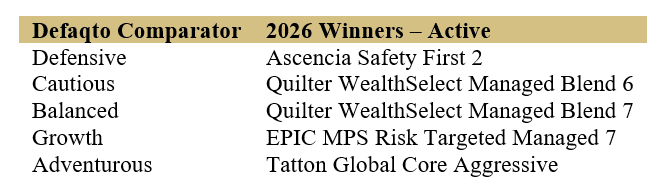
So, who came out on top? Let’s start with the sub-category of active portfolios:
“It would be reasonable to conclude the biggest contribution to the success of the 2026 winners is simply good, consistent decision-making over the past five years.
Source: Defaqto
Some familiar names from last year, than, but also a new winner emerged – EPIC can now point to five-year performance numbers and won the award in the Growth category.
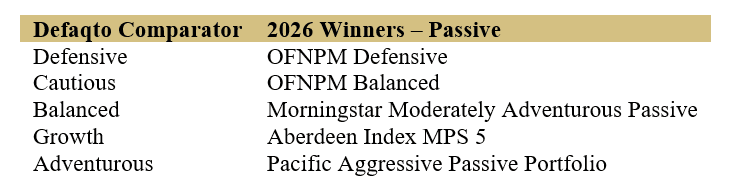
Turning to the sub-category of passive portfolios:
Source: Defaqto
Aberdeen Index MPS 5 and Pacific Aggressive Passive Portfolios were both highly commended in 2025, so have just added that little something extra to take the awards this year in, respectively, the Growth and Adventurous sectors. OFNPM, like EPIC in the active category, now boast five-year numbers and won awards in the Defensive and Cautious Categories. Morningstar portfolios have been around longer but the Moderately Adventurous Passive portfolio has come out of the pack to take the award in the Balanced category.
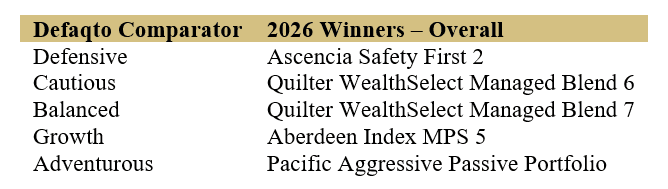
Having identified the winners at the sub-category levels, the overall Comparator winners demonstrated that active management had delivered stronger and more consistent returns in the lower-risk Comparators of ‘Defensive’, ‘Cautious’ and ‘Balanced’, while passive clearly won out when risk was being applied in the shape of the ‘Growth’ and ‘Adventurous’ Comparators.
The overall Comparator award winners were:
Source: Defaqto
Of course, there is still a significant percentage of advisers who are looking for a range of portfolios to populate their CIP or CRP, with a view to selecting the most appropriate underlying portfolio for their clients, likely based on risk profile.
With DFMs creating several ranges, each with a broad spectrum of risk/volatility portfolios, using both active and passive approaches, Defaqto felt this should be recognised in the awards, and so we launched two new awards to recognise the best ranges across active and passive where they have a minimum five-year track record and a minimum of five portfolios within the range. They are:
Best Passive Range: Tatton MPS Tracker
Best Active Range: Quilter WealthSelect Managed Blend
Massive congratulations to all the winners and those who were highly commended!
Now, given these results are all purely quantitative, is there anything the winners have in common? Let’s look at the winning passive portfolios first.
Do they all have similar discretionary assets under management? No – indeed, there is quite a spread from the lowest, at just over £600m, to well over £30bn. Biggest is not necessarily always best and smaller does not always mean swifter and more fleet of foot. Winners come from both ends of the discretionary AUM spectrum. Does it help to have longer-established portfolios? Again no – the launch dates of the winners range from May 2011, which is pre-Retail Distribution Review, through to October 2020.
Finally, is cost a deciding factor? Again, it would appear not as MIFiD II costs – which exclude platform costs – range from 0.2% through to 0.36%. This should help dispel the myth that cheapest is always best and value for money is what selection should be based on.
Turning to the active portfolio winners, we find a similar story: discretionary AUMs range from as low as £240m up to more than £20bn while portfolio launches run from February 2014 through to July 2020. In respect of cost, though, there is a broader spread than passive – ranging from 0.67 % through to 0.9% (again not including platform fees).
That being so, it would be reasonable to conclude the biggest contribution to the success of the 2026 winners is simply good, consistent decision-making over the past five years.
Andy Parsons is head of investments at Defaqto