
One small wrinkle with the whole Mean Reversion Machine experiment – and one we would need to look to iron out should we do it all again next season – is the number of so-called ‘dead’ teams in FPL. These exist where players have, reasonably enough, lost interest and/or patience with the game – or, more irritatingly, where people create one-off teams in an attempt to win one of the growing number of ‘highest weekly score’ leagues.
These are then discarded like so many wet-wipes to clog up the FPL pipes – and, of course, distort the data for any poor journalists striving to inject some mildly-diverting, yet still statistically-rigorous, investment-football hybrid nonsense into a dullish Friday afternoon. And if you think I exaggerate the problem, at the end of Gameweek 5, there were 11.9m teams in the FPL system – a million fewer than at the end of Gameweek 25.
Whatever the reason for these non-playing teams, they still feature in the ownership data, which means our MeanReversionMachine benchmark is incrementally less pure than it might be. Arguably then, a better benchmark would be the ownership of, say, the top 100,000 or million players in the game – as tracked by the likes of LiveFPL – as these would clearly all be active teams.
Less positively, such an index would be way too fluid for us to construct in any meaningful way – plus it is actually quite tricky to do manually. Just to illustrate the variance, however – all the more marked in a week where Arsenal play twice – goalkeeper Raya is currently owned by 46% of the top 100,000 teams, midfielder Rice by 72% and defender Gabriel by 88%. Compare that with their levels in our pre-Gameweek 26 benchmark:
“One-off teams created in an attempt to win one of the growing number of ‘highest weekly score’ leagues. are then discarded like so many wet-wipes to clog up the FPL pipes.
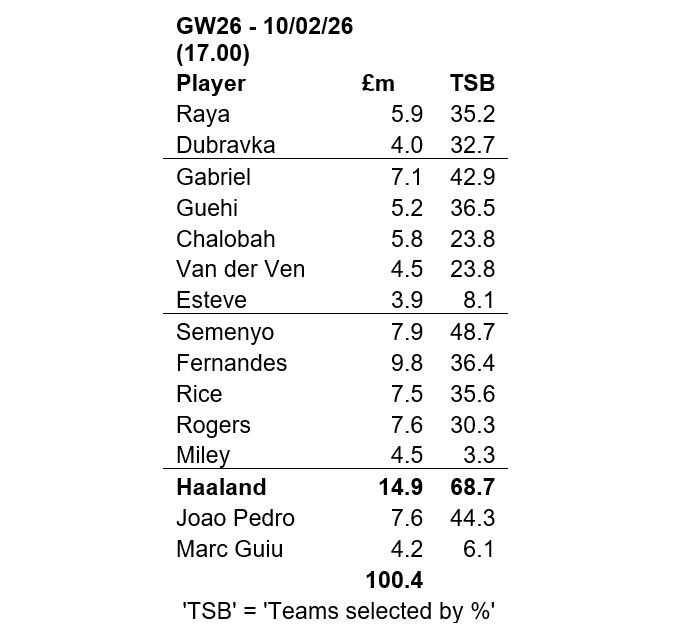
Source: Fantasy Premier League
As it happens, in recent days, the existence of dead teams has being discussed rather less graciously on certain fantasy football message boards. The argument has run that ‘committed’ players (those doing the grumbling) had been suffering lower ranks over the last few weeks as ‘casuals’ (the biggest insult in FPL) were unduly benefitting from the performances of the likes of resurgent Chelsea duo Pedro and Palmer.
Both featured in, very roughly, three-fifths of teams over the first few weeks of the season before falling away in ownership – Palmer rather more vertically than Pedro. And while Pedro has crept back above 40% ownership of late, posting scores of 8 and 10 in his last two outings, the more expensive and thus less easily reabsorbed Palmer is still only 15%-owned – despite scoring 20 and 12 in those same games.
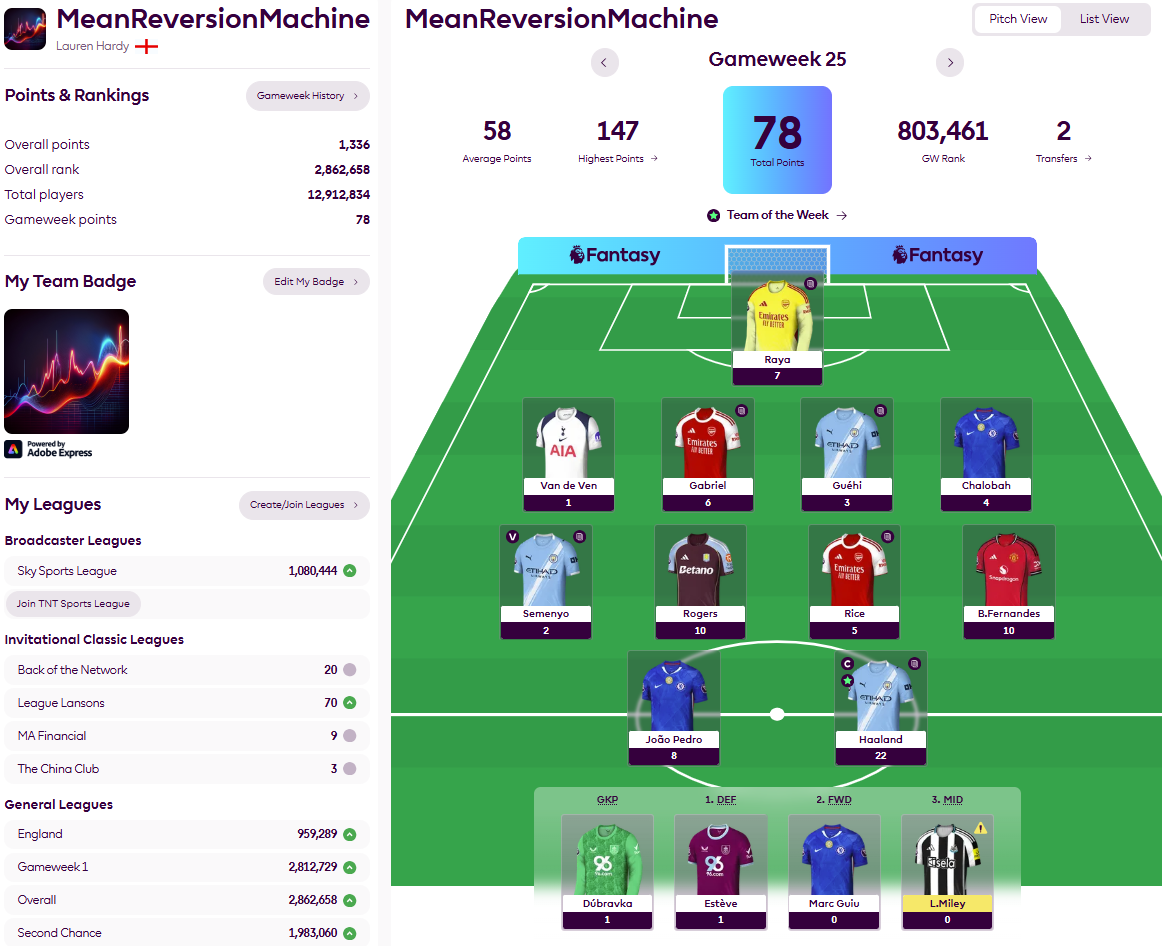
While we do not own Palmer, the portfolio’s showing in Gameweek 25 suggests the grumblers may have a point – even if it is one that elicits minimal sympathy. As you can see below, our score of 78 – well inside the top million for the week – was helped by Pedro and an unexpectedly good return from our perma-captain Haaland. Mind you, Spurs’ van der Ven, the clearest ‘residual’ from the early weeks of the season, barely contributed.
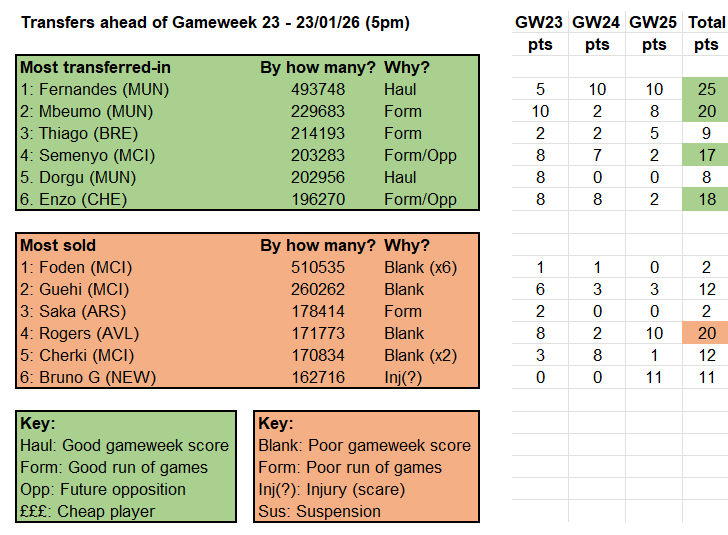
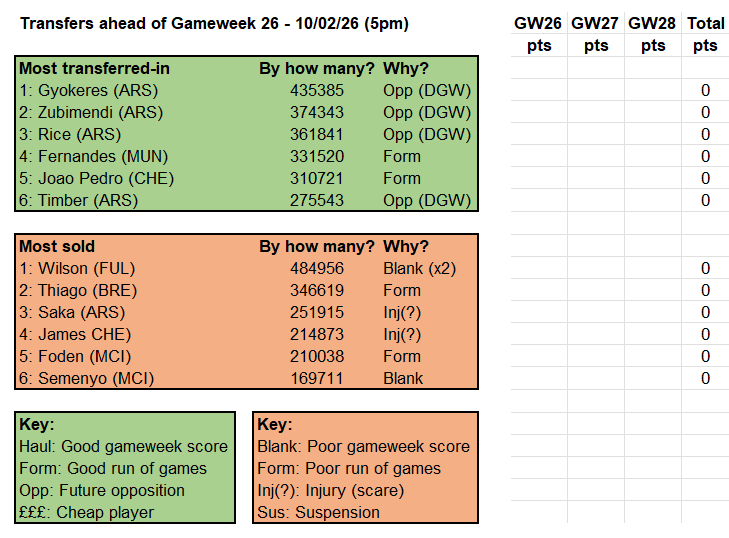
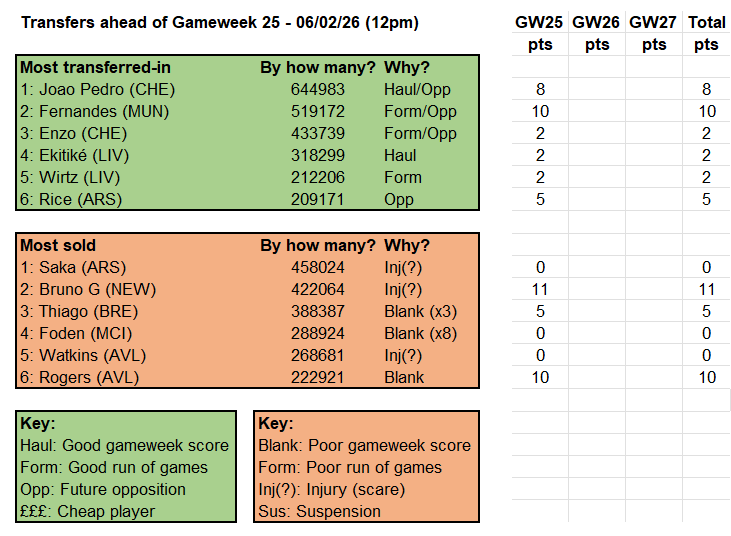
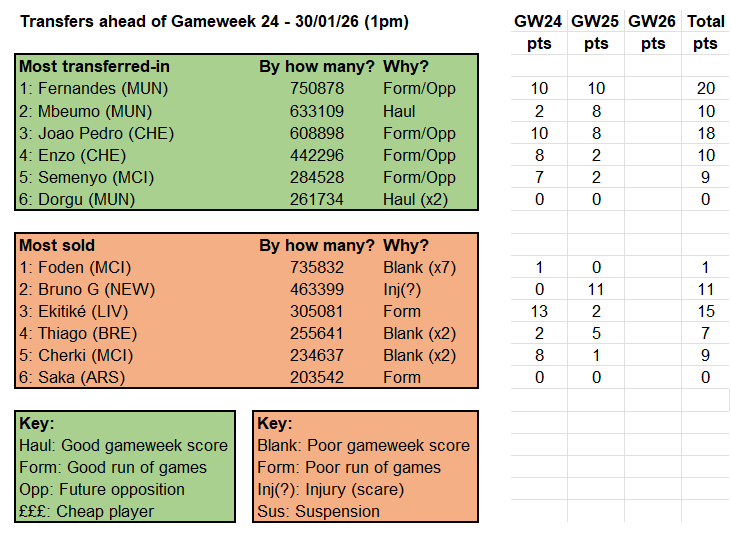
Given we are already in the teeth of another gameweek, all this backward-looking chat feels most appropriate – so let’s keep it going with a look at our Herdwatch tables of the most bought and sold players of recent weeks. No major surprise to see four representatives from the doubling Arsenal in the most recent ‘buy’ table though I suspect the corresponding sales these likely provoked, especially Thiago and Semenyo, may come to be rued.
Looking slightly longer term – that is, the full three-week timescale of the bottom-righthand table – the big ‘buys’ did seem more considered at the time than the week just gone and so it has proved with Fernandes, Mbeumo, Semenyo and Enzo. As for the ‘sells’, the mass exodus from Rogers felt especially brave ahead of a great run of fixtures for Aston Villa and so it is largely proving.
Source: Fantasy Premier League