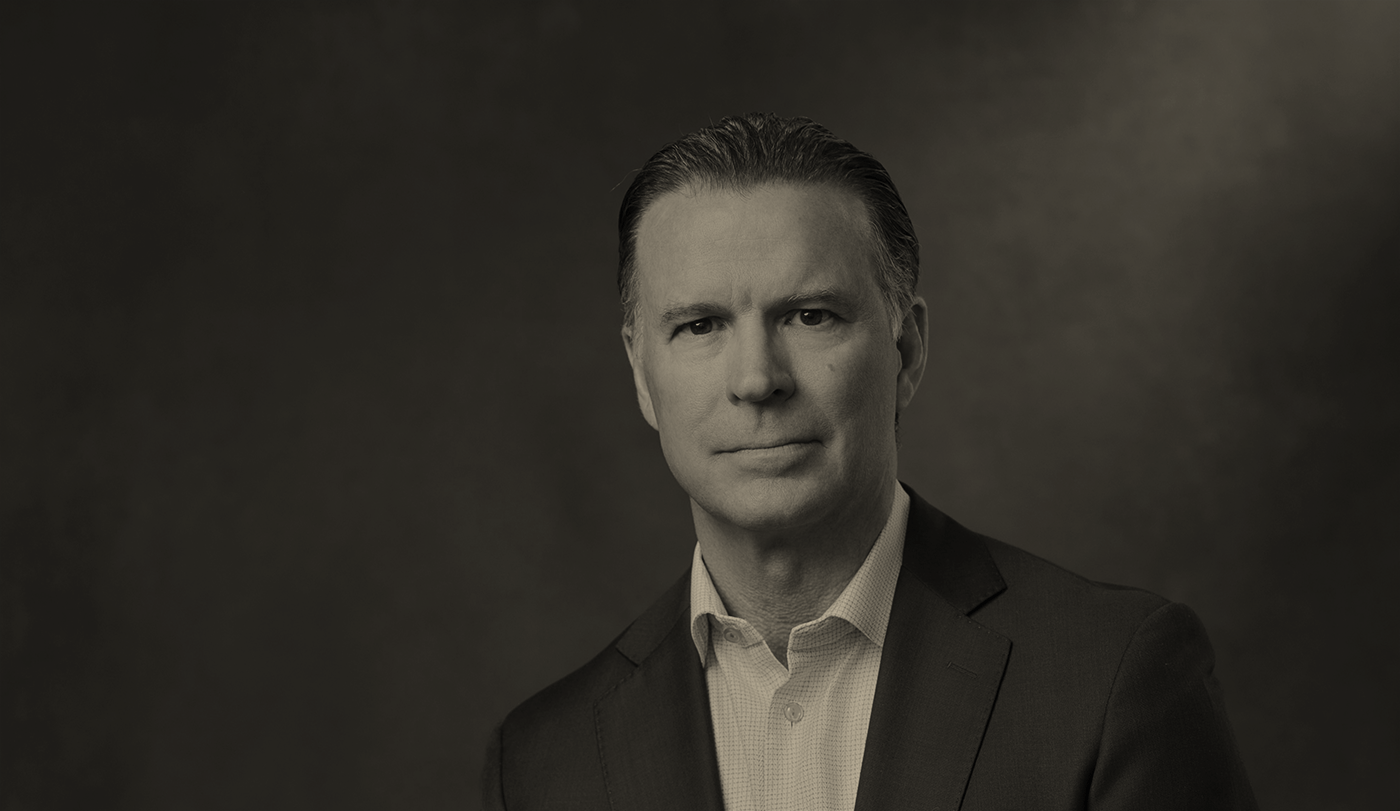

Janus Henderson Investors managing director, UK client group Pat Sanderson on leading with insight, setting the pace for the coming decade and how, as an active manager, you only win where you deserve to win
Where – and why – are you anticipating demand or fund-flows from UK-based wealth managers and their clients over the next 12 months?
For the first time in quite a while, it genuinely feels as if active management is back in vogue. We have come through an extended period where active management – and especially equity focused active – was in a challenging position and there was very little absolute AUM growth outside the mega cap technology names. That tide looks to be turning. The environment is changing – and with it the appetite for strategies that can actually distinguish themselves and add value.
If you think about the sequence from 2024 to 2025 and into 2026, it helps explain the shift. 2024 was the year of politics and elections, big geostrategic moves while 2025 was about the policy response to those moves, with structural changes being written into the rulebook.
And 2026 is when those policies start to bite and show up in the real economy, markets and sector dynamics. Overlay that with state directed capital, rapid advances in technology – and direct government involvement in tech – plus sustained geopolitical conflict, and you have a very different backdrop in which to make investment decisions.
Against that backdrop, two areas stand out. First is technology – and nobody wants to miss this next phase. Broad global equity allocations give you exposure to the biggest platforms but, when you have genuine revolutions underway, specialist tech managers come to the fore.
The second area is smaller companies, which are more nimble, often better at navigating turbulent periods and less likely to be caught directly in the crosshairs of big policy shifts. In short, technology and smaller companies look like fantastic places to allocate in the year ahead.
How are you planning to address and serve that interest?
We are very deliberately moving away from product selling – the bells and whistles of our own lens – towards seeing everything through the client’s lens. That is not a marketing tweak – it is a strategic posture. If you start from the product, you inevitably try to fit clients into what you already have. If you start from the client, you build the thread from what is changing in the world to the decisions they need to make and the outcomes they want to achieve.
For us, that means leading with insight: understanding the big movements, helping clients understand them and then connecting those dynamics to investment decisions, clearly and pragmatically. It is about equipping clients to make good decisions in real time, not just distributing information. Ultimately, we want to be great stewards of their capital – and insight led partnership is the best way to do that.
Practically, this shows up in how we engage – more time on context and consequence, less time on product features. We are focused on the translation layer between macro change and portfolio action: where to lean in, where to be cautious – and why. That is where clients need us most.
Are you seeing a divergence in the demands of UK wealth managers versus, for example, their peers in Europe or on the institutional side in the UK?
The UK and continental Europe are very different markets, particularly in how investments are consumed – for example, multi asset frameworks, wrappers, platform architecture, regulation and labelling and so on. At the same time, there is strong consistency in what ultimately gets owned. Asset classes and themes that work for UK investors generally work for European investors too. The divergence is in consumption mechanics – the investment end state is more aligned than people assume.
Where we see convergence, not divergence, is within the UK between wealth and institutional. Consolidation on the wealth side means fewer, larger players – and larger players behave like institutions, with sophisticated research teams, governance, price sensitivity and solution design. That is why we brought our wealth and institutional client groups together nearly two years ago. It has absolutely proven to be the right call: one client led approach rather than sector or product led silos.
You still find differences in how they buy and where they choose to deploy capital at the margin but the gap is closing. Big wealth platforms and leading pensions or insurers are sophisticated buyers of capabilities. They expect clarity on process, evidence of alpha, pricing discipline, and partnership. We orient to that, understanding client needs first, then mapping capability to need.
As a business, how do you define ‘alternative’ and ‘private’ assets and to what extent should asset managers be looking to service investor demand here?
Private assets are self explanatory. Alternatives, for us, are the broader universe, hedge and private assets – the strategies that do not slot neatly into traditional long only equity or bond buckets. Demand is increasing as clients consolidate and become more sophisticated. Bigger, more complex buyers have greater understanding and greater appetite for strategies with complexity and, crucially, differentiated outcomes.
As an active manager, you only win where you deserve to win. That means deploying genuine intellectual property and showing clients where and how you are adding value. We see a high correlation between building alternatives capability and our ability to evidence alpha. Clients will pay for demonstrable value – and the willingness to pay is tied to the clarity of outcome and repeatability of process.
In a world of natural fee pressure, margins compress where value is marginal and expand where value is clear. Alternatives are one of those areas where active management works, and where our inputs can be directly tied to better outcomes. So yes, managers should be servicing demand but, by focusing on where they can genuinely prove value, not by chasing complexity for its own sake.
‘ESG is dead – long live ESG 2.0’ – your thoughts as a distributor, please?
I don’t think ESG is dead – far from it. Investors care, and they care deeply. The open question is whether they would sacrifice returns for responsible investing outcomes. Some will; many won’t. But the expectation now is that ESG is built in everywhere, not confined to a labelled sleeve.
The big change is integration. Investors expect E, S and G to be factored into the actual buy and sell decisions, assessing risks, threats, opportunities and incremental return potential at the point of investment, not as an afterthought. Over time, this becomes a tailwind, not a headwind.
We are set up for this. We have a centralised team whose job it is to ensure responsible investing is understood and applied across all strategies and all portfolio managers. We also have dedicated strategies for clients who want a higher emphasis – for example with an Article 9 fund – but where the centre of gravity is clear: ESG embedded across capabilities, with decisions reflecting those factors in a disciplined, repeatable way.
What drives your approach to client communication? And is there a case for focusing on attracting the ‘right’ type of client?
Our communication is value led. The industry has moved from a product era, through a solutions era, to an insight led era. ‘Insight led’ means we understand clients, their sectors, their challenges and their businesses as well as they do, if not better, and we proactively help them to solve problems they may only just be recognising.
We lead with what matters: the big movements in the world, what those movements mean for portfolios and how to translate context into action. Less brochure, more signal. Clients don’t need noise – they need clarity and relevance.
As for the ‘right’ client, people tend to be like for like – partnership attracts partnership. Clients who want openness, who are willing to share challenges and who value a symbiotic relationship get the best out of us, and we get the best out of them. Transactional relationships will always exist, but we are at our best when we become a natural extension of our clients’ teams, aiming to achieve their intended outcomes together.
Outside of work, what is the strangest thing you have ever seen or done?
The strangest thing I have done is cut two of my toes off with a lawnmower during lockdown. I now officially have eight toes. I managed 17 seasons of professional sport, broke my neck, broke my back, blew my knee twice, my shoulder twice – all big injuries – and kept myself together. Then I retired and chopped two toes off.
It is absurd and a bit grim but also a good reminder that even when you have faced a lot, life can still surprise you in the most mundane of settings, such as mowing the lawn.
May we have two book recommendations, please – ideally, one with an investment connection?
The first finance book I was made to read in banking was John Gregory’s Counterparty Credit Risk, Credit Value Adjustment and the Ongoing Challenge of the Global Financial Markets. It is not a page turner in the airport-lounge sense but it did give me a really good grounding in one of the most important aspects of what we do, understanding counterparty and CVA in practice. If you work in markets, that foundation matters.
The other is Daniel Coyle’s The Talent Code. It is a really compelling explanation of how world class performance is created, practice, coaching and the environments that build skill. It genuinely influenced me and was one of the reasons I decided to move from professional sport into the financial markets and try something completely different. It is a book you can revisit and still find something new each time.
Together, they cover both the technical and the human sides of performance: how systems work and how people become excellent within them.
Gazing into your crystal ball, what does the asset management sector look like 10 years from now?
Consolidation will continue. Clients want partners with breadth of capability – and breadth usually requires scale. That does not mean there will not be exceptional specialists, but the centre of gravity shifts toward managers with the scope to partner meaningfully across needs.
The bigger, more transformative change is the technology revolution we are living through. Data will be collated and understood in radically more efficient ways. It will touch every aspect of our business: how we communicate internally, how we assemble and surface information about our clients and capabilities, how we deliver that information externally and, crucially, how we invest.
It is not hyperbole to say the portfolio managers of tomorrow could be the prompt engineers of today. The toolset changes: faster time to market, greater oversight, more flexible product structures, more efficient decision making and better access to asset classes.
None of this is bad news – indeed, it is good news, for us and for our clients, provided we embrace it. Ten years from now, the firms that invested early in capability, data and workflow will be the ones setting the pace.
“We are focused on the translation layer between macro change and portfolio action: where to lean in, where to be cautious – and why. That is where clients need us most.