
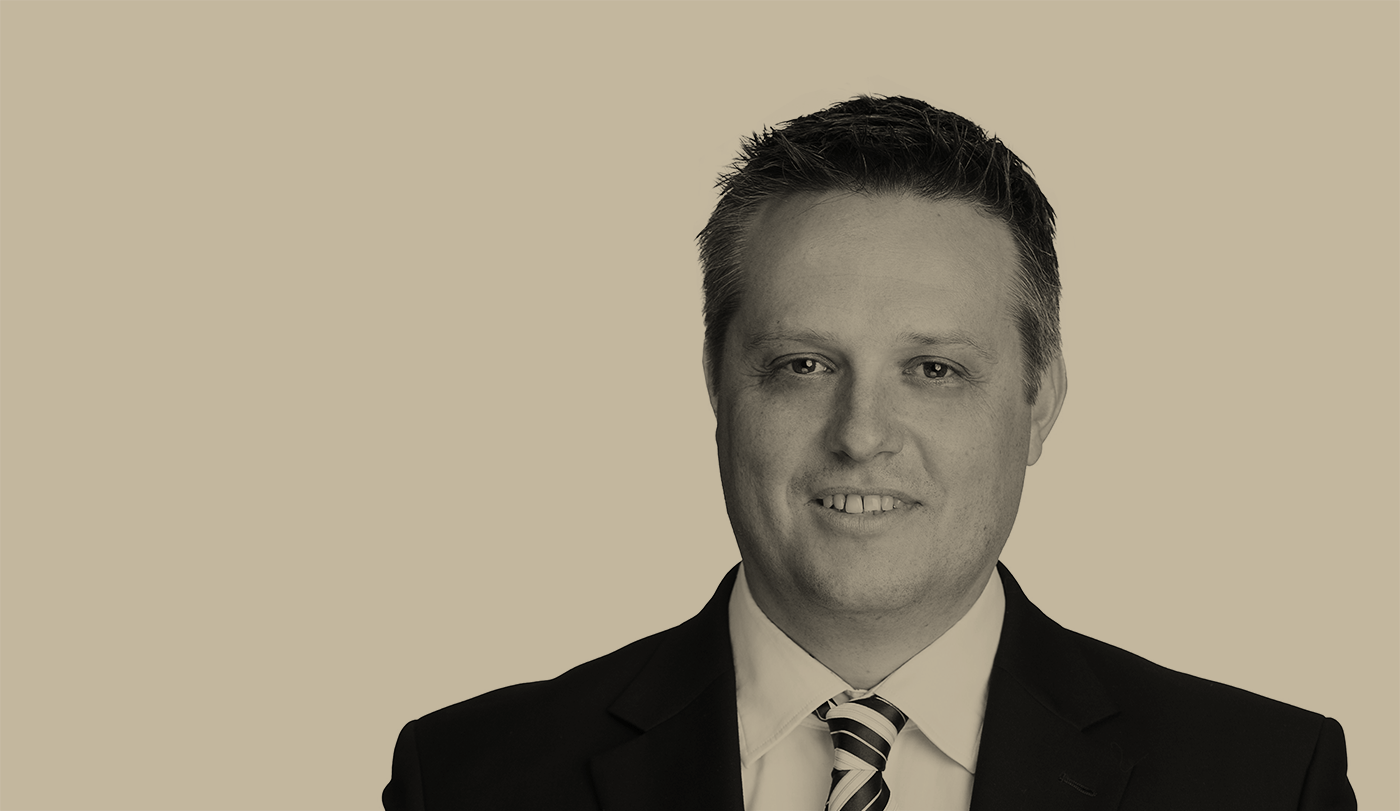
Fidelity International head of UK wholesale Dennis Pellerito on the three core demands clients now have
Where – and why – are you anticipating demand or fund-flows from UK-based wealth managers and their clients over the next 12 months?
The last year has shown us how quicky market narratives can change. We have entered a period of heightened uncertainty and anticipate more market volatility in the near term – and, as a result, we are witnessing three core client demands:
* Active resilience: Investors are prioritising solutions that can navigate uncertainty and shifting regimes – balancing growth with stability, income with preservation and agility with discipline. They want strategies that are robust enough to endure volatility across equities, fixed income, private markets and multi-asset, while remaining flexible to adjust as market conditions and client needs evolve.
* Uncorrelated sources of return: The search for returns is no longer centred on traditional benchmarks alone. Clients are looking for uncorrelated sources of value from systematic and absolute-return strategies to alternatives/private markets and outcome-oriented approaches to diversify portfolios and protect against concentration risks. What was once considered peripheral is now core: multiple, differentiated return streams are essential to meeting long-term objectives.
* Deeper partnerships, not just products: Finally, clients increasingly expect more than off-the-shelf strategies. They want to work more deeply with a smaller number of managers who can serve as true partners, understanding their distinct objectives, time horizons, and challenges and then tailoring solutions across asset classes to meet them. This is driving demand for customised, cross-capability approaches and technology-enabled services that deliver insight, efficiency and scale.
How are you planning to address and serve that interest?
Research-powered investing is in our DNA and it remains our distinctive edge right across our core capabilities. At Fidelity International, active management is not just picking stocks – it is about making deliberate, research-backed choices across portfolios, wrappers and delivery models. We are delivering value-added outcomes, resilience, customisation and long-term wealth creation, rather than aiming simply to beat a benchmark.
The strength of our investment engine and global research platform allows us to offer a wide range of market-leading capabilities across asset classes. Today’s investors want flexibility – not only in what they invest in, but in how they access it. We are committed to increasing choice and flexibility, allowing clients to access our capabilities in multiple formats and investment vehicles.
Fidelity is expanding its ETF platform, scaling systematic strategies and developing bespoke solutions aligned to clients’ priorities. We are also investing in digital platforms and distribution partnerships that integrate seamlessly with client ecosystems, ensuring our solutions are accessible in the formats and channels clients use most. The result? Strategies that meet investors where they are, while giving them the tools to compete and grow in their own markets.
Are you seeing a divergence in the demands of UK wealth managers versus, for example, their peers in Europe or on the institutional side in the UK?
Our clients need a range of solutions that align with their desired outcomes, whether that is single-strategy funds, ready-made portfolios or fully bespoke solutions. Beyond product choice, they expect exceptional service and a business that can provide continuous innovation and support.
In the UK, we continue to see strong growth in our Model Portfolio Service alongside an increased adoption of cost-efficient solutions. More recently, we have seen an increase in clients looking for active strategies that deliver a diversified source of alpha. In this situation, we must offer the right services to ensure we are a component in the solutions.
Across Europe, the ETF wrapper is gaining traction – particularly with retail investors – while the demand for segregated mandates is also rising. Our clients are seeking solutions that are consistent and offer uncorrelated alpha returns.
As a business, how do you define ‘alternative’ and ‘private’ assets and to what extent should asset managers be looking to service investor demand here?
For investors with a longer-term investment horizon, there are opportunities for enhanced returns and portfolio diversification through sectors not available in public markets. At Fidelity International, we are dedicated to offering a diversified and comprehensive suite of solutions to clients, including both public and private offerings.
As an example, Fidelity International has a strong real estate team, founded in 2006, and plans to build on recent successes following the launch of two new funds focused on impact investing and decarbonisation: European Real Estate Climate Impact Fund and our Real Estate Logistics Climate Impact Fund.
We also run our Fidelity Diversified Private Assets LTAF in the UK – a key contributor to our workplace investing DC scheme, FutureWise. Finally, we are continuing to explore opportunities to collaborate with third-party providers, to better scale our capabilities and broaden client access to private asset solutions.
‘ESG is dead – long live ESG 2.0’ – your thoughts as a distributor, please?
ESG has entered a new era. While ESG investing may now be viewed as a mainstream consideration in asset allocation, a Fidelity International study last year showed ESG remains firmly on investors’ minds. For our part, we believe the integration of sustainability into investment research and portfolio construction is important as it can impact long-term value creation and drive better client outcomes.
As an active manager and steward of client capital, we have a part to play in moving towards a more sustainable economy that better takes into account system-level risk but – as that study highlighted – there is no one way to achieve this. This is why we believe effective stewardship combines bottom-up, thematic and system-wide approaches.
We continue to support increased data transparency and standardisation as well as the harmonisation of global regulatory regimes that enable decision-useful disclosure. We also champion for greater focus on policies driving real-world outcomes, complementing the role of enhanced disclosures in guiding investor choices.
What drives your approach to client communication?
And is there a case for focusing on attracting the ‘right’ type of client? Client communication is key for us. We engage with our clients through the good times and the bad times, offering reassurance and insights when needed. Our aim is to be recognised as a business that cares, is a trusted partner and is truly client-centric.
We prioritise clear and transparent communication in every interaction we have, offering insights into markets and trends, and we support our clients’ goals – especially as our industry continues to evolve at pace. All clients are important to us so there is no ‘right’ client and we hope we can bring the best of Fidelity to the market and be the partner of choice.
Outside of work, what is the strangest thing you have ever seen or done?
I was fortunate enough to spend a year travelling around Europe in a kitted-out campervan with a close friend. We worked as we travelled, discovering beautiful places and meeting fascinating people along the way. One moment that stands out was in the hills of Pelion in central Greece, where I saw the strangest animal I’ve ever seen. To this day, I have never been able to decide what it was … my best guess is a camel spider!
“Investors are prioritising solutions that can navigate uncertainty and shifting regimes – balancing growth with stability, income with preservation and agility with discipline.

Just in case you were wondering what a Greek camel spider might look like ...
May we have two book recommendations, please – ideally, one with an investment connection?
Working at Fidelity, I will always recommend Beating the Street by Peter Lynch – but another of my favourite business leadership books is Will it Make the Boat Go Faster? by Ben Hunt-Davis and Harriet Beveridge.
Gazing into your crystal ball, what does the asset management sector look like 10 years from now?
There are three fundamental industry disrupters that are reshaping asset management: longevity, which is redefining retirement and savings needs; advanced technology, which is reshaping our industries and accelerating new sources of growth; and sustainability, which remains a key focus.
In parallel, the industry is going through a structural shift driven by fee compression and the need for low-cost solutions, consolidation and the emergence of retail investors. These themes are having an important impact on investing, growth opportunities and capital allocations.
In this context, clients do not just need access to markets – they need forward-looking strategies that combine global scale with local insight, and enduring partnerships that can adapt as their world changes. Clients are looking to work in a different way through deeper partnerships with fewer asset managers – but ones who understand their unique objectives, timelines and challenges and can provide tailored solutions across various asset classes. This is driving demand for customised, cross-capability approaches and technology-enabled services that deliver insight, efficiency, and scale.