


The week that was …
Economic round-up
Inflation concerns drive US rate rise
After last week raising US interest rates for the first time in more than three years, the Federal Reserve indicated they may raise them higher still in a bid to slow rising prices. In a unanimous decision, the US central bank hiked rates 25 basis points from the 3.5%-3.75% range to 3.75%-4%. Fed chair Kevin Warsh said the move was because “inflation is too high and has been for too long”. Read more in ‘In focus’ below and from the BBC here
UK interest rates on hold – for now
UK interest rates are likely to rise if the Iran war continues, the Bank of England has warned, with inflation now on course to reach 4%. At last Thursday’s meeting, the UK central bank’s Monetary Policy Committee voted (6-3) to leave borrowing costs at 3.75% – as markets had widely expected. Read more from the Times here
Fuel and transport prices drive UK inflation
UK inflation hit 3.1% in August, as fuel and transport prices rose in response to the Iran war. Motor fuel prices rose by almost a quarter while factories reported a rise in their input costs, which pushed up the cost of their products. Read more from the Guardian here
UK pay growth close to six-year low
Quarterly data showed the UK jobs market still weak, with the fewest vacancies since 2021. Average weekly earnings, excluding bonuses, grew by 3.5% in the three months to July compared with the same period in 2025. The pace of growth in pay was meanwhile close to its slowest level since 2020. Read more from Reuters here
August retail sales in UK surprise on upside
UK retail sales volumes increased by 0.5% over August, according to the Office for National Statistics, beating economists’ consensus expectations of a 0.2% contraction. The latest figure compares with a 0.5% drop in July when shoppers cut back on spending during the heatwave. Read more from the Times here
Early ‘Prime Day’ prompts bounce in US retail sales
US retail sales rebounded strongly in August after an earlier-than-normal Amazon Prime Day disrupted the usual June and July spending patterns. US retail sales rose 1.2% month-on-month in August versus expectations of a 0.8% gain. Read more from ING here
Yen falls despite Japan interest rate rise
The yen fell sharply on Friday despite the Bank of Japan lifting interest rates to a 31-year high. The policy board of Japan’s central bank had voted by a 7-2 margin for a 25 basis-point rise, taking its target rate to 1.25%. The yen sank as much as 1.3% to ¥158 to the dollar following the decision, however. Read more from the FT here
Manufacturing data boosts China’s economy
China’s industrial production grew 5.2% year-on-year over August, accelerating from a 4.5% rise the previous month and surpassing consensus expectations of 4.8%. The acceleration came amid faster growth in manufacturing. Read more from Trading Economics here
Markets round-up
Oil demand declining over 2026 – IEA
The latest Oil Market Report from the International Energy Agency (IEA) has forecast a 2.5m barrels-per-day decline in global oil demand this year as prolonged Middle East disruption tightens supply and drives fuel prices higher. The report went on to project demand would recover by 2.7m barrels-per-day in 2027, narrowly offsetting this year’s decline. Read more in ‘In focus’ below and from Oil and Gas Middle East here
Wall Street dips on Fed decision
Wall Street’s main indices fell on Friday, as investors digested shifting oil prices, higher treasury yields and a US interest rate rise. The rate hike from the Federal Reserve and chair Kevin Warsh’s commentary on the future trajectory of borrowing costs weighed heavily on investor sentiment. Read more from Reuters here
Borrowing costs rise for French government
The costs of insuring French government debt against default have jumped to their highest level since April 2025. Bond yields also climbed as investors grew more concerned about the country’s financial situation. The spread between French and German 10-year government bonds has now exceeded 100 basis points for the first time since the eurozone debt crisis in 2012. Read more from Investing.com here
Gold bullion rises as oil prices stabilise
Gold prices rose on Friday, as lower oil prices eased concerns about prolonged inflationary pressures – although a stronger dollar limited gains. Bullion increased around 1% over the week. Read more from Reuters here
“We are again seeing energy as a geopolitical target. It is easy to hit energy infrastructure – and very difficult to build more.
Selected equity and bond markets: 11/09/26 to 18/09/26
| Market | 11/09/26 (Close) |
18/09/26 (Close) |
Gain/loss |
|---|---|---|---|
| FTSE All-Share | 5734 | 5744 | +0.2% |
| S&P500 | 7657 | 7651 | -0.1% |
| MSCI World | 4906 | 4914 | +0.2% |
| CNBC Magnificent Seven | 451 | 455 | +1.0% |
| US 10-year treasury (yield) | 4.97% | 5.00% | |
| UK 10-year gilt (yield) | 5.28% | 5.30% |
Investment round-up
‘Band back together’ at Fund Research Centre
Square Mile research and consulting team head Diane Earnshaw has joined the Fund Research Centre as research and consulting director – reuniting with former Morningstar and OBSR colleagues Peter Toogood, Gill Hutchison and Marianne Weller.
Bond yields the biggest risk, say fund managers
A third of fund managers view an uncontrolled surge in bond yields as the most significant tail risk facing markets, according to the Bank of America’s latest Global Fund Manager Survey. Even so, fund managers are shown to remain broadly bullish on the global economy.
Janus Henderson strengthens global equity team
Global equity specialists Helen Jewell and Shilpee Raina are to join Janus Henderson Investors as the firm looks to bolster its global equities franchise, following the departures of Lucas Klein and Nick Schommer. Based in London, Jewell will join the firm as head of EMEA and APAC equities on 1 December.
Stocks and shares ISAs grow in popularity
Some 16.8 million adult ISA accounts were subscribed to in the 2024/25 tax year, according to the latest data from HMRC – up from 15 million in 2023/24. The increase was largely attributable to stocks & shares ISAs, which rose by 802,000 in the 2024/25 tax year to reach a total of almost 4.9 million.
Invesco’s Hargreaves to retire
Invesco co-head of Asia and emerging markets equities Ian Hargreaves is to retire after 32 years at the firm. Hargreaves is currently listed as co-manager on five funds with a total of some £14.3bn in assets under management. This includes the £6.5bn Invesco Developing Markets and £2.7bn Invesco Asian portfolios. Charles Bond and Wiliam Lam will take over his responsibilities.
ICA launches actively managed income ETF
Infrastructure Capital Advisors has launched an actively managed ETF combining US equities with an options strategy designed to generate monthly income. The Infrastructure Capital S&P 500 Option Income UCITS ETF has launched with HANetf on the London Stock Exchange.
Baillie Gifford US Growth issues Saba defence
Baillie Gifford US Growth has published its defence document against activist hedge fund Saba Capital, which is seeking to replace the investment trust’s board at next month’s AGM. Chair Tom Burnet said the £980m trust faced an “existential” threat as it battled with Saba for the third time in 21 months and urged shareholders to vote against Saba’s three resolutions.
Keyridge launches systematic global equity fund
Keyridge Asset Management has launched a systematic global equity fund for UK investors, combining active stock selection with controls designed to limit deviations from the benchmark. The Systematic Core Global Equity fund is an Irish-registered UCITS vehicle.
Aberdeen and JPM pursue smallcap trust merger
The Aberdeen UK Smaller Companies Growth trust (AUSC) has sought out a merger with rival JPMorgan UK Small Cap Growth and Income after a five-year downturn. AUSC chair Liz Airey said her board had chosen to combine with the JPMorgan trust after a “competitive private review process”, having become conscious of the challenge facing the company after buying back more than half its shares since 2021.
Carmignac launches European strategy
Carmignac has launched Portfolio Invest Europe, which is designed as a flexible European equity fund investing in quality growth companies. The fund will focus on companies with strong competitive positions, transformation potential and the ability to create long-term value.
HSBC AM launches short-duration bond fund
HSBC Asset Management has launched a sterling-denominated short-duration optimal income bond fund, focused on capital preservation and liquidity. The fund follows a multi-sector short-duration credit approach, investing dynamically across investment-grade corporates, securitised credit, emerging markets and selective high-yield.
… and the week that will be
All eyes on the US/China summit …
US president Donald Trump and his Chinese counterpart Xi Jinping are set to hold a summit in Washington this week, with a truce on the tariffs war between the world’s two biggest economies due to expire on 10 November. Ahead of the meeting, which is expected to cover Iran, trade and AI developments, US and Chinese officials have discussed creating a new “notification mechanism” for AI incidents that could affect national security. Read more from the BBC here
… and further reaction to rate decisions
Markets will still be digesting last week’s interest rate rises in Japan and, especially, the US. While the US increase had been widely expected, investors were left uncertain about how many hikes the Federal Reserve may eventually implement and the implications for already-climbing Treasury yields. Read more from Reuters here
The week in numbers
UK business sentiment: Consensus forecasts have the flash September reading of the UK’s services purchasing managers’ index (PMI) rising to 52.6 and the manufacturing equivalent holding steady at 51.7.
US business sentiment: Consensus expectations for the flash September reading of the US’s manufacturing PMI is a drop to 53 from 53.9 last month, with the services equivalent edging down to 56.4 from 56.5.
Eurozone consumer sentiment: Consensus expectations for the flash September reading of the Eurozone consumer confidence index is a fall to -17 from -15.5 in August.
Eurozone business sentiment: Consensus forecasts have the flash September reading of the Eurozone’s manufacturing PMI holding steady at 52.7 and the services equivalent dropping to 51.5 from 51.6.
Japan business sentiment: Consensus forecasts have the flash September reading of Japan’s manufacturing PMI falling to 54 from 54.9 last month, and the services equivalent down to 52 from 52.5.
In focus: Refiner points
Since the first US/Israeli strikes hit Iran almost seven months ago, the direction of the oil price has exerted a powerful influence over the global economy. From around $73 (£55) a barrel at the end of February, Brent Oil is currently hovering a little above the $100 mark – about $14 off its May peak. This is driving inflationary pressures, which in turn are contributing to real fragility in bond markets. Very much higher and oil prices could wreak significant economic damage – so where might they head next?
It is fair to say the impact of higher oil prices has – thus far – not been as bad as had been widely anticipated. There are a number of reasons for this. First, while the Strait of Hormuz – previously a thoroughfare for 20% to 25% of all global oil supplies – has remained largely shut, some oil has been getting through: having dropped from a 2025 average of 20m barrels a day to 1m-2m, the number is now back up to 5m-6m.
The region’s oil producers have also adopted alternative arrangements. “Middle Eastern countries have been quick to re-route,” notes Jonathan Waghorn, portfolio manager on the Guinness Global Energy fund. “The Saudis very quickly rerouted three to four million barrels a day of oil along the Saudi Arabian East-West pipeline. There is also a pipeline around the Strait in the UAE that has taken 0.5m to 1m barrels a day, and then a pipeline up into Turkey that has taken smaller volumes.”
Strategic inventory management has been a further positive as countries had built up stores of oil in anticipation of exactly this type of scenario. The International Energy Agency (IEA) has meanwhile helped release 320m barrels, representing around 80% of the world’s strategic inventory.
According to Waghorn, however, the biggest single factor has been the role of China, which has more than halved its imports of crude oil. “That is a large volume of oil that China has chosen not to take to allow the rest of the market to balance,” he notes. “Goldman Sachs has calculated that oil prices would have been $15 a barrel higher if it had not been for the actions of China here.”
The oil price has not moved as much as everybody expected – however, the refiners are running at very high margins because that is where the pressure is.”
Now, though, all these levers are largely pulled. Strategic inventories are nearing critically low levels and need to be refilled while alternative pipelines are coming under threat. Three pumping stations serving the vital East-West Pipeline in Saudi Arabia, for example, were damaged in an attack on 13 September.
“We are again seeing energy as a geopolitical target,” says Waghorn. “It is easy to hit energy infrastructure – and very difficult to build more.” As yet, there is no clear timeline for the line to be up-and-running while Iran-backed Houthi militants in Yemen have now threatened a second chokepoint – the Bab al-Mandab strait.
Then there is the problem of refining margins. Refining capacity has been hit not just by attacks in the Gulf but by strikes on Russian refineries by Ukraine. “Really, the problem is not the oil price,” argues Paul Flood, head of multi-asset investment at Newton Investment Management.
“The oil price has not moved as much as everybody expected – however, the refiners are running at very high margins because that is where the pressure is. It is really diesel and the products that are made out of oil where we are seeing a lack of capacity. This is driving a big difference in crack spreads.”
Crack spreads, which measure the gross profit margin an oil refinery earns by turning crude oil into finished fuels such as gasoline and diesel, are currently three times the level they were back in February. Waghorn agrees, adding: “The world does not consume oil – the world consumes oil products: gasoline, diesel, and jet fuel. Refining margins have gone up very sharply – and so have product prices.”
The current assumption is the oil market will take until 2029 to normalise. The IEA, for example, has said it no longer expects the Strait of Hormuz to reopen this year and warned that 2026 and 2027 would be “a lost period” for growth in global oil demand. It is now forecasting demand to fall by 2.5 million barrels a day this year.
Although the companies involved in alternative energy may be less profitable, the range of outcomes is more predictable.”
This has, of course, been good news for the majority of energy companies as well as for refining companies. Energy remains the best performing sector over one year – up 46% according to Reuters data. Many fund managers have participated in the rally – though they are clear it is because valuations no longer reflect companies’ improved cashflows. “Our energy holdings are not predicated on high oil prices but, rather, on low equity valuations,” argues Mark Dunley-Owen, manager of the Orbis Global Balanced fund, for example.
The longer-term winner, however, may be the alternative energy sector. Guinness’s Waghorn points out that, after a second fossil-fuel crisis in five years, governments have recognised they need to accelerate energy self-reliance. “We are seeing a change in behaviour,” he says.
“The EU has announced Accelerate EU to oversee the addition of 100 gigawatts of renewables every year. They are quadrupling the size of energy storage. They are doubling the rate of electrification. We are getting to the stage where 40% of world energy demand will be satisfied by electricity.”
Consumers are also changing their habits – for example, moving towards electric vehicles. The latest data shows electric vehicles now have a one-third market share in Europe, with ‘battery-electric vehicle’ (BEV) registrations across the continent rising 54.2% in August, pushing the market well ahead of forecasts for 2026.
In absolute terms, says Craig Cameron, senior portfolio manager on the Templeton Global Climate Change fund, spending on electrification – including renewable energy and grid infrastructure – is now bigger than spending on AI. “Although the companies involved may be less profitable, the range of outcomes is more predictable,” he adds. “High oil and diesel prices are accelerating these trends.”
It is difficult to envisage the oil price dropping very far in the short term. The situation in the Middle East is becoming more febrile and inventories need to be refilled. While there are longer-term solutions – such as re-routing and electrification – they obviously cannot be deployed quickly. In the meantime, unless the US can calm the situation in the Middle East, the pressures of higher energy costs will remain.
In focus: Dot, dot, dot
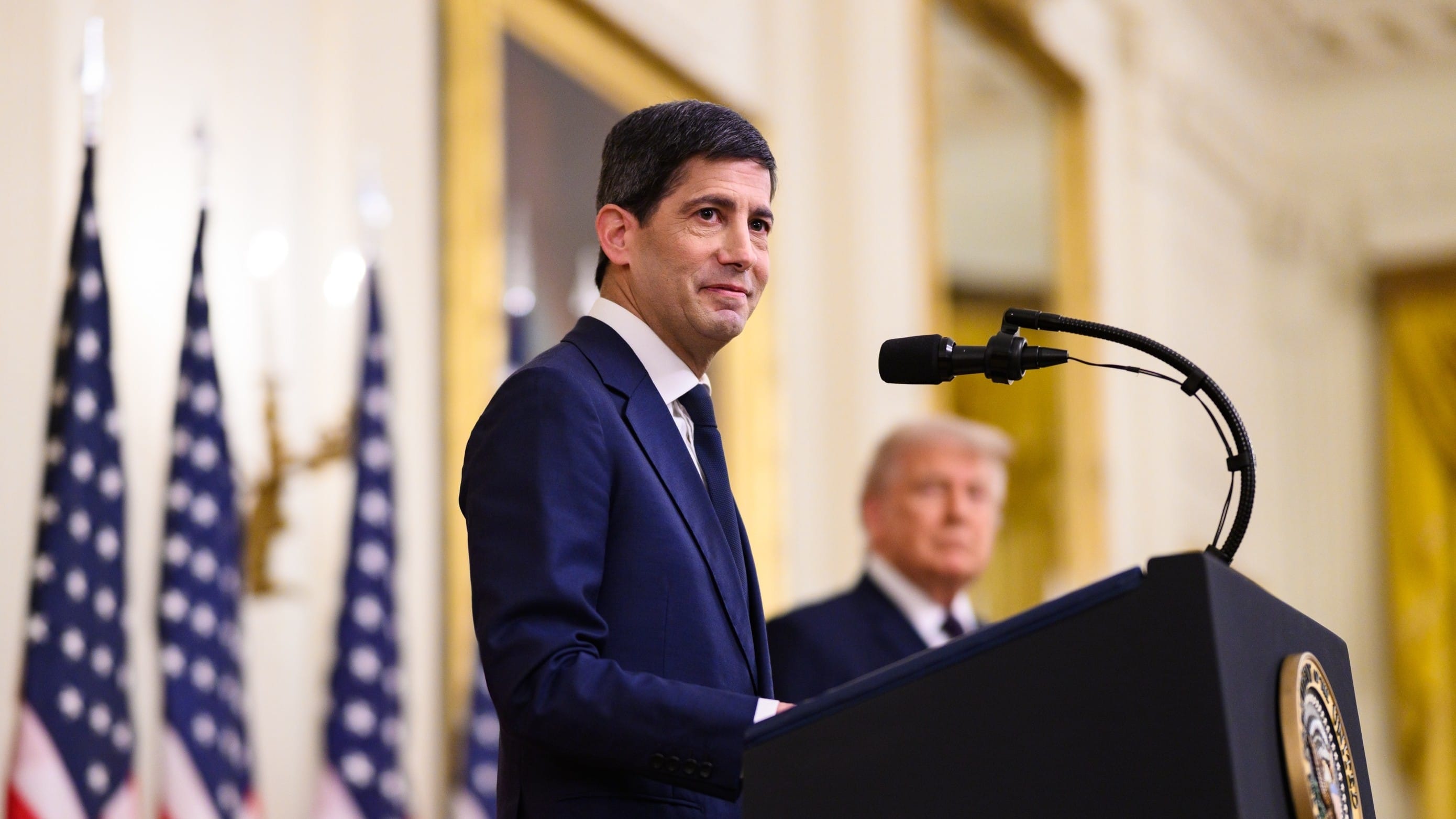
Federal Reserve chair Kevin Warsh had an important choice to make last week. He could indulge president Donald Trump, who believes interest rates should be at 1%, or he could keep his historical legacy intact. Markets appeared unsure which way he would go but – fortunately for the long-term stability of markets – he decided posterity was more important than pandering and the Fed delivered a unanimous verdict for a rate rise.
“Today’s action starts to show we are serious about this,” Warsh said as he opened the press conference. Characterising the Fed’s decision as removing “a dose of accommodation” left in the system, he also clearly signalled more rate rises could be on the cards, if necessary, to try and wrestle inflation back to target. In doing so, he firmly rejected Trump’s optimistic calls for lower rates.
Bond markets were relieved. The US 10-year treasury yield stabilised just below 5%, while the two-year yield was marginally higher. The 30-year yield – the real test of inflation expectations – meanwhile shifted lower.
The question – as is so often the case – is what happens next? While most economists expect one or two rate rises from here, the consensus is this is not the start of an extended cycle. As a note from Edmond de Rothschild Asset Management puts it: “A prolonged rate-hike cycle is not our core scenario and the Fed’s dot plots seem to go along with this idea.”
For his part, Jon Butcher, senior US economist at Aberdeen, notes: “By next year, underlying wage, rent and tariff dynamics – and, potentially a fallback in oil prices – should allow inflation to moderate, making a prolonged cycle unnecessary.”
Nevertheless, there are some significant risk factors. Increasingly, the path of inflation lies with the US administration. If Trump chooses to escalate the war in Iran, for example, or follow through on his scattergun tariff threats, further rises in inflation are an inevitability. The Federal Reserve has shown it will not be swayed by presidential coercion and therefore a more severe rate-rising cycle could be set in motion.
It is difficult to know whether a defeat in the mid-terms this November could curb Trump’s instincts or galvanise them. It is possible he will turn his attention to his domestic enemies but this is by no means guaranteed. Either way, the path of US interest rates remains uncertain and bond market volatility could well continue.