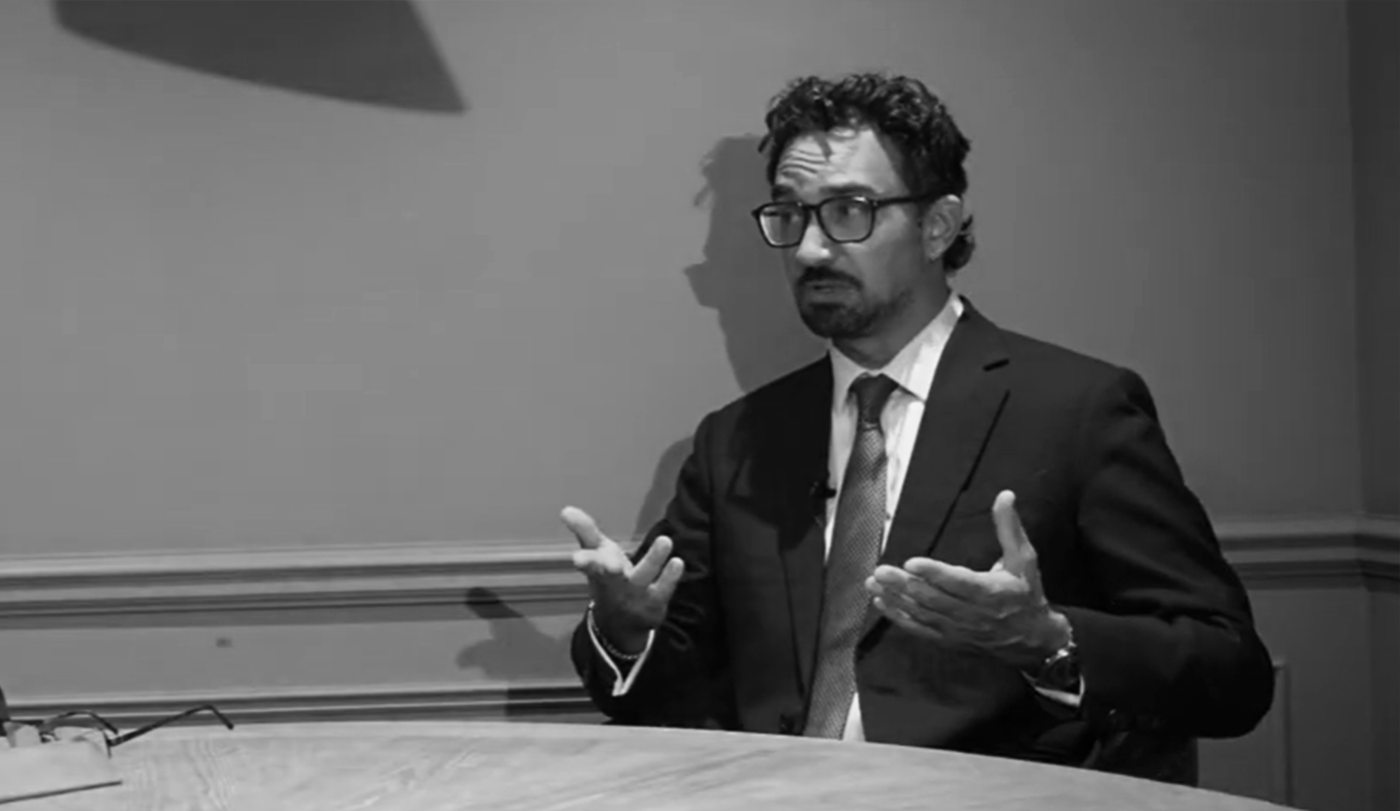

On private markets, better client outcomes and improving financial literacy
In our regular video series, we interview the wealth sector’s key decision-makers to discover how they think about life, both within the world of investment and beyond it; what brought them into the business and what keeps them here; and what makes them and their companies tick
‘Magic beans’ is how Dan Boardman-Weston, CEO of BRI Wealth Management, dismisses bitcoin – at least in the context of less traditional asset classes professional investors should be considering for client portfolios – before quickly moving on to discuss the merits of private assets, albeit with some important caveats.
“We have had, over the last few decades, a big trend of ‘de-equitisation’, companies staying private for longer and listing on the stockmarket not being the only avenue open for raising capital,” he tells Wealthwise editorial director Julian Marr in the above video. “As a result, you have lots of good companies that are staying private and that you cannot get access to in the traditional way. So there very much is a role for private client investors to access private companies – although where I get a little bit nervous and cynical is with some of the structures the industry is coming up with.
“There is no perfect answer to this but, with the big push we have towards private markets at the moment and the structures we are being offered, it feels like there is going to be a liquidity mismatch at some point – like we have seen with property funds in the past; like we have seen with other sorts of funds that have gated.
“So that worries me – and it worries me as well from a cyclical perspective that retail end-customers may end up with a lot of stuff they probably do not fully understand, probably at pretty punchy prices and probably paying pretty punchy fees. So the succinct answer is private markets – but with a big question mark over structure. And the addendum to that answer would be, while not perfect, investment trusts do provide a good solution to the private market question.”
You are always learning in investment – every day is a school day – and I have two broad investment principles ‘forged’ through making mistakes.”
As for the biggest investment mistake he is prepared to admit too, and what he learned from it, Boardman-Weston says: “Nothing specific springs to mind – which is either a good thing because I have not made any massive ones, or it is bad because I have blocked them out! Still, you are always learning in investment – every day is a school day – and I have two broad investment principles ‘forged’ through making mistakes.
“One goes back to a quote – I think it was from Peter Lynch originally – about how selling your winners and running your losers is like cutting your flowers and watering your weeds. Too often, I have taken a profit too soon and, actually, a lot of the wealth you make at the time is from compound interest and gains on gains – and winners tend to keep on winning.”
To encapsulate his second lesson, Boardman-Weston picks out the classic Keynesian wisdom that ‘markets can remain irrational longer than you can remain solvent’. “There were times going back where I was thinking, Technology valuations just make no sense whatsoever,” he continues.
“Yes, the earnings are growing but this is on 50x or 60x earnings – it is ridiculous! It has got to fall. And they might well fall – eventually; by a bit – but, as we have seen over the last six months or a year, things can move very quickly. So the two lessons are: Don’t cut your winners too soon and Don’t become too entrenched in your views.”
Money skills
Later in the conversation, Boardman-Weston addresses his best and worst-case scenarios for the future of UK wealth management. “Worst-case, financial advice and investment management just get gobbled up by US tech and AI,” he replies. “That is not my base case – I think there will continue to be a place for face-to-face advice – but that is probably my worst case.
“Whereas the best outcome for the UK wealth management industry – and from a societal perspective as well – is closing the financial advice gap. Only 9% of people in the UK receive any form of financial advice on an ongoing basis. Government is trying to do things here but, while financial literacy may have been on the curriculum for ages, it is only taught in about a third of schools overall.
“We are not equipping young people with the money skills they need to enter the adult world. They are coming out of school, having learned about oxbow lakes and four different sorts of soil erosion, but not understanding what mortgages or ISAs are or why investing is actually quite a good thing to do. So the best case is us closing that advice gap and equipping younger generations with the skills they need to be making the right financial decisions to make everyone wealthier.”
A full transcript of this episode can be found after this box while you can view the whole video by clicking on the picture above. To jump to a specific question, just click on the relevant timecode:
00.00: What excites you about the current investment outlook? What worries you?
02.20: What do you most look for in an individual investment? What constitute ‘red flags’?
04.14: To what degree should professional investors be thinking beyond so-called ‘traditional’ investments? Towards what?
06.49: What drives your approach to client communications? Should professional investors aim to attract the ‘right’ type of client?
09.50: What was your path into investment – and, if you hadn’t taken it, what do you think you would be doing now?
12.49: What is the biggest investment mistake you are prepared to admit to – and what did you learn from it?
14.59: Outside of work, what is the strangest thing you have ever seen or done?
17.55: What are your best and worst-case scenarios for the future of wealth in the UK?
19.45: What advice would you have given your younger self on your first day in this business?
21.04: Two Choice Words recommendations, please – one a book; one a free choice?
Transcript of Choice Words Episode 38:
Dan Boardman-Weston, with Julian Marr
JM: Well, hello and a very warm welcome to another in our series of ‘Choice Words’ videos, where we get to talk to the great and the good of UK fund selection and UK fund research and find out what makes them tick. I am Julian Marr, editorial director of Wealthwise Media, and today I am delighted to be talking to Dan Boardman-Weston, who is CEO of BRI Wealth Management. Hello, Dan.
DBW: Afternoon, Julian.
JM: Great to see you. Thanks for coming to play. Let’s jump straight in. What excites you about the current investment outlook? What gives you pause for thought?
DBW: I think the main thing that excites me is the technological revolution that is going on. It is largely AI but maybe with a hint of space – given it is quite a topical week for that, with the SpaceX IPO coming up. AI is starting to impact and change so many industries in so many ways and, while the revenue case for a lot of AI tools or services maybe is not proven yet, things are evolving so, so rapidly.
And if you look at the amount of money that is being spent on it as a proportion of US GDP, say, it is far bigger than other big cycles we have seen in past history – whether that be the railroads in the 19th Century or the internet back in 1999. So I am really very positive about that over the long term and what that is going to lead to.
The pause for thought, I think, is the valuation side of things: markets do look pretty expensive at the moment. It feels like they have just been going up in a bit of a straight line – especially tech and semiconductors and AI-related stocks. So I think the valuation is a bit of a concern. And also the circularity with some of the revenues of AI companies – all sort of buying off each other, lending each other money. You know – it all feels a bit incestuous. So that gives me cause for concern over the short to medium term.
JM: Thank you for that – and I suppose I should thank you also for time-stamping this interview! We sometimes have a bit of a delay after filming Choice Words interviews but I guess if SpaceX goes really, really well and this has come out just afterwards, well, that’s fantastic. If not, well, we’ll see where we go! But I will time-stamp this interview [as 9 June 2026] when I write this up.
Quant and qual
JM: So let’s zoom in from the macro to the micro, now –what do you most look for in an individual investment and what would you consider to be a red flag?
DBW: I think if we are talking about investing in fund managers, whether that is open-ended or closed-ended funds, there are a number of things we look for. We start off with the quantitative analysis: so really that is looking at the numbers, the performance, the drawdown, the volatility, the Sharpe ratio – all of the usual stuff, to be honest, that anyone would address.
But then what I think is most important is the qualitative side of things: really getting to understand what a manager is doing, the process they are following, how they are thinking about the world – and then coming to an informed view on that. Every investment decision you make is subjective – you don’t know how it is going to unfold. And, once you have covered off the quantitative and the qualitative, that gives – me, anyway – a lot more confidence that, over the medium to long term, that is hopefully going to be a good investment, ceteris paribus.
What is, I suppose, a red flag is where there is a deviation from that process or where the fund does not perform as you would expect. You know, if you buy a technology fund and the technology market sells off 10% and it is down, say, 8% or 12%, you are probably fine. If it is down 20% or 30% – or even if it is up – you might be asking some questions.
So I think, where funds do not necessarily perform as they should or where there has been a change of process, that is usually when we start getting a little bit more nervous about things and would have follow-on meetings with the manager to really try and understand what is going on.
Liquidity mismatch
JM: Good answer. To what degree should private investors and, by extension, their advisers be looking beyond the traditional asset classes – fixed income, equity, cash – towards other areas and, in your opinion, to what?
DBW: I am somewhat sceptical – well, I am very sceptical – about bitcoin. I will put that out there straightaway. I have never got it – never will. I just do not think it has a role to play in private client portfolios – it is ‘magic beans’ to me! I think the one area, though, that people are starting to look at is private markets. We have had, over the last few decades, a big trend of ‘de-equitisation’, companies staying private for longer and listing on the stockmarket not being the only avenue open for raising capital.
So you have got lots of good companies that are staying private and that you cannot get access to in the traditional way. So I think there very much is a role for private client investors to access private companies. Where I get a little bit nervous and cynical is some of the structures the industry is coming up with.
Now, there is no perfect answer to this but, with the big push we have got towards private markets at the moment and the structures we are being offered, it feels to me like there is going to be a liquidity mismatch at some point – like we have seen with property funds in the past; and like we have seen with other sorts of funds that have gated.
So that worries me – and it worries me as well from a cyclical perspective that retail end-customers may end up with a lot of stuff they probably do not fully understand, at probably pretty punchy prices and probably paying pretty punchy fees. So the succinct answer is private markets – but with a big question mark over structure. And the addendum to that answer would be, while it is not perfect, investment trusts do provide a good solution to that private market question.
JM: A very tactful answer. Really, I think that is always when the bubbles occur – the institutions pass it on to the middle side of investment and then it always ends up with retail – and we haven’t got there yet, which means you can’t have a final reckoning just yet. But once they find a way to push that along – to transmit it. Gosh, you said ‘cynical’ – I have just added to that!
Discerning on clients
JM: Anyway, back in the nice world, what drives your approach to client communications? And, if I can extend that, I keep trying to push this idea of the ‘right client’ – somebody who is going to join BRI at the beginning, but then stick with you for the whole journey, so they reap the full benefit of your wisdom …
DBW: Yes, in terms of client communications, what drives it? I mean, we have a regular schedule of communications we do – whether that is quarterly updates, weekly videos on the stockmarket and then ad hoc pieces, if something interesting is going on in the world. If markets are moving up very quickly or moving down very quickly, we will adapt our communication style to what is going on.
When it comes down to the investment manager or the financial adviser level, though, it is very much up to them and the client about how they communicate and what the frequency of that is. Some people don’t want you to communicate with them a lot – you know, we used to ask clients, Do you want to receive marketing communications from us? And by that, we meant what was going on in the stockmarket – and some of them would say, No! So we found this weird situation where we maybe did not send communications to people.
Still, I think for advisers and for clients, it is about finding that right mix of frequency and content and pitching that at the right level – because some people will want to know the ins and outs of what is going on with the SpaceX IPO at the moment and index inclusion and be really detailed; others will want to see what the valuation is at maybe once a year and that is pretty much it.
In terms of the ‘right client’ question, I think that is key. I think that is a really good question to ask and it is one the industry needs to be better at having good answers to. We have a whole host of clients – different ages, walks of life, amounts of investable wealth – and we are getting a lot better at, you know, who we are more suited to advising and dealing with.
But we are quite clear – you know, if someone came to us and they are looking to retire, they are at that age in life and they have only got £50,000, then look, we are not the people for you. I would love to be able to help you – and maybe we can in the future with some sort of innovation we have got going on – but we offer a premium service and it is uneconomic for us at that level to provide that service.
So I think sometimes firms – and we can all be guilty of it – you know, taking on any business, basically, because you want to grow the top line and funds under management. But I think being more discerning about the type of clients you think you can help and partner with ultimately leads to better client outcomes and also better long-term outcomes for the firm.
JM: Great stuff – and thank you for not merely tolerating my ‘right client’ question but actively engaging with it! I knew there was somebody out there who would and, thank you – it was you!
Mind the Gap year
JM: A more personal question now: what was your path into investment and, in an alternative universe, if you had not taken it, what do you think you would be doing now?
DBW: I was doing my A-levels when I was 18 – I had applied to go to university but I was going to have a Gap year. I got an internship at BRI Asset Management – as it was then – on the investment side. The plan was to do a few months, get some pocket money, go travelling – hurrah – and then off to university to do International Relations.
Anyway, after a couple of months, I was quite enjoying the investment side of things – this was in the depths of the eurozone crisis, when markets were moving around a lot – and my boss at the time said to me, Do you want to stay on? That took me by surprise a bit but I thought about it – I can’t remember how long for, but it must have been a number of weeks or months.
And it was tough decision because I think I was the only person from my school not to go to university. This was a time when everyone went to university – it was the ‘done thing’. And, you know, the prospect of going to university and learning – and all the other things that go on at university – is quite appealing to an 18-year-old boy!
However, I decided I really liked investments and I really wanted to forge a career for myself, so I gave it a go. So I stayed at BRI and progressed through the investment side of the business to head that up. I then left for a year when I was 24 to do an MBA at Warwick Business School for a year, then rejoined BRI in 2018, heading up the investments side as chief investment officer – and then took over as CEO in 2022, which is a bit scary!
If I hadn’t got into wealth management – and I’ve never met anyone … I do a lot with universities and younger people and I think most people don’t understand what ‘wealth management’ is. You don’t get many people saying, Oh, I want to be an IFA or an investment manager – they all just say sort of ‘corporate finance’ or ‘investment banking’, which are terms they don’t really understand.
So what would I have done if I hadn’t been in wealth management? Probably something to do with politics. I was going to do international relations and I’m fascinated by politics. The early stage of my adult life – when I was 18 – it was sort of 2011 and the eurozone crisis. Since then, we have had the Scottish referendum and Brexit and all of the shenanigans and everything else that has happened over the last five or six years. It has been a lot of politics and it is something that truly fascinates me. So I would be in politics in some way, shape or form.
JM: That is very interesting. I thought you were going to say, No – there was never an alternate universe after I decided to just chuck in university. I see financial journalism the same way – no baby is lying on his back in his crib thinking, When I grow up, I am going to be a financial journalist! That person I do not believe exists!
Every day’s a school day
JM: Weird question now, maybe, but what is the biggest investment mistake you are at least prepared to admit to? And to give it a happy ending, did you learn anything from it?
DBW: You are always learning in investment – every day’s a school day. There probably are specific mistakes – but none that spring to mind. That is probably … well, it is either a good thing because I have not made any massive ones, or it is bad because I have blocked them out! Still, I think there are two broad investment principles that have been ‘forged’ through making mistakes.
One sort of goes back to a quote – I think it was from Peter Lynch originally – about how selling your winners and running your losers is like cutting your flowers and watering your weeds. Too often, I have taken a profit too soon and, actually, a lot of the wealth you make at the time is from compound interest and gains on gains – and winners tend to keep winning. I mean that is very basic – I can speak on that for hours – but they do.
So there is that. And then, another quote to bring this to life is from Keynes: ‘Markets can remain irrational longer than you can remain solvent.’ You know, there were times going back where I was like, Technology valuations just make no sense whatsoever. Yes, the earnings are growing but this is on 50x or 60x earnings – it is ridiculous! It has got to fall.
And they might well fall – eventually; by a bit – but, as we have seen over the last six months or a year, things can move very quickly. So, again, not cutting your winners too soon and not being too entrenched in your views about things. Yes – those two are interlinked but that is probably the answer.
JM: It is a very good answer – while hiding whatever dark, nebulous mistake you made in your past that you cannot bring to the forefront of your mind! Well played.

Strike a pose
JM: Everyone’s favourite question now – outside of work, what is the strangest thing you have ever seen or done? DBW: I always struggle with these sort of questions. They are tricky. I was reflecting on the Covid period the other day – which was a weird time for all of us – and I think the strangest thing I have done was in those first weeks and months of Covid when we were all locked down.
DBW: I was trying to keep morale up in the ‘virtual office’ – this isn’t the strange thing – but, you know, I was doing weekly quiz questions and stuff, where you win some toilet paper or some pasta or tinned tomatoes. So all the things that were running out at supermarkets.
But for some reason – I can’t remember why – I thought it would boost morale in the office if I copied certain poses that Ricky Gervais did in The Office as David Brent. I don’t know whether you have seen The Office, Julian – when he is doing motivational speaking and he is dressed in jeans and quite a tight white top and sort of lying on a table and posing in lots of different ways, which I am hoping you are not going to ask me to do now!
JM: I am so tempted – but Choice Words is a purely sedentary endeavour!
DBW: So I recreated these poses, with pretty much the exact same clothes, in my parents’ kitchen at home. And I got my mother to take the photos and I sent them round to the office. So it is probably not the strangest thing I have done but it is one that sprung to mind quite recently.
JM: I think it counts. And when Covid was over, you celebrated by doing the David Brent dance?
DBW: I have not perfected the dance yet!
JM: Oh well – one day! You can be the first guest invited back as a sequel and then it will be a fully interactive episode! Very good.
DBW: As for the strangest thing I have seen, I am going to look towards the future. Again, I am sure I probably have seen lots of strange things, some of which – you know, stag dos or drunken nights – you probably don’t want to talk about! But one of my friends is, in a couple of weeks’ time, going to try and eat 36 regulation-sized hash browns in an hour.
He thinks he can do it. I think he can’t. And this was an evening in the pub, and he was giving it the big ‘un saying, Oh, I could easily do that. And I was thinking, You absolutely cannot! Anyway, this has escalated and sort of turned into a bet for charity and he is going to be doing this in a couple of weeks. So, I suspect him trying to ingest 36 hash browns in an hour is going to be quite a strange sight.
JM: Yes – it is either going to be memorable or, if it is too memorable, then you are just going to be trying to forget it for the rest of your life! Well, maybe you can send a photograph of that our way because it might coincide with the publication date of this interview. OK, food challenges – that will be interesting.
Societal perspective
JM: Now, back in the grown-up world – or, at least, the more professional side of life, what do you see as the best and worst-case scenarios for the future of UK wealth? Either wealth in the UK or the UK wealth management industry – or both?
DBW: I will probably go for UK wealth management industry. And I think worst-case – which is not my base-case scenario – is financial advice and investment management just get gobbled up by US tech and AI. I just think that would be bad. As I say, it is not my base case – I think there will continue to be a place for face-to-face advice – but that is probably my worst.
I think the best outcome for the UK wealth management industry – and from a societal perspective as well – is closing the financial advice gap. Only 9% of people in the UK receive any form of financial advice on an ongoing basis. Government is trying to do things but, while financial literacy in schools may have been on the curriculum for ages, it is only taught in about a third of schools overall.
We are not equipping young people with the money skills they need to enter the adult world. They are coming out of school, having learned about oxbow lakes and the four different sorts of soil erosion, but not understanding what mortgages are or ISAs or why investing is actually quite a good thing to do.
So, for me, the best case for the wealth management industry – and linking in with that societal perspective – is us closing that advice gap and equipping younger generations with the skills they need to be making the right financial decisions to make everyone wealthier. Hurrah!
JM: It is a beautiful world! You never know.
Get out
JM: Two questions to go now. The first one is quite short – well, it can be as long as you want to make it but it is usually quite short! What advice would you have given your younger self – 18-year-old Dan! – on your first day in the job?
DBW: First day in the job … that is a very good question …
JM: Or, since you got a job offer a few months later, maybe you didn’t need any advice!
DBW: Well, maybe I didn’t! You can tell by me sort of delaying that I don’t know the answer to this! Maybe not one for the first day on the job but I think, earlier on in a career, being more externally oriented than I probably was. I am not a natural extrovert. I probably didn’t see the value in networking and getting out there and sort of meeting people and knowing people until I was older.
So I would probably go back to my younger self and impart those words of wisdom – just to get out there, meet people and learn. JM: Yes. And summed up in my world by the idea you can be a drinker and a thinker! It is tough work but it is achievable! Excellent.
Berbers v Barbarians
JM: Last one now – we call these videos Choice Words because of what you do for a living but I am looking for two personal choices now. One is a book – it can be on investment but does not have to be – and the other one is a free hit. So it can be on anything … hash browns or other extreme eating tips! Perhaps ‘Don’t do it’!
DBW: Yes – do … not … do … it! The book – and I will keep it finance-related – would have to be Barbarians at the Gate, by Bryan Burrough and John Helyar, detailing the acquisition of RJR Nabisco by KKR. Wonderful book. Even if you are not interested in finance, the drama in it and everything is just fantastic – and it really shines an insight into Wall Street in the 1980s and what was going on.
And if you are interested in finance, then you get all the added bonus bits that are quite good. So that is the book I would recommend, which I read every two or three years. And then the other recommendation would be a hotel. Have you ever had a hotel before, Julian?
JM: If we have, it is a little while back – but I am looking forward to hearing this one.
DBW: It is a little hotel called Tigmi, which is in the foothills of the Atlas Mountains in Morocco – about 35 minutes outside Marrakesh. I have been there, I don’t know, at least a dozen times – probably closer to 20. It is in a traditional sort of Berber village, you have the Atlas Mountains behind you, you have nice weather, nice culture, nice people. It is quite small and it is the place I try and go to each year to reset and relax and do very little. And, for me, it is just a wonderful, wonderful place.
JM: Excellent. Sounds like some sort of FCA initiative – Tigmi – but actually a relaxing hotel!. Superb. Those are great Choice Words choices, Dan – and a great conversation as well. Thank you so much for coming on.
DBW: Thanks for having me, Julian.
JM: And thank you very much for watching. Do look out for future Choice Words videos, as and when they are published.