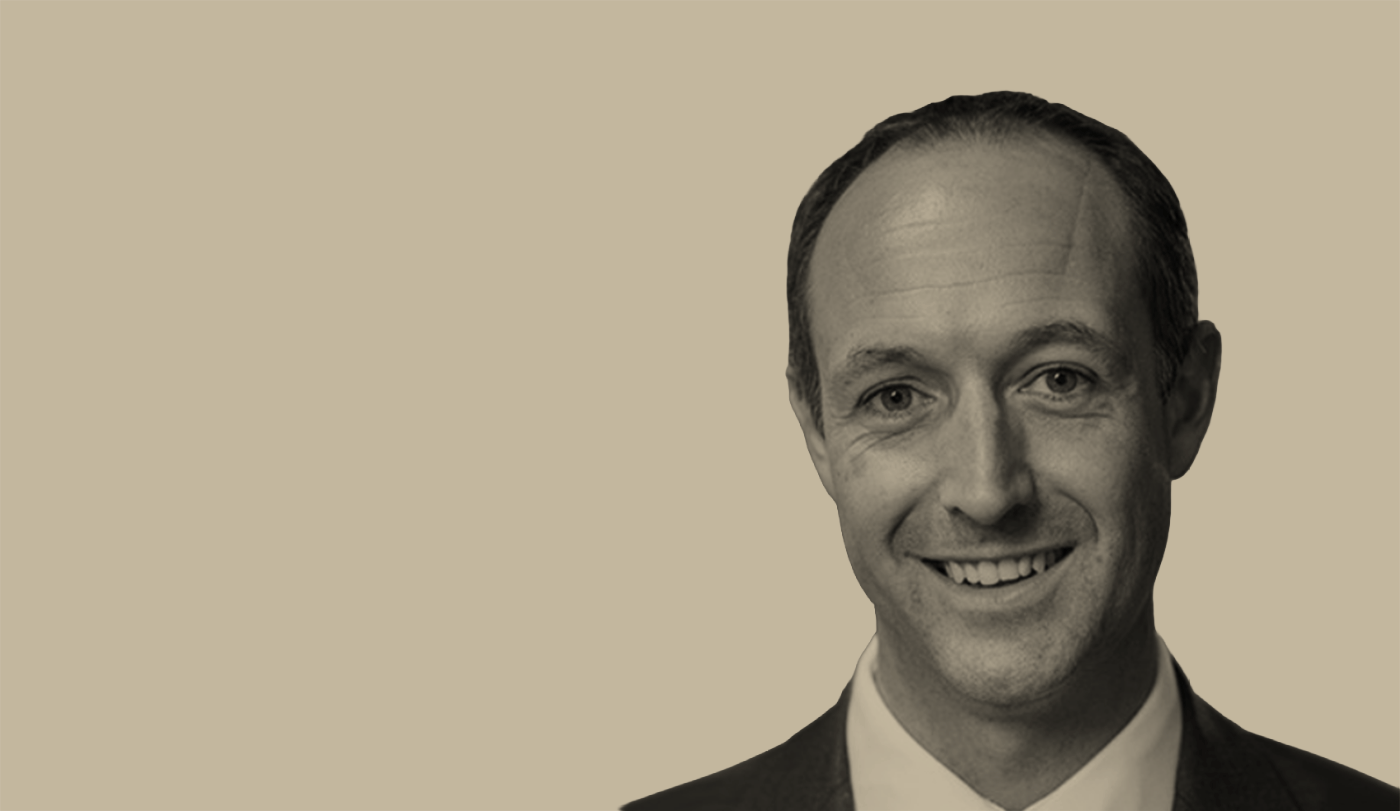


Orbis Investments head of UK retail Matthew Spencer on thoughtful exposure beyond US markets, genuine contrarianism and explaining not just ‘what’ to clients but ‘why’
Where – and why – are you anticipating demand or fund-flows from UK-based wealth managers and their clients over the next 12 months?
We are seeing a clear increase in demand – albeit gradual rather than a surge – for exposure outside the US. In particular, wealth managers are asking for thoughtful exposure beyond US markets, rather than simply reallocating capital mechanically.
That demand is being driven by two things – the first being the sheer concentration of global markets in the US, which is prompting clients to question whether they are sufficiently diversified. Second, there is a growing desire to identify high-quality opportunities elsewhere, including in emerging markets, but with a strong emphasis on selectivity and risk awareness.
What is interesting is it is not just a blanket shift. People are not saying, ‘Just give me emerging markets’, they are saying, ‘Where are the high-quality businesses outside the US?’ – and that is a very different, much more thoughtful question.
How are you planning to address and serve that interest?
At Orbis, we are not in the business of launching funds because something is fashionable. We always ask two questions: Is there a real client need? And do we actually have the skill to add value?
In this case, the answer to both question is yes, so we have made what we already do well more accessible to UK investors. That has meant bringing three of our existing strategies – Japan Equity, Emerging Markets Equity and International Equity, our global ex-US strategy – to the UK market. We introduced the sterling share classes in March because we believe they give clients access to more of what Orbis does best: a distinctive, long-term and genuinely contrarian approach.
The international (ex-US) piece is interesting because it is not something you would traditionally offer in the UK but, given the questions clients are asking, it feels like one of the more relevant solutions right now. It is also typical of how we approach things at Orbis. We have a willingness to take investment positions that are a bit uncomfortable – positions that might be at odds with conventional wisdom, but where we think the opportunity is genuinely compelling.
Are you seeing a divergence in the demands of UK wealth managers versus, for example, their peers in Europe or on the institutional side in the UK?
Yes – anecdotally. The European wealth managers, particularly the Swiss, are often first-movers and we have seen them move capital away from the US and into other areas. The UK is not far behind, and we have seen a similar trend here – albeit in the far earlier stages.
‘ESG is dead – long live ESG 2.0’ – your thoughts as a distributor, please?
ESG has become less of a focal point for many investors – what was once a central topic in almost every meeting now barely comes up – yet our approach has always been consistent. We have always focused on the sustainability of earnings and being responsible stewards of capital.
If you do that properly, you are naturally incorporating a lot of ESG thinking – just without the labels or box-ticking; or relying on rigid exclusions or labels. In that sense, while ESG as a theme is no longer front-of-mind for investors, the underlying principles remain embedded in how we invest at Orbis.
What drives your approach to client communication? And is there a case for focusing on attracting the ‘right’ type of client?
Everything we do at Orbis is about building real understanding with clients – because the reality of investing is, if you are doing anything even slightly contrarian, you will go through periods of underperformance. And while those periods are often when the best opportunities are right in front of you, it still feels most uncomfortable.
If clients do not understand what they own, they will not stick around – it is as simple as that. That is why we put so much effort into commentary, newsletters and ongoing communication – not just telling clients what is happening but helping them understand why.
And yes, there absolutely is such a thing as the ‘right’ client. It is someone who can see through the noise and stay the course. Our whole business is built around alignment and this includes refunding fees when we underperform because we know this is when trust really gets tested – and it helps our clients stick around and see through these testing periods.
“We have a willingness to take investment positions that might be at odds with conventional wisdom, but where we think the opportunity is genuinely compelling.

Outside of work, what is the strangest thing you have ever seen or done?
My first time scuba diving in the ocean was memorable. It was five kilometres off the coast in South Africa at Aliwal Shoal, where we descended to 18 metres just to be circled by eight ragged tooth sharks. I went through my air faster than anyone else and was sent to the surface, just to realise the boat was much further away than I had thought. All I could think of was the sharks’ view of my legs from beneath – and the Jaws music.
May we have two book recommendations, please – ideally, one with an investment connection?
My investment recommendation would be The Little Book of Value Investing by Christopher Browne. It is simple but genuinely impactful and it changed how I think about investing. I think everyone should read it. As for non-investment, it is The Fountainhead by Ayn Rand – a book that made a profound impression on me early on, to the extent I read it twice in the space of about two months.
Gazing into your crystal ball, what does the asset management sector look like 10 years from now?
If I am honest, probably more similar to today than people expect, as we tend to overestimate how quickly things change. You will still have a huge amount of passive investing and, alongside that, a smaller group of genuinely high-quality active managers that can actually deliver something different.
Where I think there should be more change – whether it happens or not – is around fees. The idea of just charging a percentage of assets regardless of outcome will come under more pressure and there will be a stronger push towards paying for actual value added.
There is also a growing trend of individuals taking charge of their own financial health. Gone are the days of defined benefit pensions, so it makes sense that individuals are playing closer attention to putting their money to work. I am hopeful this will mean a venture beyond cash and into the market – but only time will tell.