
On four key investment criteria, instilling a more risk-taking culture – and one 'crabby' toddler
In our regular video series, we interview the wealth sector’s key decision-makers to discover how they think about life, both within the world of investment and beyond it; what brought them into the business and what keeps them here; and what makes them and their companies tick
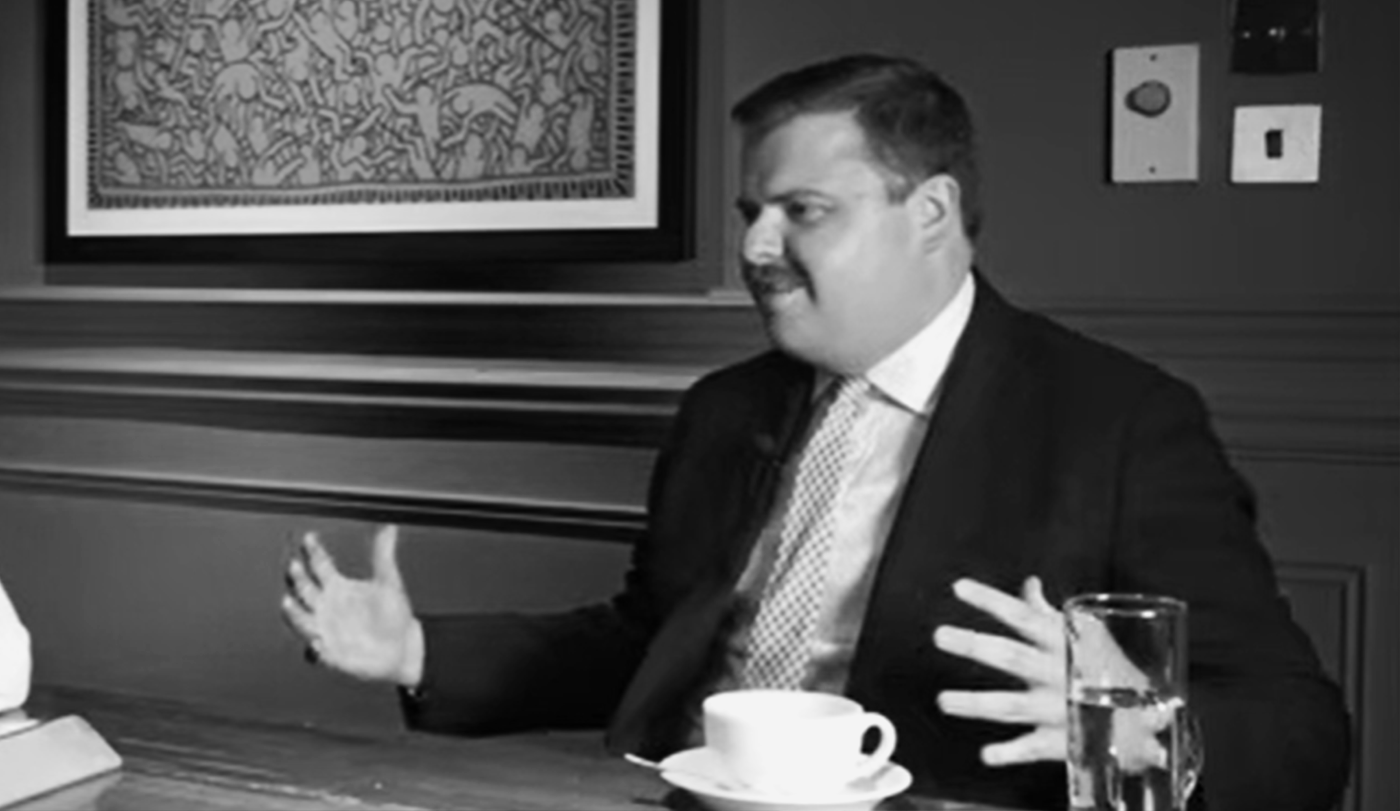
Asked what he would do if he was head of the FCA for a day, Luke Hyde-Smith, co-head of multi-asset at W1M, suggests two possible answers – one relating to what might actually be achievable in that timeframe; the other should he happen to have access to a magic wand. And, on the latter, he tells Wealthwise editorial director Julian Marr in the above video: “We seem to be in an environment of reducing risk rather than maximising returns.
“If you look at the pension schemes, they have large holdings in bonds over equities; if you think about individual savers, they have large investments in cash ISAs, rather than the equity market. So this is a hard one to solve but, as head of the FCA, instilling a more equity risk-taking culture in savers across the UK would be a great outcome.”
As for what might be feasible in a day, Hyde-Smith says: “I would ensure the UK treats listed investment companies as they are treated around the world – as other listed shares on an exchange – both from an investment and a reporting standpoint.
Investment companies can be fantastic vehicles so trying to make them more attractive to invest in would see more shareholders coming to the market and support share prices at a time when quite significant discounts to NAVs is a problem.”
“The investment company sector is a great sector – it is a leading long-term investment structure for the UK and it has been incredibly successful – but is under a huge amount of pressure at the moment. So I think easing the regulatory burden on reporting would be an easy way to instil some more confidence in that market.”
Does Hyde-Smith think is there more the investment companies could be doing to help themselves? “Boards could do a lot more to ensure they are acting on behalf of shareholders rather than, perhaps, the management teams,” he replies. “Also, it goes back to this saving and investment point. These can be fantastic vehicles so trying to make them more attractive to invest in – be it for wealth and investment firms such as ourselves, be it the retail platforms, be it the pension funds – would see more shareholders coming to the market and thus support share prices at a time when quite significant discounts to NAVs is a problem.”
Not that it is just the investment company sector, adds Hyde-Smith, asserting: “The UK market overall is somewhat on the ropes. So how we can best instil more international investor enthusiasm for the UK market is a big question – probably longer than we have time for today!
“Still, the regulatory backdrop and the desire to make investing in UK equities easier are key – for example, we could think about reducing stamp duty on share purchases, which is an outlier here. We are very high versus many other jurisdictions – in the US, you pay zero; in the UK, it is 0.5% – and that is just one example of it being incrementally negative for people to invest in the UK.”
Four equity criteria
Asked earlier in the conversation what he most looks for in an individual investment and what he would consider a ‘red flag’, Hyde-Smith says: “On the equity side, we really try and focus on four key criteria. First, the durability of a company’s earnings – how sustainable can they be and can we have real confidence in the growth and the ongoing delivery?
“We also look at the opportunity – how large is it for that company? We look for alignment – are the management team aligned with that success? And are we then aligned as shareholders with that success? And, lastly, valuation is very, very important – you don’t want to be overpaying for that opportunity if you have identified it.
“A big red flag for us, meanwhile, would be anything on the governance side – you know, if we have concerns over management, alignment and so on. Another would be a big change in a management team – be it from a third-party fund or be it from an individual company – if there is an unexpected sea-change, that really warrants a lot of further investigation and research. And then, big changes in style – so if a management team change their focus materially, that is another red flag.”
A full transcript of this episode can be found after this box while you can view the whole video by clicking on the picture above. To jump to a specific question, just click on the relevant timecode:
00.00: What excites you about the current investment outlook? What worries you?
02.22: What do you most look for in an individual investment? What would constitute ‘red flags’?
04.08: To what degree should professional investors be thinking beyond so-called ‘traditional’ investments? Towards what?
06.00: What was your path into investment – and, if you hadn’t taken it, what do you think you would be doing now?
07.57: What was the biggest investment mistake you are prepared to admit to – and what did you learn from it?
09.26: How would you explain risk to someone who does not work in investment?
10.16: If you were head of the FCA for a day, what would you do?
12.01: What can investment companies and their investors be doing to improve their current situation?
14.07: Outside of work, what is the strangest thing you have ever seen or done?
15.20: Two Choice Words recommendations, please – one a book; one a free choice?
Transcript of Choice Words Episode 30:
Luke Hyde-Smith, with Julian Marr
JM: Well, hello and a very warm welcome to another in our series of ‘Choice Words’ videos, where we get to speak to key decisionmakers from the world of UK fund selection and UK fund research and find out what makes them tick. I am Julian Marr, editorial director of Wealthwise Media, and today I am delighted to be talking to Luke Hyde-Smith, who is co-head of multi-asset at W1M. Hello, Luke.
LHS: Good morning, Julian. Delighted to be here.
JM: Oh, good energy! We like that – good start. Let’s jump straight in. What excites you – you sound excited already! – but what excites you about the current investment outlook? And what gives you pause for thought?
LHS: I think we would frame our current positioning as ‘cautiously optimistic’. If you think about two of the big drivers out there for asset markets – economic growth and inflation – both actually look in reasonable shape. We have OK growth – depending on where you look around the world – and inflation, having been a major problem for, certainly, developed economies over the last few years, does look like it is coming back within touching distance of those central bank targets. So those two big factors do look pretty constructive for asset markets.
We then look at the earnings picture, for the equity market, and again that has been very robust in 2025 – and I think is one of the reasons the equity market has probably been stronger than many people expected at the beginning of that year. So when we look out across the asset classes – be it equities, be it fixed income, be it alternatives – we can find plenty of bottom-up opportunities that really meet our investment criteria.
So we do think there is plenty of opportunity but, to your second point – on risks – plenty of those as well, right? One of the big risks out there is valuation. Clearly the US is trading at pretty toppy valuations – or certainly parts of the equity market are pretty toppy. And if you look at credit spreads and the fixed income market – again, that looks pretty tight in terms of where spreads have traded relative to history.
So there is a valuation risk – and then, secondly, there is a big risk out there with AI. You know – is it a bubble? Are these earnings going to come through? And then the final risk that is very, very difficult to time is fiscal concerns and fiscal sustainability of developed market economies and those levels of debt, which have come into focus over the course of 2025.
Earnings, opportunity, alignment and valuation
JM: Great start. You mentioned bottom-up opportunities. I am not going to ask you for specifics – because, while I may like winding up compliance, I appreciate not everyone does! Let’s not be too detailed, then, but what do you most look for in an individual investment? And what do you see as red flags?
LHS: If I split out what we look for by the asset classes, on the equity side, we really try and focus on four key criteria. First, the durability of a company’s earnings – how sustainable can they be and can we have real confidence in the growth and the ongoing delivery?
We look for the opportunity – how large is the opportunity for that company? We look for alignment – are the management team aligned with that success? And are we then aligned as shareholders with that success? And, lastly, valuation is very, very important – you don’t want to be overpaying for that opportunity if you have identified it.
Then, if I think about the fixed income opportunity, we look at credit, we look at duration – to the length of the maturity of the bonds – and then, clearly, currency is an important factor. And then finally, on the alternative side, looking at real assets, really we want to own unique assets – unique locations – run by really high-quality management teams. So that is how we frame what we look for.
What would be a big red flag for us? Well, anything on the governance side – you know, if we have concerns over governance, management, alignment and so on, that is a big red flag. A big change in a management team – be it from a third-party fund or be it from an individual company – if there is an unexpected sea-change, that really warrants a lot of further investigation and research. And then, big changes in style, right? So if a management team or whatever change their focus materially, that is a bit of a red flag for us.
Delivering consistent outcomes
JM: Excellent. You are doing a great job of setting me up for each question here – this time because you mentioned alternatives. To what degree should professional investors and their clients be looking beyond the traditional asset classes and thinking more alternatively? And what should they be looking at?
LHS: I mean, we have spent a lot of time at W1M, thinking about portfolio construction – we have actually used alternatives in portfolios for a number of years, if not decades. Now, if we consider traditional portfolios, traditional assets – your 60/40 of 60% equities, 40% government bonds – one of the things we have been discussing with clients, and I’m sure you have had people on before discussing this, is this correlation between equities and bonds.
Up until 2022, when it came spectacularly unwound, we had been through an environment where equities and bonds were negatively correlated. So bonds, when there was an equity market wobble, came to investors’ rescue – they not only delivered returns, but they performed when equity markets declined. Then 2022 came along – a big drawdown in equity markets and, actually, the bond market drew down even more.
And what you have seen is a bit of a continuation of that trend – that is, bonds and equities have been moving in a similar direction. We think that is due to a slightly higher inflationary environment and we think alternatives – in their broadest sense, be it absolute return or real assets – can help deliver better, more consistent portfolio outcomes.
Clearly, they bring in some diversification – but it is not just about protection. We want our alternatives exposure to deliver genuine returns and, importantly, we are trying to do that in an environment where the fixed income market, particularly, may struggle. And that goes back to my earlier point about fiscal concerns – those bond vigilantes – where are yields going in this current environment as we look ahead.
Still learning
JM: A more personal question now – what was your path into investment and, in an alternative universe, if you had not taken that path, what do you think you would be doing now?
LHS: Well, I would love to say I had this very unusual path into the investment industry – but it was pretty traditional! I studied a finance degree but, upon finishing that, I didn’t go straight into the City. I actually took a year off – I went travelling, I did some community work, I did some teaching.
But you don’t get an opportunity to begin a career with a finance degree all that often – it obviously comes around once in your life – and I actually went off to the Channel Islands and got myself a job there in an investment department. And, having thought the office life and finance and so on could be rather boring and not where I wanted to spend my time, I had a great mentor there and I just found the world of investment totally engaging.
I got started on the CFA – which wasn’t quite as engaging! – but it was very good background. And I really felt that learning about markets, about the interaction with people, about how economies, markets and the behavioural aspect of it all worked, was fascinating – and here I am, 20-odd years later, still learning and still finding it totally fascinating.
If I wasn’t an investment professional, what would I be? I mentioned moving to the Channel Islands and I do love the sea and sailing so one of the careers I thought of following would be working in or indeed owning vineyards. Fantastic locations, a really interesting and engaging job – and, if it all goes to pot, you have a great product from great produce to drink at the end of the day! So you never know, I might end up doing that in my retirement years – but that was a career I may have followed.
JM: We will keep in touch, just in case – you never know!
Home truths
JM: Still looking backwards, what is the biggest investment mistake you are prepared to admit to? And what did you learn from it?
LHS: Well, clearly we don’t get all our investment decisions correct. I think I would highlight our investment in Home REIT as our biggest mistake. We unfortunately invested in that company and we learned a lot, I think. You know, a lot of the things we actually went through in terms of diligence and the research of that company – we couldn’t have done a lot better – but it is incredibly difficult.
Thankfully, it was only a small position. And I suppose one of the things we learned from that was there was a large amount of money raised very quickly. That was then put to work very quickly. I think we could have been more detailed in our analysis of that and our coverage of that name but, safe to say, in terms of lessons, I think it is going to be much harder for companies – certainly in that space, the investment company market – to IPO because, you know, that company was a total disaster from an investment standpoint and, clearly, a very, very disappointing outcome.
JM: Those ones are interesting other because, to a large extent, investment is so much more about process than it is about outcome – you know, would you do the same things again? And it almost, if someone’s being like that to you, then you almost feel, Gosh, I might make that same decision again – and that is quite a worrying state of affairs.
The essence of risk
JM: So, yes, speaking of risk – as I am now feeling we are in the realms of! – how would you explain risk to someone who does not work in investment?
LHS: I think this is actually relatively simple – and really goes to the heart of how we describe risk to our clients. We frame risk as ‘the probability of permanent capital loss’ – and I think most people can understand that. So we explain we are seeking, obviously, to deliver a return in keeping with the level of risk we describe to clients – and what we want to avoid is any long-term and permanent capital loss.
I think any other descriptions of risk – and there are many of them out there in the investment industry; we have done an incredibly good job of complicating it and bringing in all sorts of jargon – are secondary in nature. So I would say the fundamental definition of risk – as we describe, running our multi-asset strategies – is that risk of permanent capital loss.
A matter of confidence
JM: Very good. If you were head of the FCA for a day – and not mentioning the words ‘Home’ or ‘REIT’! – what would you do?
LHS: Well, this would play to my small megalomaniac tendencies!
JM: Good, good!
LHS: So I think I would answer this in two ways – what might actually be possible in a day? And what might be feasible if one had a magic wand?
JM: I like that.
LHS: OK, so let’s deal with what might be feasible in a day as head of the FCA: I would ensure that, from a regulatory standpoint, the UK treats UK-listed investment companies as they are treated around the world – as other listed shares on an exchange – both from an investment standpoint and a reporting standpoint.
The investment company sector is a great sector – it is a leading long-term investment structure for the UK and it has been incredibly successful – but is under a huge amount of pressure at the moment.
So I think easing the regulatory burden on reporting would be an easy way to instil some more confidence in that market. So that is what I would do on day one. In terms of, if I had a magic wand, I would want to instil a bit more equity culture into this country. You know, we seem to be in an environment of reducing risk rather than maximising returns.
And I would frame that – if you look at the pension schemes, they have large holdings in bonds over equities; if you think about individual savers, they have large investments in cash ISAs, rather than the equity market. So this is a hard one to solve but, as head of the FCA, instilling a more equity risk-taking culture in savers across the UK would be a great outcome.
On the ropes
JM: That is excellent – and so it is very unfair of me to reward you by throwing it a random question. Still ,you mention investment companies, which do feel to be on the ropes. You were talking about them from a regulatory perspective but what do you think the industry can do itself to help investment companies – both as investors and the companies themselves? I am sorry to spring that one on you but what would you be suggesting there?
LHS: No, no, no – I think it is an important question because, you know, they are on the ropes. One of the things we have been very active in is improving the governance. So I think boards could do a lot more to ensure they are acting on behalf of shareholders rather than, perhaps, the management teams.
And also I think it goes back to this saving and investment point as these are fantastic vehicles, right? Not all of them are great – clearly, you have to find the management teams and the underlying assets that you like.
Still, trying to make investment companies more attractive to invest in – be it for wealth and investment firms such as ourselves, be it the retail platforms, be it the pension funds – would see more shareholders coming to the market and thus support the share prices. As you know, these are trading at quite significant discounts to NAVs in the majority of cases, which is a problem.
But it is not just the investment company sector – the UK market overall is somewhat on the ropes. So how we can best instil more international investor enthusiasm for the UK market is a big question – probably longer than we have time for today!
Still, the regulatory backdrop and the desire to make investing in UK equities easier – we could think about, for example, reducing stamp duty on share purchases, right? You know, it is an outlier. In the US, you pay zero, in the UK, it is 0.5% – so we are very high versus many other jurisdictions – and that is just one example of it being a little bit incrementally negative for investors to invest in the UK.
‘Crabby’ toddler
JM: Well, we live in hope. Everyone’s favourite Choice Words question now – outside of work, what is the strangest thing you have ever seen or done?
LHS: I thought this was an interesting one and I have been pondering it. My seven-year-old son probably won’t thank me for bringing this up but most babies, when they grow up and begin to crawl, they crawl in a straight line – but Jack suddenly started crawling in this crab-like, crossways stance!
And he was incredibly good at it – he was very, very quick! Now, you may have seen many other babies or kids growing up doing it – but it was quite strange for us and we got quite a lot of comments saying it was very unusual. Thankfully, Jack is now seven and walking … JM: In a straight line? LHS: He is walking in a straight line – so that’s good! We seem to have moved on from the crab phase! But it was quite strange – and a little bit of a concern as a parent.
JM: I can imagine. On the bright side for you, the Choice Words viewing figures among seven-year-olds are not as high as I would like so you are probably safe! I don’t think Jack will get to see this anytime soon.
‘Healthy body, healthy mind’
JM: Last question, then – we call this ‘Choice Words’ because of what you do for a living but we are now looking for a couple of personal recommendations. One is for a book – it does not have to be on investment, but it can be – the other one is a free hit on anything: words of wisdom, restaurants, podcast, vineyards, whatever you like …
LHS: Yes – and a bit of a cheat, if I may, as I would like to suggest two books: one with a little bit more of an investment lens and one less so. It is something obviously one gets asked every now and again – you know, What would you recommend in terms of books? Where should I start if I want to get into investment? And I think one of the best books out there, written by Sebastian Mallaby, is More Money than God.
It describes the chronology of financial markets through the lens of the most successful investment firms of the time – so it starts in the 1920s and takes you through all the decades and all the crises we have faced, and also how the financial markets and the firms that operate in them have evolved. It is a great read.
Sebastian writes it incredibly clearly and it is a real sort of whistle-stop tour of how capital markets – and indeed the firm’s operating in them – have evolved. And then the second book I would recommend is Born to Run by Christopher McDougall, which is a great book. I think it is a life-affirming read about just enjoying getting out there and running. It is a great read and people will enjoy how it is written.
JM: And are those your two recommendations?
LHS: No – for my ‘ freebie’, I think it would be ‘Healthy body, healthy mind’. You know, if you want to operate in this investment world, it can be pretty intense on occasions – particularly mentally – and, in order to fulfil your role to the best of your ability, you have got to try and stay healthy. I think that is a really important asset, if you like, to ensure you are on top of your game for the investment world and can really deliver for your clients and your colleagues.
JM: Sounds promising – too late for me, but good advice for everyone else! Well, great Choice Words choices, Luke. Thank you so much for those and indeed for all your answers and this conversation.
LHS: Julian, it has been a pleasure. I look forward to keeping in touch.
JM: Absolutely – especially on the wine! And thank you all very much for watching. Please do look out for further Choice Words videos as they are published.